Discovery and name
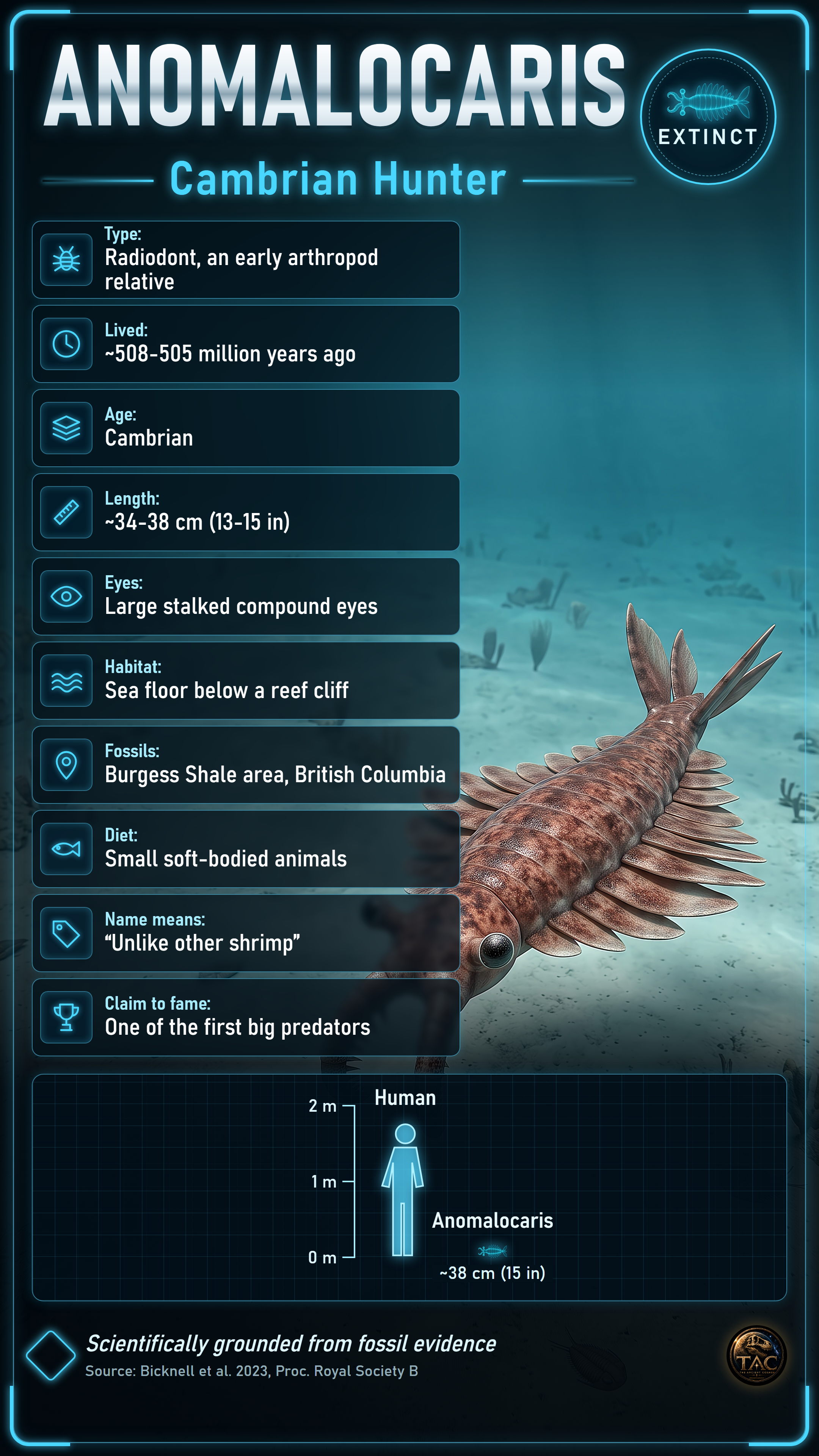
The first piece was found on Mount Stephen in British Columbia and described in 1892 by Joseph Whiteaves. All he had was a curled, segmented, spiny object, which he took to be the body of a shrimp-like crustacean. He named it Anomalocaris canadensis: the genus name comes from Greek words meaning 'unlike' and 'shrimp', and canadensis marks the country where it was found.
In 1911 Charles Walcott, working on the Burgess Shale, described a ring of toothed plates as a jellyfish, Peytoia nathorsti, and a squashed body as a sea cucumber, Laggania cambria. In 1979 Derek Briggs argued that the 'shrimps' were really the grasping limbs of an unknown large animal. In 1985 Harry Whittington and Briggs described a specimen with a pair of Anomalocaris canadensis arms still attached to a body, showing that these parts came from large swimming animals, not shrimps, jellyfish or sea cucumbers.
The story has one more twist. The 'jellyfish' mouth and the 'sea cucumber' body turned out to belong to a second, related animal, now called Peytoia nathorsti. In 2012 Allison Daley and Jan Bergström showed that Anomalocaris canadensis had a different mouth, built around three large plates arranged in a triangle.
Body and anatomy
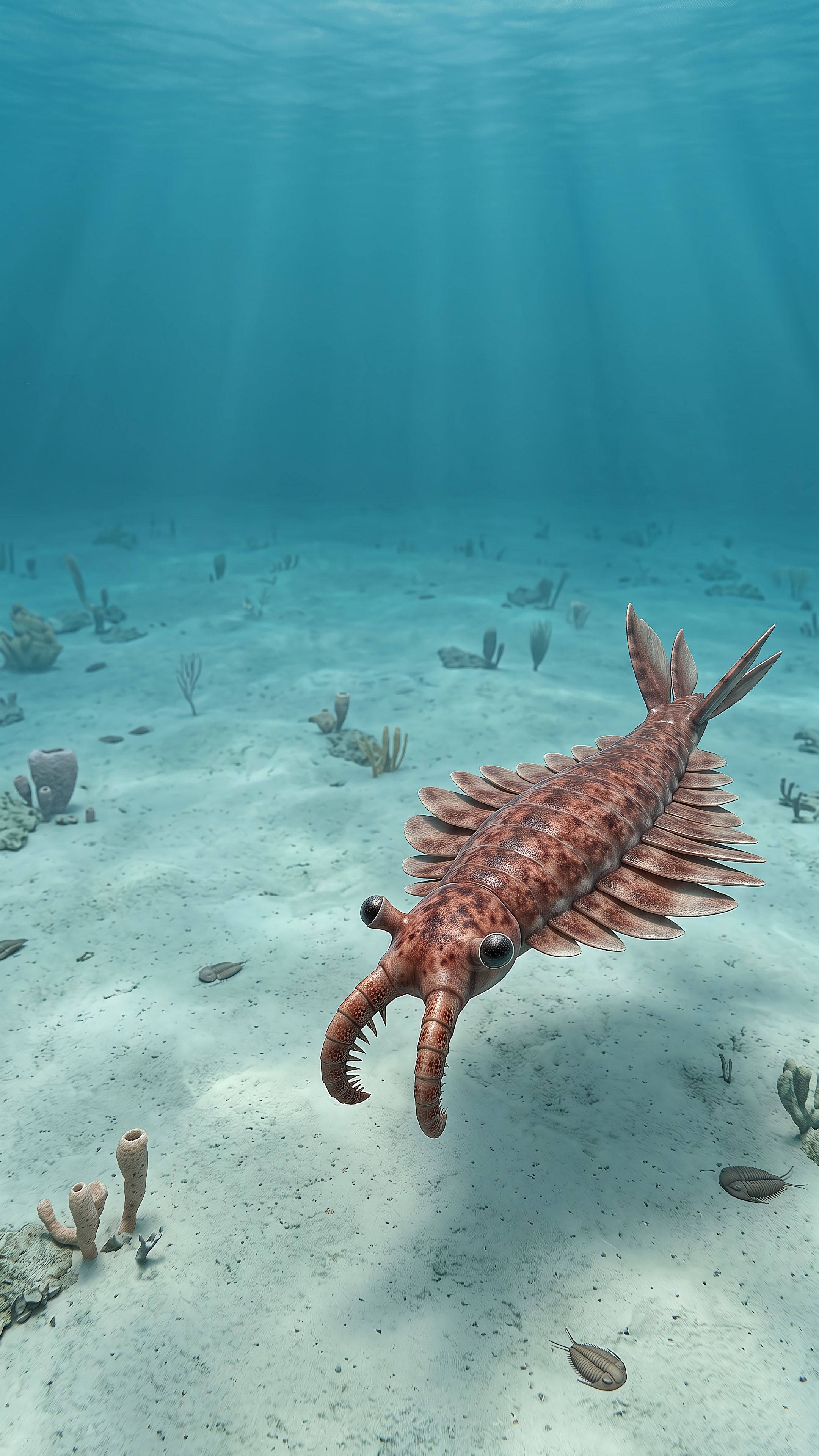
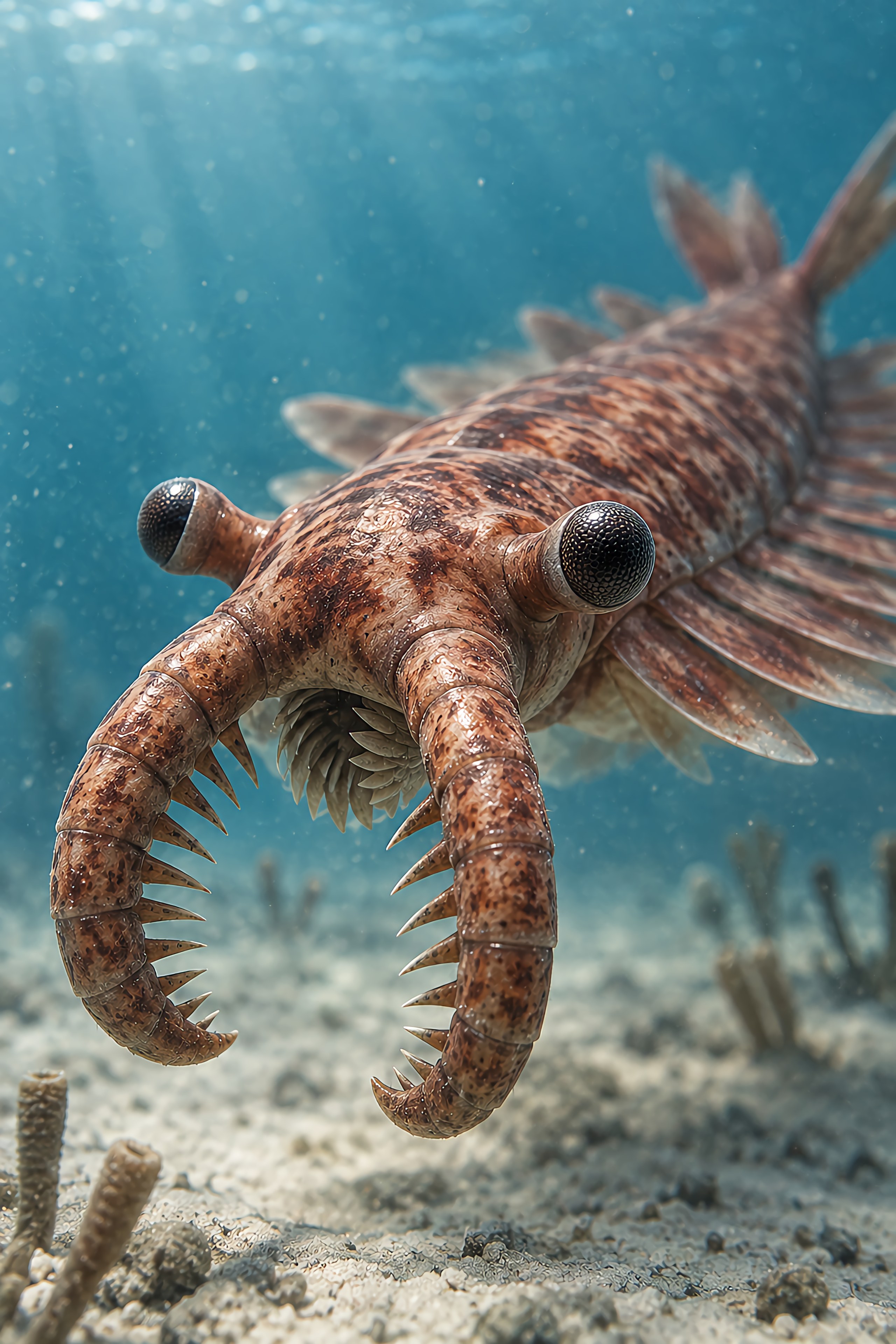
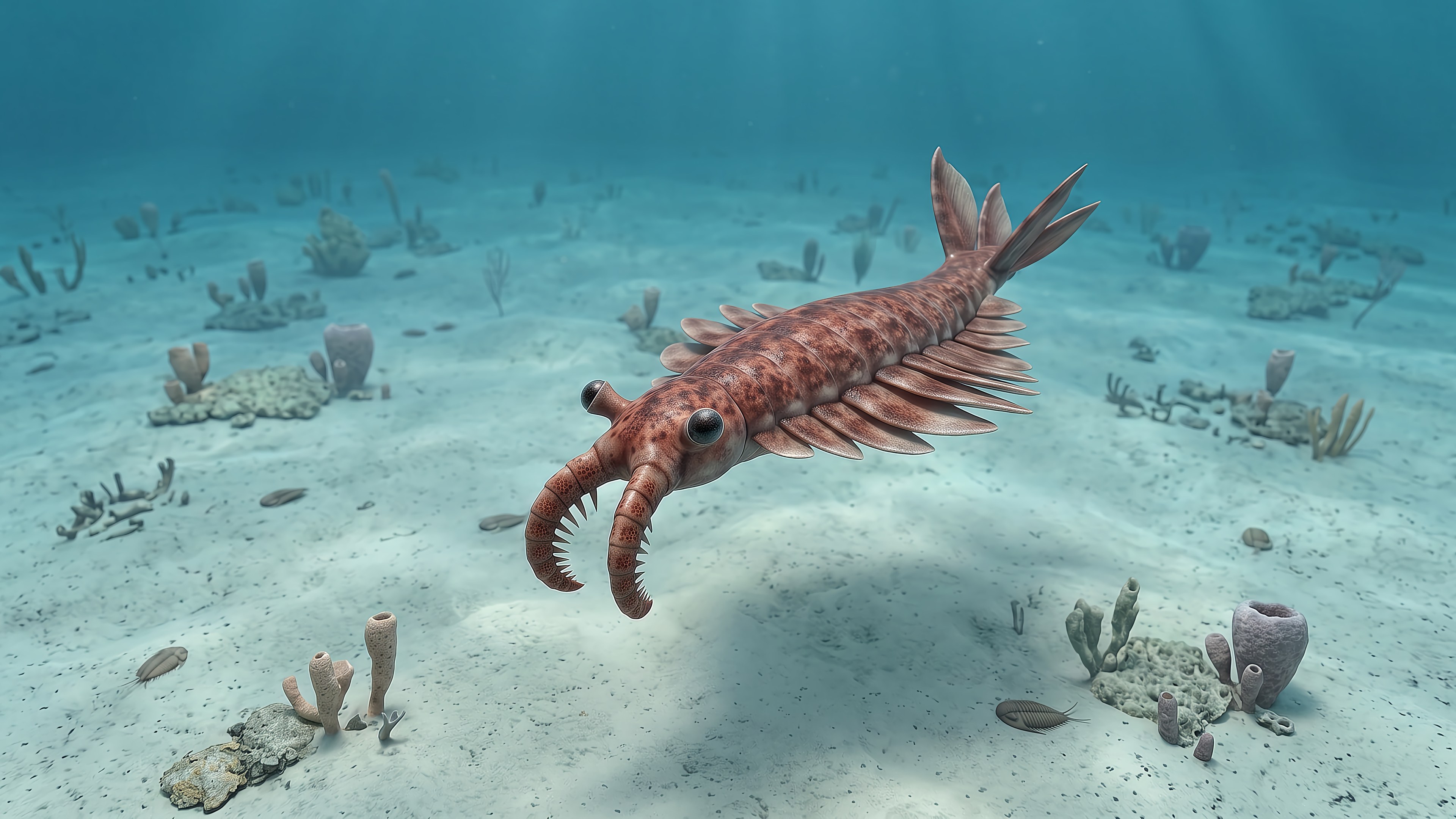
Anomalocaris had a flattened, segmented body with a row of overlapping swimming flaps along each side and a three-lobed tail fan at the back. On the head were two large compound eyes on short stalks. In front of the head hung a pair of frontal appendages, each made of 14 segments and lined with paired spines on the inner side. Underneath the head was the mouth: a ring of tooth-bearing plates with three large plates and a variable number of smaller ones between them.
Isolated arms and mouthparts are common in the Burgess Shale area, with several hundred collected, but complete bodies are rare; the Royal Ontario Museum counts about ten from one quarry. The fossils show the shape and stalks of the eyes but not their individual lenses. Colour is never preserved, so the reddish tones in most reconstructions are an artist's choice.
How it lived
The streamlined body points to an active swimmer. Palaeontologists think the side flaps moved in waves to drive it forward, as a ray's fins do, while the tail fan helped it steer and turn quickly. The large eyes, spiny arms and ring-shaped mouth all suggest a predator, but no fossil records an actual meal, so its diet has to be reasoned from its anatomy.
For decades Anomalocaris was pictured grabbing trilobites and cracking their shells. In 2023 a team led by Russell Bicknell tested this with a 3D computer model of an arm, stress analysis and simulated water flow. The arm could grab, but it could not close fully and was too weak to crush hard shells. The team concluded that it was a fast hunter of soft-bodied animals swimming in well-lit water, such as the arthropods Waptia and Canadaspis. Daley and Bergström had already noted that its small, irregular mouth opening was poorly suited to strong biting.
Its world
Anomalocaris canadensis lived in the Wuliuan Age of the Middle Cambrian, about 505 million years ago. Most Burgess Shale animals lived at the foot of the Cathedral Escarpment, an underwater cliff at the edge of a wide, tropical platform of carbonate rock. The water there was calm, below the reach of storm waves, but every so often torrents of mud swept down and buried animals whole, which is why even soft bodies were preserved.
Its neighbours included trilobites and a wide range of soft-bodied animals: small swimming arthropods such as Waptia and Canadaspis, comb jellies, and odd creatures such as vetulicolians. Its relative Peytoia, with a different mouth and different arms, shared the same seas.
Size and records
The largest complete fossils are about 25 cm (10 in) long, but isolated arms come from bigger individuals. By scaling the largest arms against complete specimens, researchers have estimated a maximum body length of roughly 34-38 cm (13-15 in), not counting the arms and tail fan. That is about a fifth of the height of a 1.8 m (5 ft 11 in) adult, or roughly the length of a school ruler plus a hand's width.
Earlier estimates were larger. Whittington and Briggs gave a length of 0.5 m (20 in) in 1985, and some accounts suggested up to 1 m (3 ft 3 in). Even at its revised size, it was one of the largest animals of its time.
Relatives and legacy
Anomalocaris belongs to the radiodonts, the order Radiodonta, named by Desmond Collins in 1996. Radiodonts are stem-group arthropods: early branches of the lineage that later produced insects, crustaceans, spiders and their relatives. They left no living descendants, so their closest living relatives are the arthropods as a whole. The group was more varied than once thought, ranging from grasping hunters like Anomalocaris to filter feeders such as Pahvantia, which strained tiny plankton from the water.
Other species of Anomalocaris are known. The best studied is Anomalocaris daleyae from the older Emu Bay Shale of South Australia, named in 2023. Its fossils preserve the surface of the compound eyes in fine detail, giving a rare look at how a radiodont saw.
Myths and misconceptions
A popular story says that the arm was mistaken for a shrimp, the mouth for a jellyfish and the body for a sea cucumber, all from the same animal. Only the first part is true of Anomalocaris canadensis: the 'jellyfish' mouth and 'sea cucumber' body belong to its relative Peytoia. Anomalocaris canadensis also did not crunch through trilobites as older books claimed; computer modelling suggests it was built for soft prey.
Anomalocaris canadensis is often said to have had more than 24,000 lenses in each eye. That figure comes from eyes found in the Emu Bay Shale of Australia, which were first assigned to a species similar to A. canadensis and are now placed in Anomalocaris daleyae. The lens count of the Canadian species is unknown, because its fossil eyes do not preserve that detail.