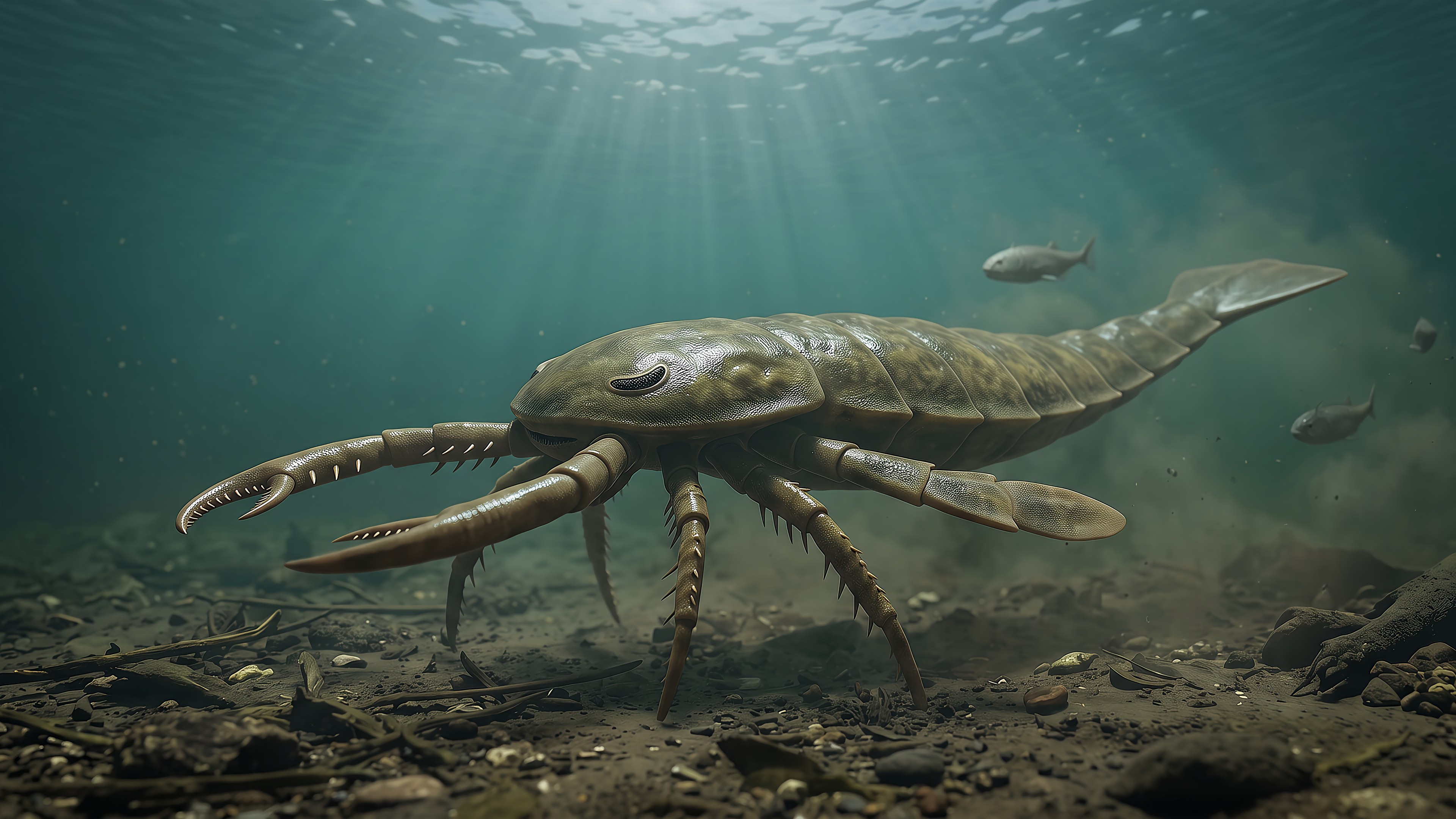
Discovery and name
The German palaeontologist Otto Jaekel described the species in 1914 from Lower Devonian rocks of the Rhineland, placing it in the genus Pterygotus as Pterygotus rhenaniae. In 1964 the palaeontologist Waterston judged it different enough to deserve its own genus, which he named Jaekelopterus in Jaekel's honour. The name joins Jaekel with the Greek pteron, 'wing', a common ending in eurypterid names, while rhenaniae refers to the Rhineland.
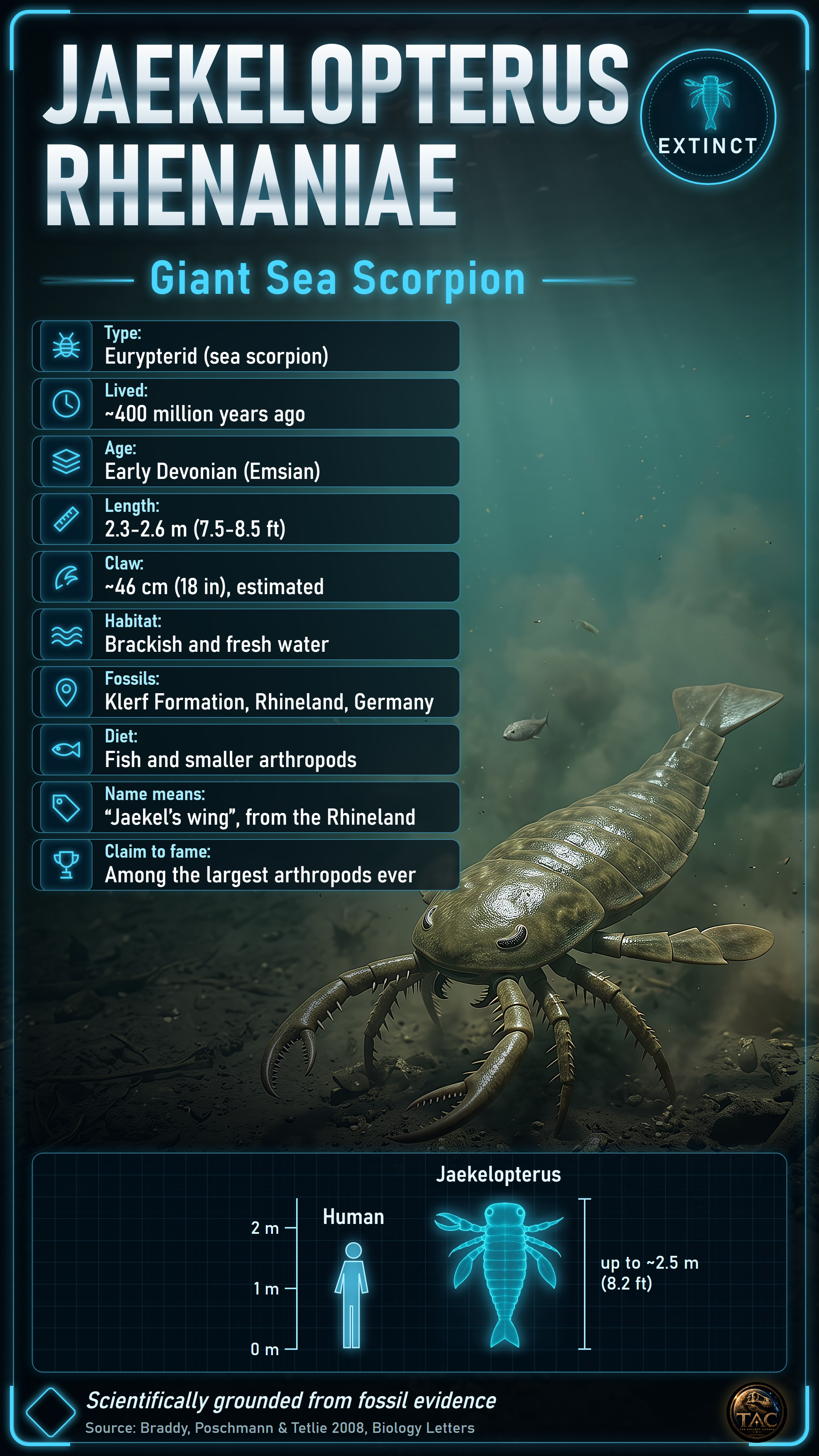
The animal became famous in 2007. Markus Poschmann was loosening pieces of rock with a hammer and chisel in a quarry near Prüm, in the Eifel hills, when he noticed a dark patch of organic matter on a freshly split slab. It was part of an enormous claw. Simon Braddy, Poschmann and O. Erik Tetlie described it in the journal Biology Letters, and their conclusion made headlines: this was the largest arthropod ever found.
Body and anatomy
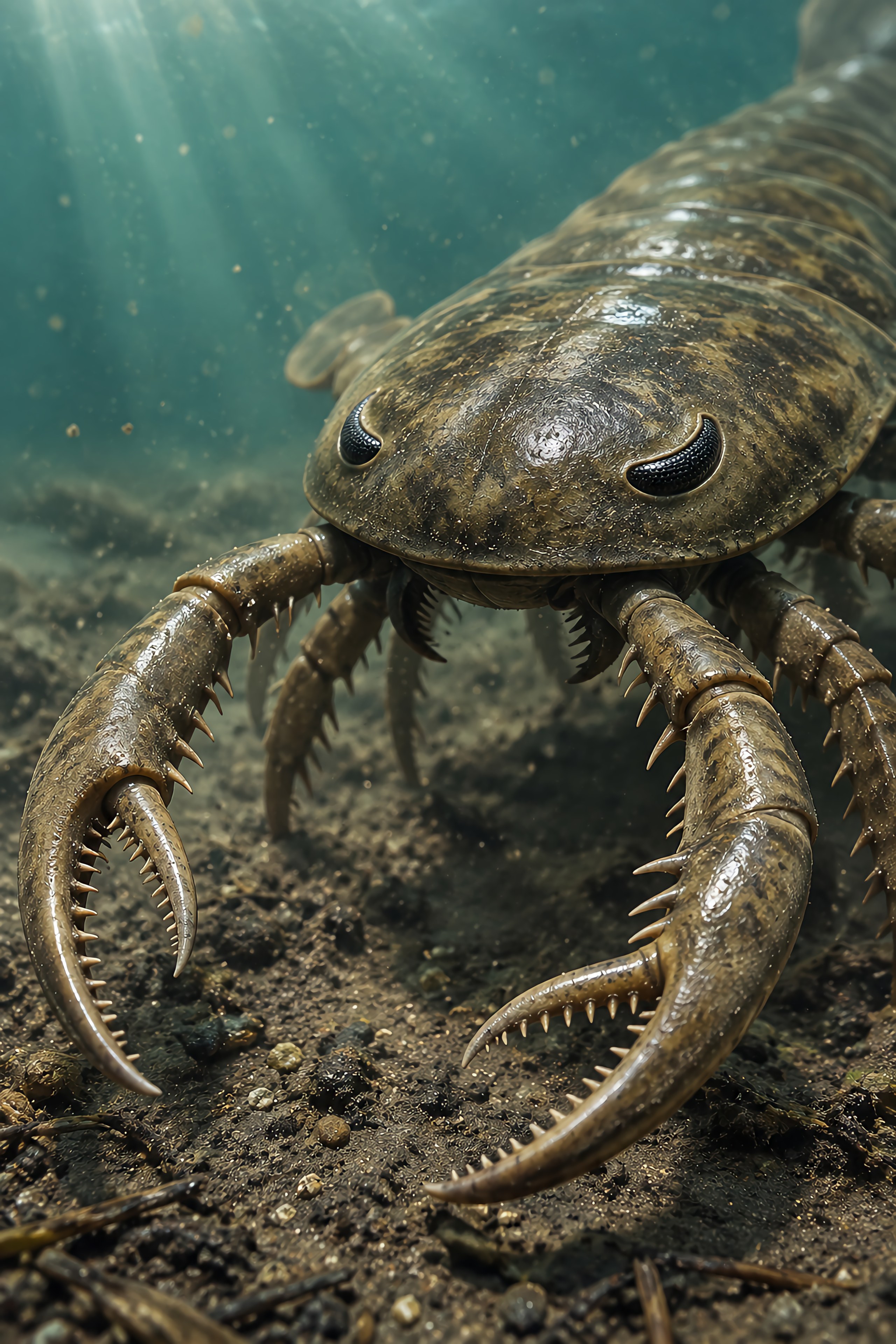
Pterygotids like Jaekelopterus had a pair of greatly enlarged, forward-pointing chelicerae: the pincer-tipped mouthparts that are small in spiders and scorpions. The fixed finger of the Prüm claw is 36.4 cm long as preserved but is missing about a quarter of its length, so it would have been about 45.5 cm (18 in) when complete. The claws of Jaekelopterus are robust, with teeth of different sizes and a curved moving finger, features linked with strong grasping and piercing.
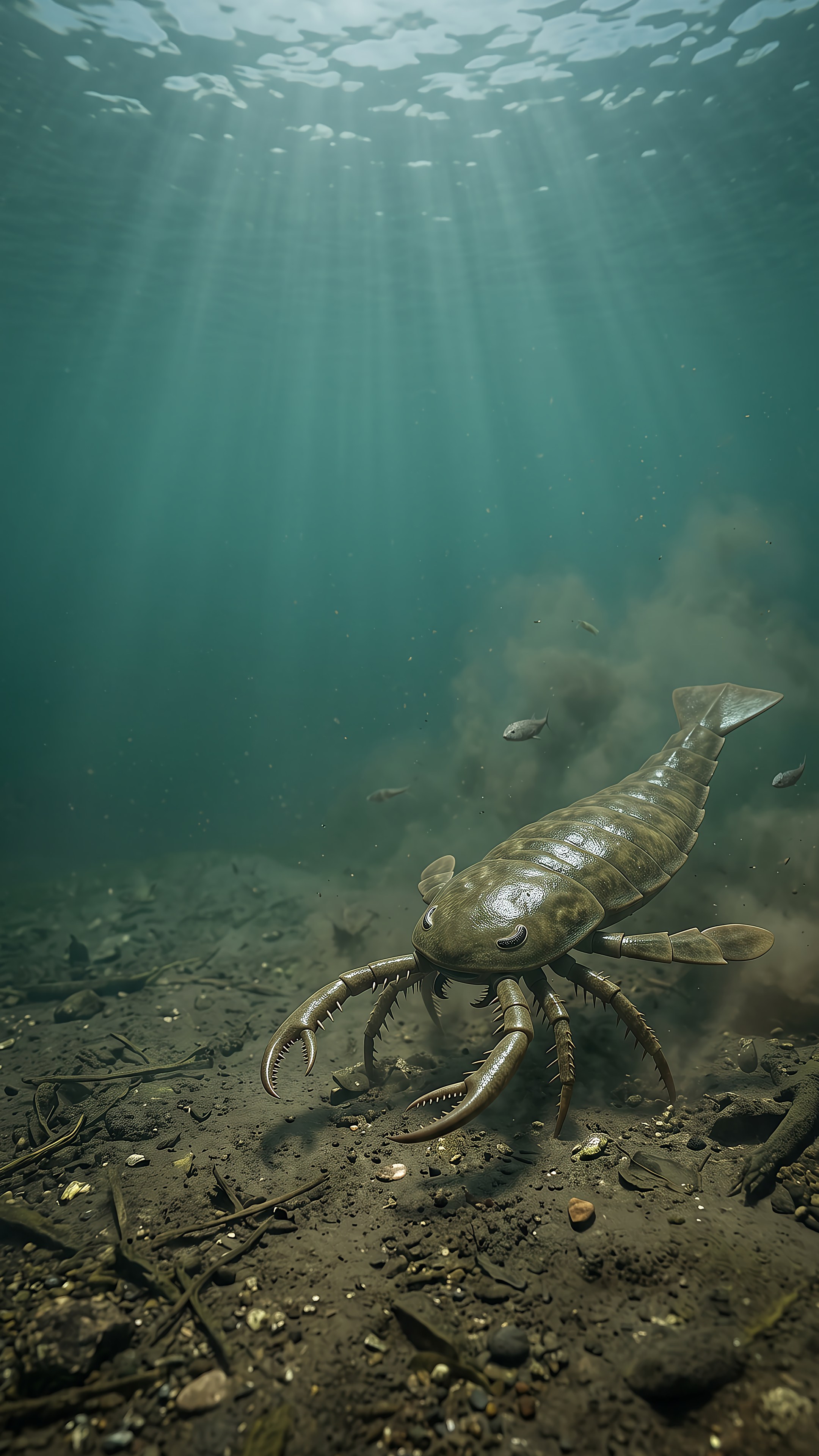
A 2015 study of its compound eyes counted an average of about 3,160 lenses per eye, with the lenses angled less than 1 degree apart. That combination gives sharp vision, comparable to living predatory arthropods. The giant individual itself is known only from its claw, so full-body reconstructions borrow the long segmented body, swimming paddles and broad, flat tail from better-known pterygotids.
How it lived
The fossils point to an active predator that hunted by sight: sharp eyes, strong claws and a body built for swimming. In 2022 Russell Bicknell and colleagues compared computer models of pterygotid claws and found that the Jaekelopterus claw carried much lower stress than those of its relatives. They concluded it probably fed on larger and harder prey, including armoured fishes.
These are inferences from anatomy; no fossil shows Jaekelopterus rhenaniae eating. Braddy and colleagues suggested that fully grown animals were the top predators of their waters, feeding on early vertebrates and smaller arthropods, possibly including their own kind. Evidence of attacks does exist for a related species: puncture wounds in the armour of an Early Devonian jawless fish from Utah have been blamed on Jaekelopterus howelli.
Its world
The giant claw comes from the Klerf Formation at Willwerath, in rocks of the early part of the Emsian Age of the Early Devonian, about 400 million years ago. Despite the 'sea scorpion' name, this was not open sea: Braddy's team interpreted the setting as a restricted body of water, possibly a brackish lagoon or a lake on a river floodplain in a delta. Its neighbours included several other eurypterids and a number of armoured fishes.
Giant arthropods are often explained by high oxygen levels in the ancient air. Braddy and colleagues pointed out that this may fit giant land arthropods of the Carboniferous, but not aquatic giants such as Jaekelopterus. A 2024 study of almost all known eurypterids found no strong evidence that oxygen or water temperature drove their giant sizes; bursts of size change seem to have happened for reasons inside the group itself.
Size and records
To estimate its size, Braddy's team used the ratio between claw length and body length in the related pterygotids Acutiramus and Pterygotus. This gave a body length of 233-259 cm (7 ft 8 in - 8 ft 6 in), about 2.5 m on average, or roughly one and a half times the height of a 1.8 m (5 ft 11 in) adult. With its claws stretched forward, the animal would have been around a metre longer again.
That estimate was almost half a metre longer than earlier estimates for the group. Its only rival is the giant millipede Arthropleura, estimated in 2021 at about 1.9-2.6 m (6 ft 3 in - 8 ft 7 in) from a fossil found in northern England. Both figures are scaled up from partial fossils, so the title of largest arthropod ever is best thought of as shared.
Relatives and legacy
Eurypterids were aquatic chelicerates, part of the same great branch of arthropods as spiders, scorpions and horseshoe crabs. Within the pterygotid family, Jaekelopterus appears most closely related to Acutiramus and is among the most advanced members of the group. A second species, Jaekelopterus howelli, is known from Early Devonian rocks of western North America.
The large predatory eurypterids did not last. Lamsdell and Braddy found that this group declined through the Devonian while armoured fishes called placoderms spread and diversified, which suggests competition with vertebrates. Other kinds of eurypterids survived until the end of the Permian, about 250 million years ago, but none left living descendants.
Myths and misconceptions
Jaekelopterus is sometimes described as a giant scorpion that lived in the sea. It was neither: eurypterids were a separate group from true scorpions, and this species lived in brackish and fresh water rather than the open ocean. Its 2.5 m length is also often quoted as if it were measured, when it is an estimate scaled up from a single claw.
Some accounts say that bite wounds on Devonian fish were made by Jaekelopterus rhenaniae. The wounds in question are on a fish from Utah and have been linked to the American species Jaekelopterus howelli, not to the German giant. Finally, its size is often credited to high oxygen levels, but recent studies of eurypterids do not support that explanation.