Discovery and name
The first fossils came from the Bugti Hills of Balochistan, in present-day Pakistan, where the geologist Guy Pilgrim collected jaw and tooth fragments in the early 1900s and named the species bugtiense in the hornless-rhino genus Aceratherium. In 1911 the British palaeontologist Clive Forster-Cooper moved it to a new genus, Paraceratherium, meaning 'near Aceratherium', itself 'the hornless beast'.
Larger bones soon received new names. Forster-Cooper named Baluchitherium in 1913 from Pakistani fossils, and the Russian palaeontologist Aleksei Borissiak named Indricotherium in 1916 from a skeleton found in Kazakhstan. In 1922 an American Museum of Natural History expedition to Mongolia, with the palaeontologist Walter Granger, recovered one of the most complete skulls known (AMNH 18650).
In 1989 Spencer Lucas and Jay Sobus argued that these giant hornless rhinos all belonged to one genus, and that Paraceratherium, the oldest name, has priority. A 2021 study by Deng Tao and colleagues also treated Indricotherium and Baluchitherium as junior synonyms and recognised six Paraceratherium species.
Body and anatomy
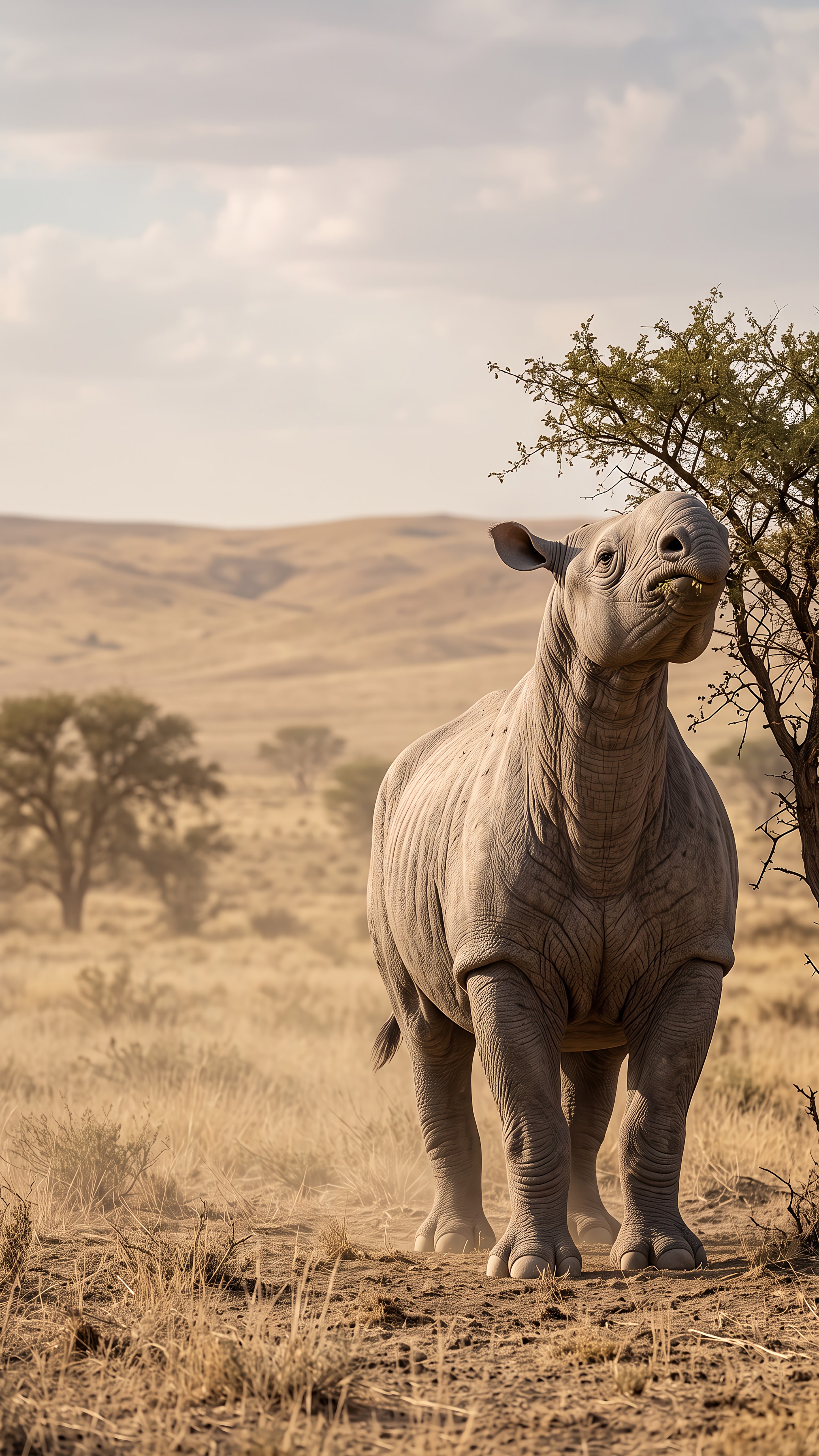
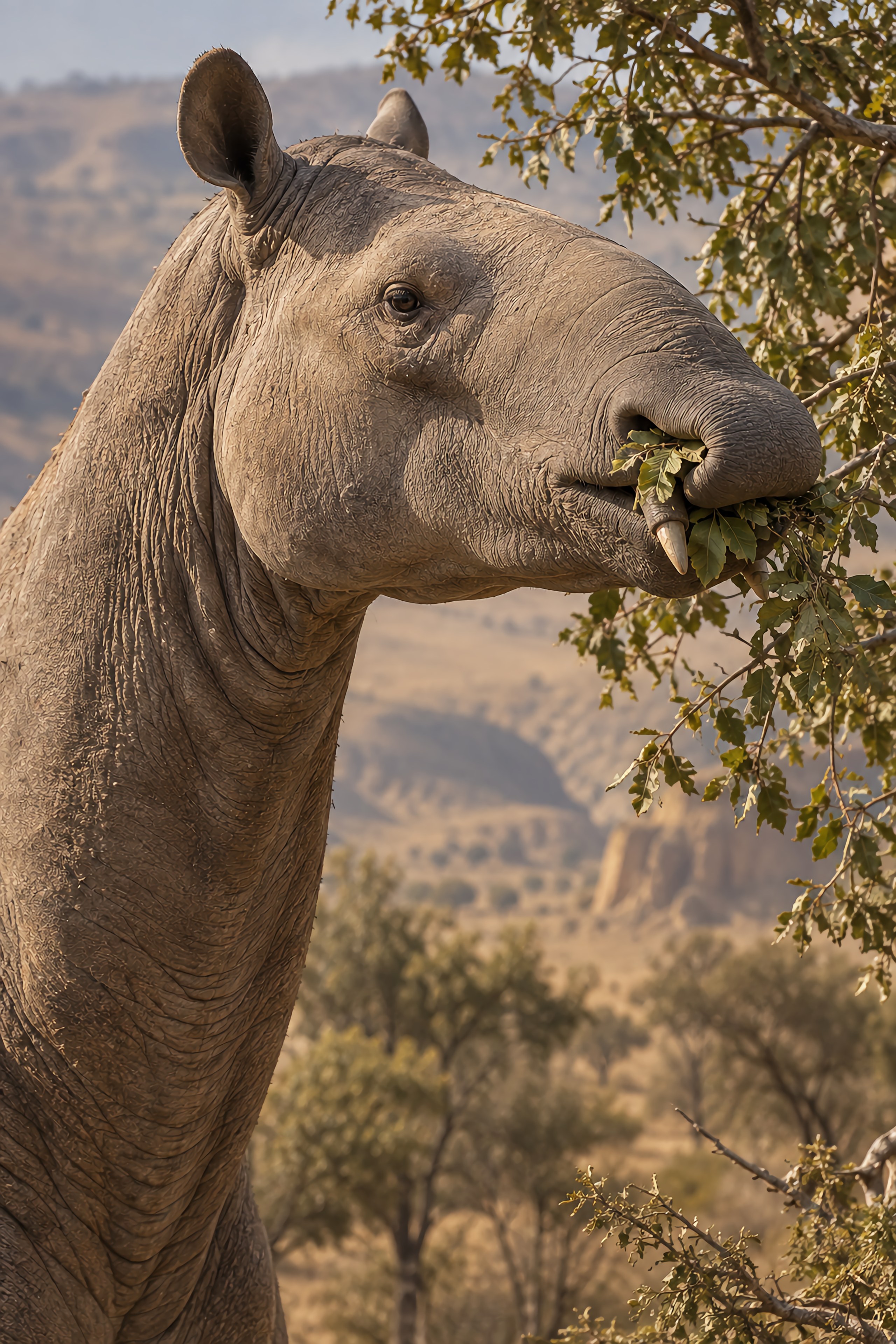
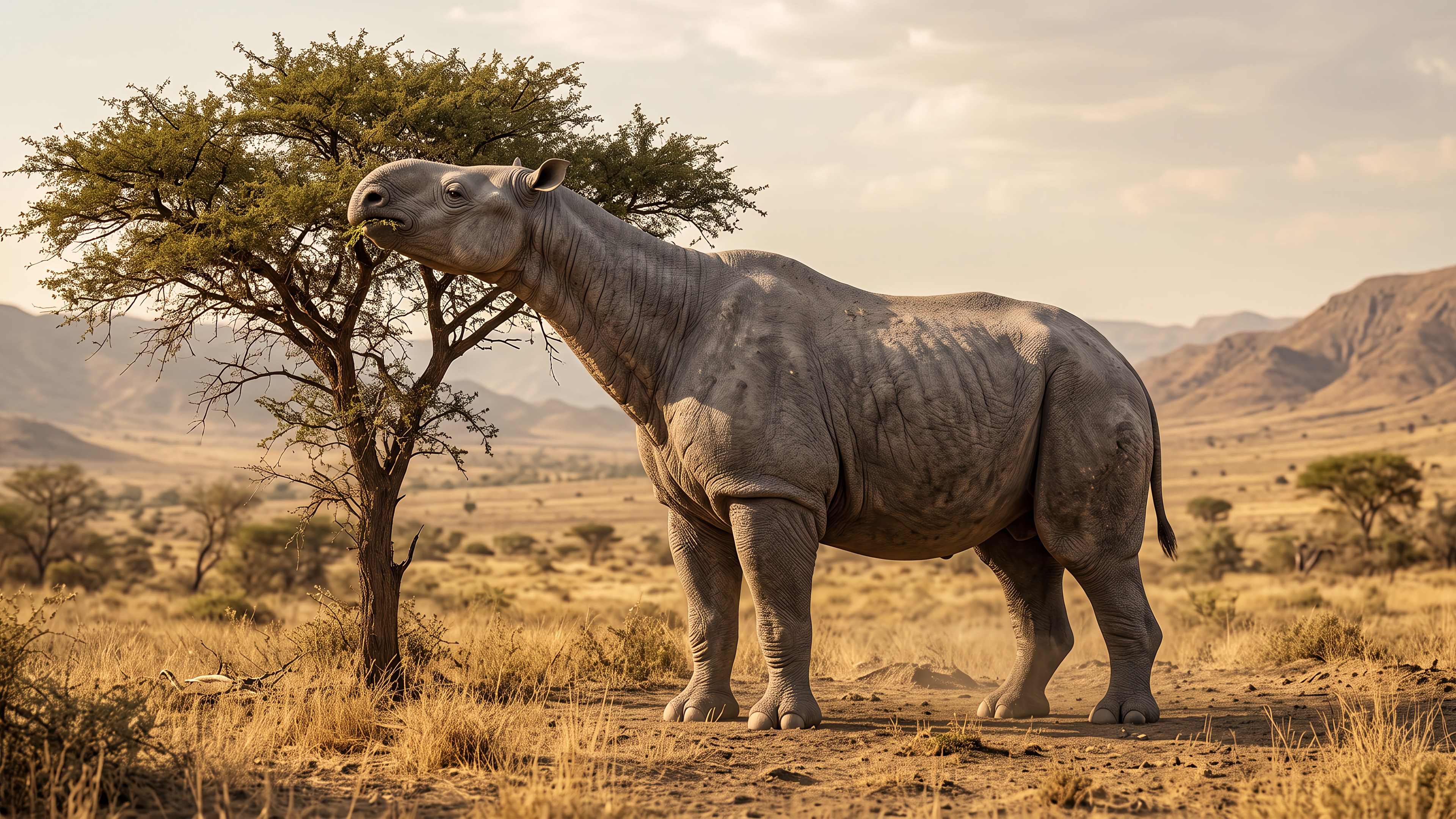
No single complete skeleton is known. Reconstructions combine bones from different individuals and sometimes different sites, which is one reason size estimates vary so much. The picture that emerges is of an animal with long, pillar-like legs, a long neck and a long, low skull with no horn.
In 2021 a complete skull with its lower jaw and first neck vertebra was described from the Linxia Basin in Gansu, China, as the new species P. linxiaense. Features of its neck vertebrae point to a long, flexible neck suited to a giant body. Soft parts such as the lips and ears are not preserved, so reconstructions of the face differ.
How it lived
Paraceratherium was a plant-eater. Its great height would have let it reach leaves far above the heads of other animals, and most researchers reconstruct it as a browser of trees and shrubs, feeding rather like a giraffe. Late Oligocene sites in north-western China suggest open woodlands with a mix of trees and grassland.
The fossils also show that the genus travelled. Deng and colleagues concluded that early in the Oligocene Paraceratherium spread west from the Mongolian region to Kazakhstan and then south into South Asia, and later moved back north across the Tibetan region. That implies parts of Tibet were still low enough, possibly under 2,000 m, for giant browsers to cross.
Like elephants, an animal this big probably grew slowly and had long pregnancies, but there is no direct fossil evidence for its growth rate, lifespan or social life.
Its world
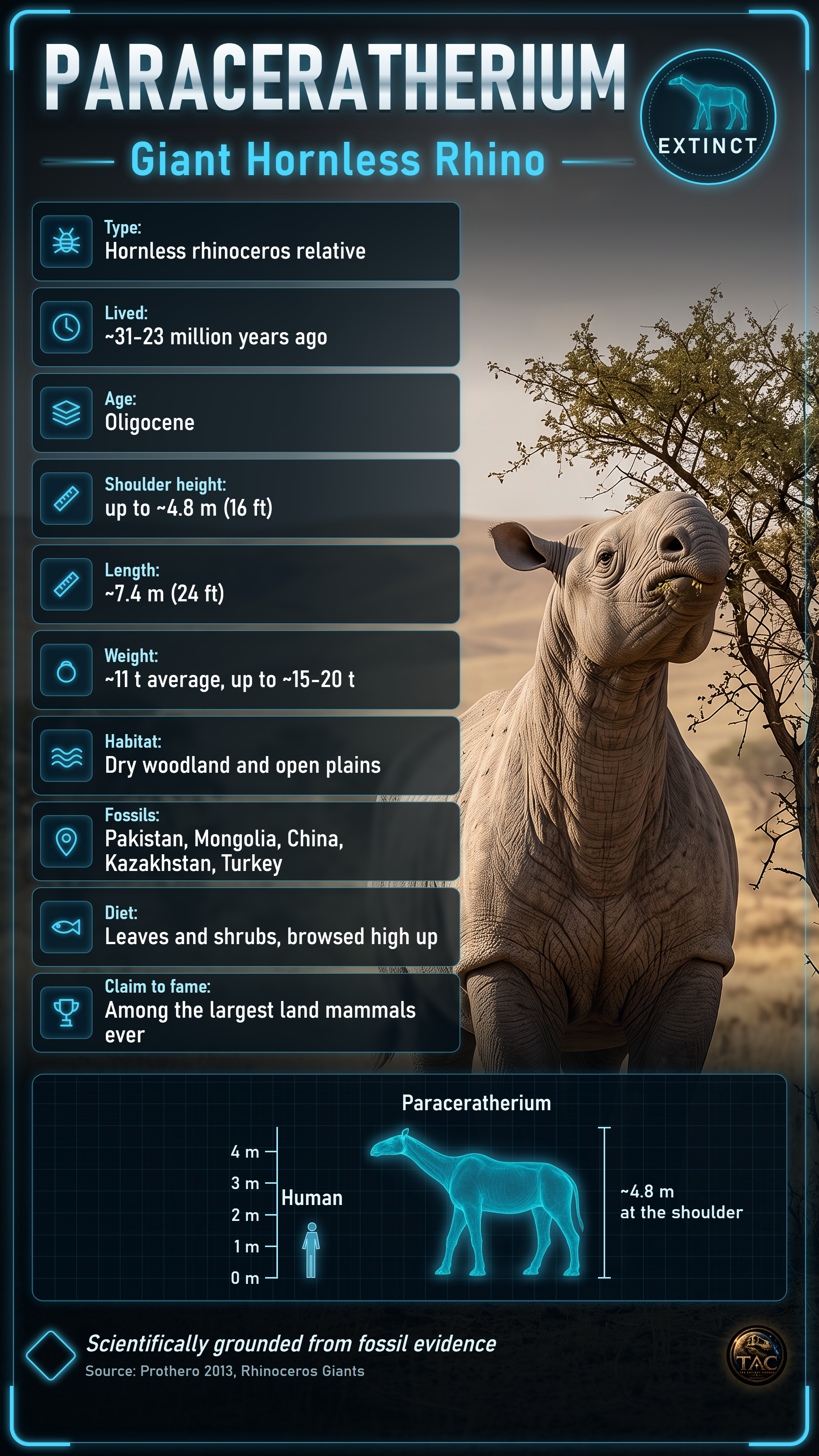
Paraceratherium lived in the Oligocene epoch, after the warm Eocene had given way to a cooler, drier world. The oldest fossils of the genus, from Hsanda Gol in Mongolia, date to about 31 to 28 million years ago, and P. linxiaense lived about 26.5 million years ago. The Pakistani species P. bugtiense survived into the earliest Miocene, around 23 million years ago.
Fossils have been found in China, Mongolia, Kazakhstan and Pakistan, with further records from Anatolia (Turkey), the Caucasus and eastern Europe. Central Asia was fairly dry in the early Oligocene, while South Asia was moister, with a mosaic of forest and open country.
Size and records
Older books often gave Paraceratherium a weight of 20 to 30 tonnes. In 1993 Mikael Fortelius and John Kappelman combined more than 90 estimates from head-and-body length, skull size, tooth size and limb-bone thickness. They found an average of about 11 tonnes and a probable maximum of 15 to 20 tonnes, and traced the inflated figures to a famous 1930s reconstruction that had been scaled up too much.
The largest individuals are known mostly from two giant neck vertebrae and part of a hand bone. Scaling from more complete skeletons, Asier Larramendi (2016) estimated that such a bull stood about 4.8 m (15 ft 9 in) at the shoulder and weighed about 17 tonnes, while most large skeletons suggest animals nearer 8 to 10 tonnes. A 1.8 m (6 ft) adult human would not reach halfway up its front leg to the shoulder, and its body is usually reconstructed at around 7 to 8 m (23 to 26 ft) long.
Relatives and legacy
Paraceratherium belongs to the Paraceratheriidae, a family within the rhinoceros superfamily Rhinocerotoidea; some older classifications placed it in the Hyracodontidae, the lightly built 'running rhinos'. Its closest living relatives are therefore the five living rhinoceros species, although it was not their ancestor. A second giant genus, Dzungariotherium from China, had a proportionally larger skull and teeth but a smaller body.
The genus disappeared around the boundary between the Oligocene and Miocene, about 23 million years ago, after surviving for roughly 8 million years. Why it died out is not known; changing vegetation and competition from newly arriving mammals have both been suggested, but the fossil record cannot yet test these ideas.
Myths and misconceptions
Myth: it was definitely the largest land mammal ever. Larramendi's 2016 study of proboscideans found that the largest bulls of the elephant Palaeoloxodon namadicus may have been about 5 tonnes heavier and 40 cm taller at the shoulder than the biggest Paraceratherium, and that Mammut borsoni reached similar sizes. The title is now contested.
Myth: it weighed 20 to 30 tonnes. Those figures come from an over-scaled reconstruction; modern estimates put typical large adults at about 8 to 11 tonnes and the very largest bulls at about 17 tonnes.
Myth: Baluchitherium, Indricotherium and Paraceratherium were three different animals. They are names for the same genus, and Paraceratherium, published in 1911, is the valid one. Despite being a rhinoceros relative, it also had no horn.