Discovery and name
The first Basilosaurus bone to reach scientists was a single vertebra found in Louisiana in 1832. More bones followed from Clarke County, Alabama, and in 1834 the naturalist Richard Harlan named the animal Basilosaurus, 'king lizard', because he took the huge vertebrae for those of a giant marine reptile. In 1839 Harlan carried teeth and jaws to England, where the anatomist Richard Owen noticed that the cheek teeth had two roots, a mammal feature. Owen renamed the animal Zeuglodon cetoides, the species name recognising its link to whales, but under the rules of zoological naming the first published genus name wins, so today it is Basilosaurus cetoides.
In the mid-1890s the Smithsonian Institution sent the collector Charles Schuchert to Choctaw County, Alabama. He dug up the front half of one skeleton near Melvin and the back half of another near Fail, and the two were combined into a nearly complete composite that has been on display in Washington since 1910. Alabama made Basilosaurus cetoides its official state fossil in 1984.
Body and anatomy
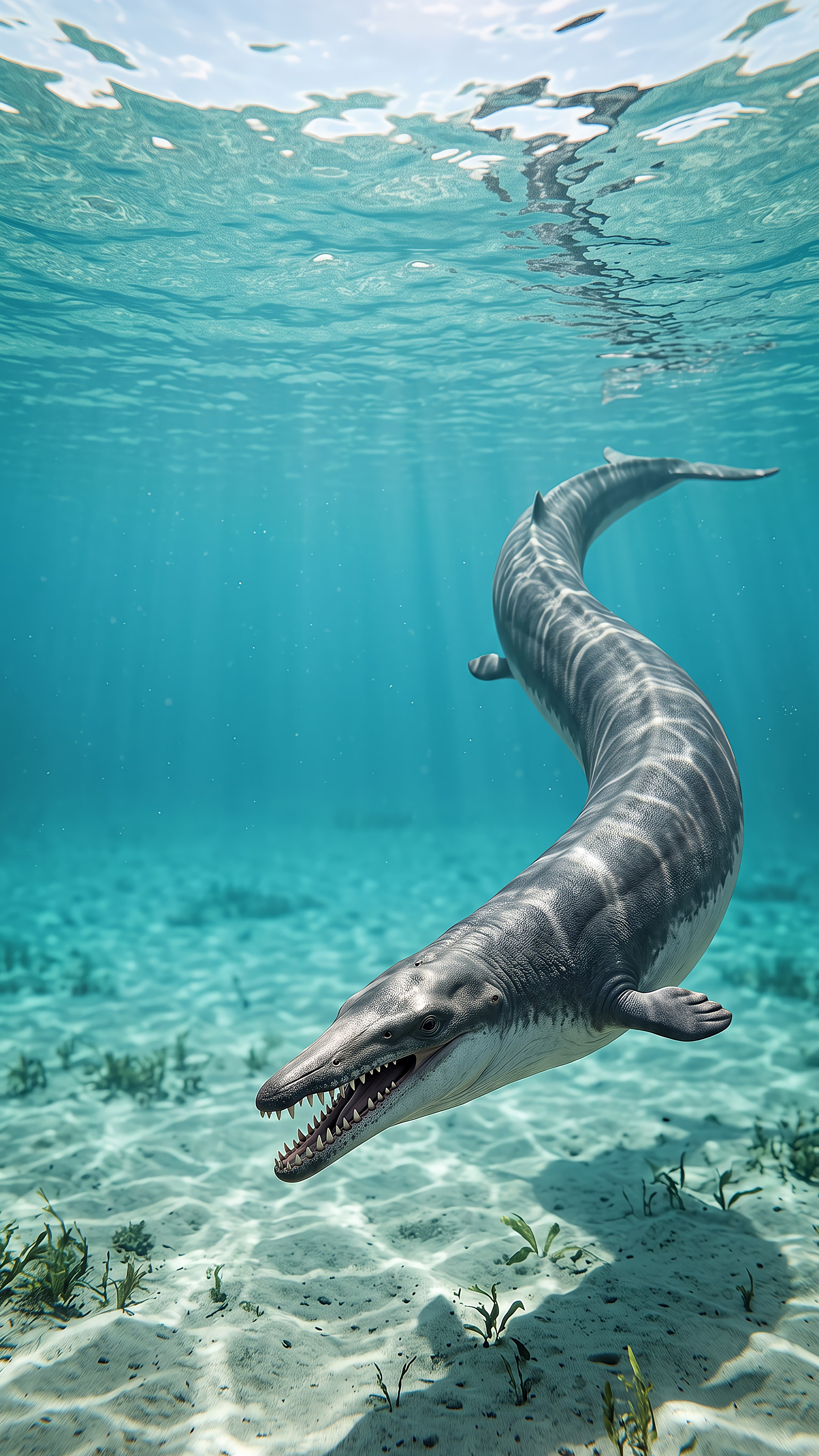
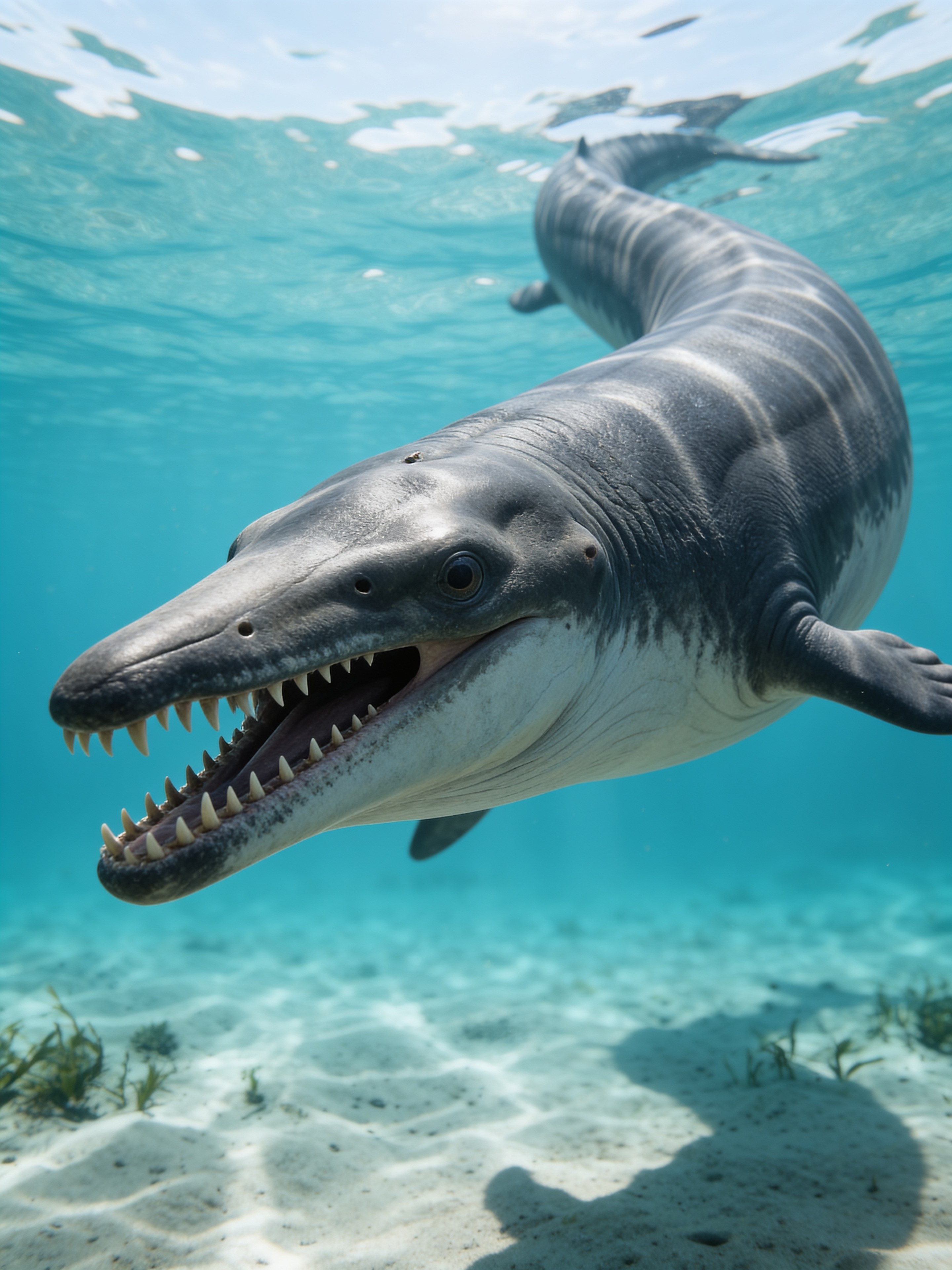
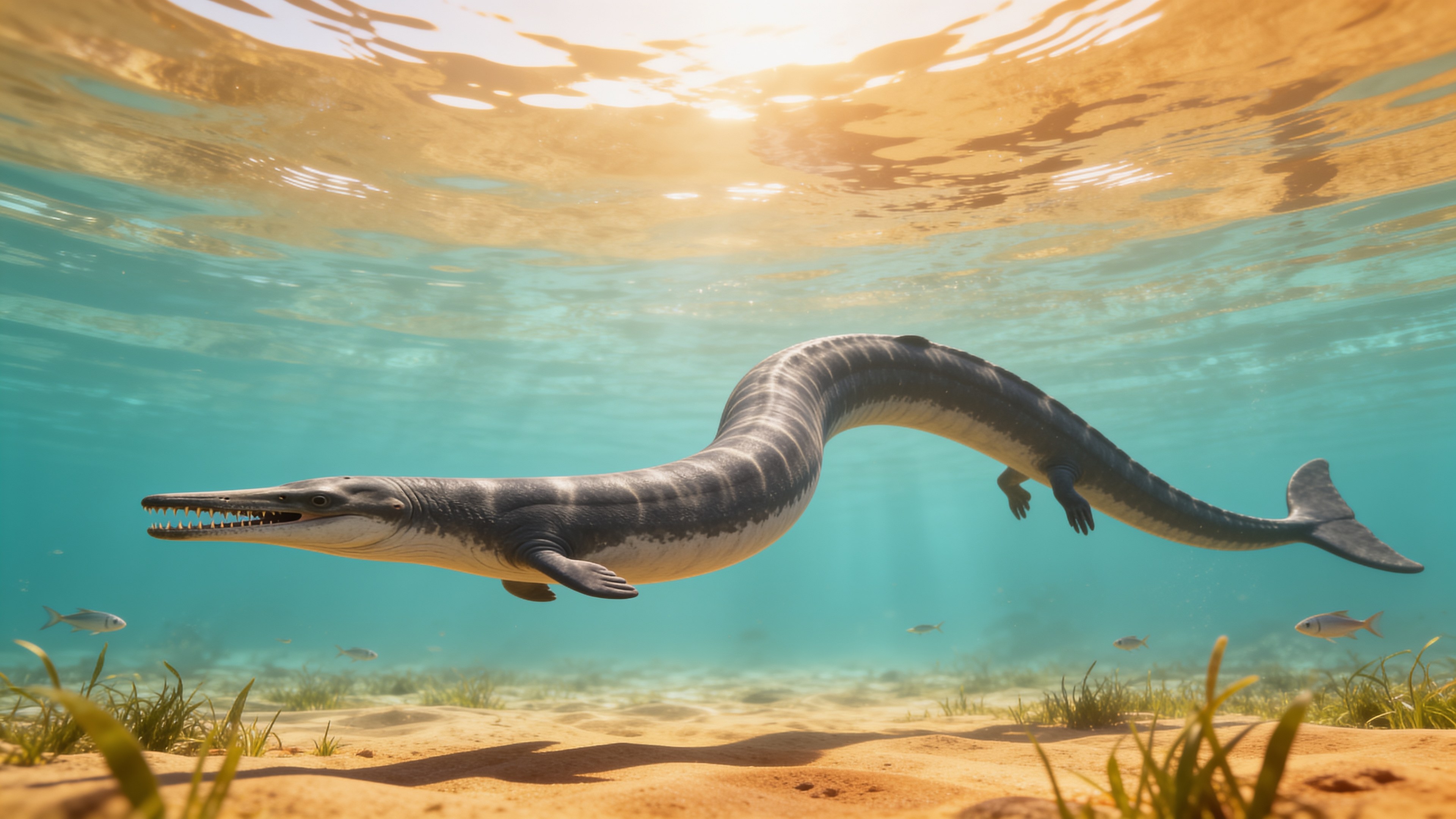
Basilosaurus had a long, slender body built from unusually long vertebrae, which is why early reconstructions made it look like a sea serpent. The skull carried a mix of tooth types: pointed teeth at the front for gripping, and large cheek teeth with several sharp cusps for shearing, crushing and puncturing. Its nostrils sat part-way along the snout, not on top of the head as in a modern whale's blowhole.
Much of the complete picture comes from its close relative Basilosaurus isis in Egypt, known from many skeletons. B. isis had flipper-like forelimbs with a stiff wrist but a mobile elbow, heavy ribs that probably acted as ballast, and tail vertebrae that suggest a small fluke. Its tiny hind legs still had a working knee, ankle and toes, but the hip bones were not joined to the spine, so they could not support walking or help swimming. In B. cetoides, the hind legs are known mainly from hip bones and part of a thigh bone found on the Smithsonian skeleton and described in 1900.
How it lived
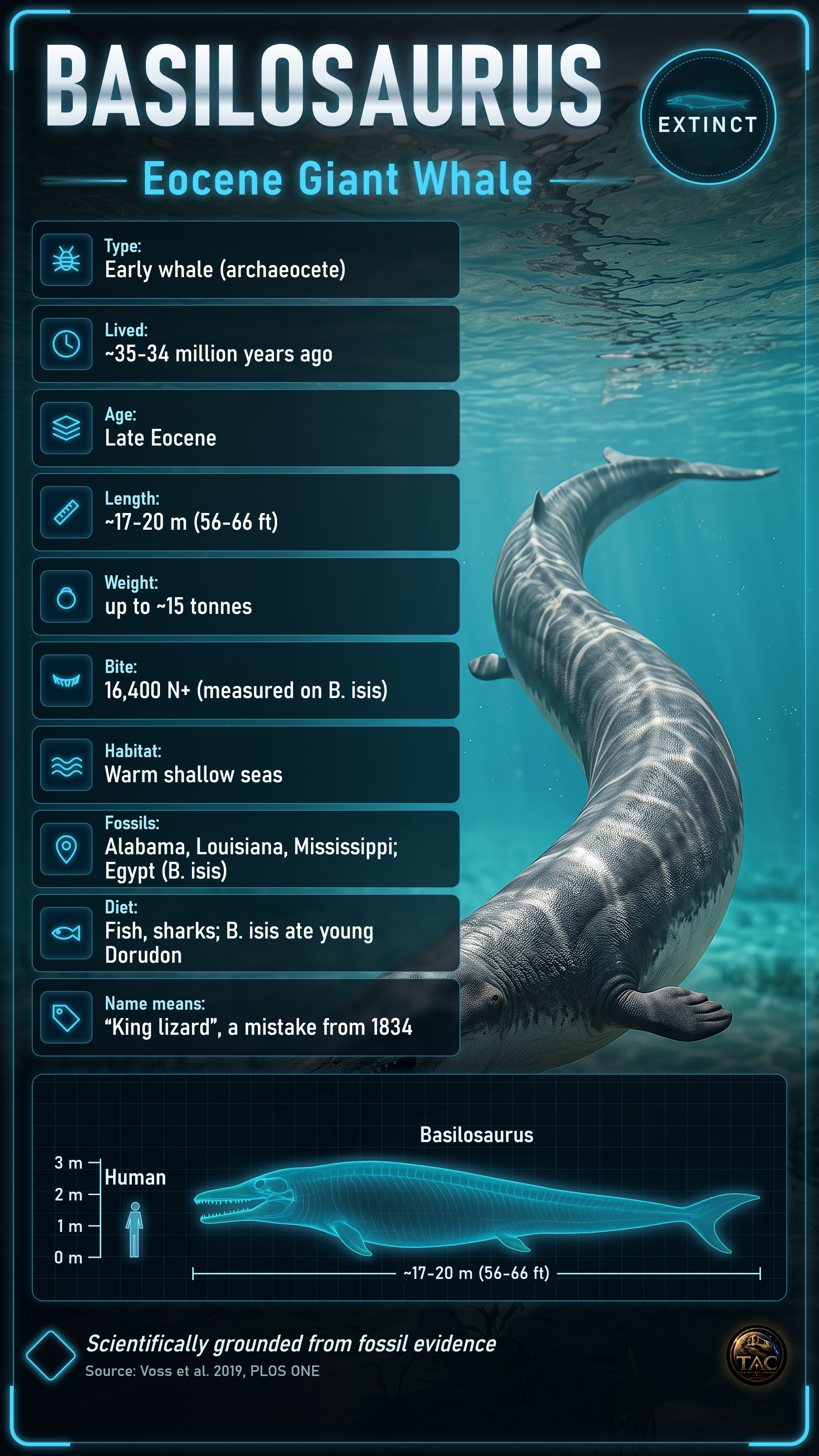
Direct evidence of the diet of B. cetoides comes from stomach contents reported in 1996: the remains of fishes and sharks up to about 50 cm (20 in) long. The Egyptian species B. isis ate larger prey: its stomach contents include young Dorudon whales, a bony fish about 1 m (3 ft) long and the tooth of a large shark, and bite marks on young Dorudon skulls match its teeth. Palaeontologists therefore describe Basilosaurus as the top predator of its seas, though nobody has yet shown that B. cetoides itself hunted other whales.
The long body and small fluke suggest Basilosaurus swam by bending its body in waves, more like an eel than a dolphin, which is an inference from the skeleton. Its ear region and thin-walled lower jaw show it could tell which direction sounds came from under water, but there is no sign that it could echolocate as modern toothed whales do. Growth layers in the vertebrae of B. isis suggest the skeleton grew long quickly.
Its world
B. cetoides lived near the end of the Eocene, roughly 35 million years ago, when a shallow sea covered what is now southern Alabama, Mississippi and nearby states. Its fossils come from rock layers such as the Pachuta Marl and Shubuta Clay in western Alabama and the Ocala Limestone farther east, which extends into Florida. Smaller early whales such as Zygorhiza kochii and Cynthiacetus maxwelli shared the same sea, along with bony fish and sharks.
Across the ocean, Basilosaurus isis hunted in a shallow sea over what is now the Egyptian desert, around 37.5 million years ago. Dinosaurs other than birds had been gone for more than 30 million years by then, so Basilosaurus never met one.
Size and records
B. cetoides is usually estimated at about 17-20 m (56-66 ft) long. A 2025 study that rebuilt the Smithsonian composite skeleton in three dimensions gave a total length of 18.35 m (60 ft), about ten adult humans lying head to toe, and estimated a body mass of roughly 15 tonnes. Mass is harder than length to judge: other researchers consider published mass estimates for Basilosaurus unreliable because its stretched vertebrae do not fit the usual formulas.
The Egyptian B. isis was slightly smaller, at about 15-18 m (49-59 ft). Using computer models of an adult B. isis skull 113 cm (3.7 ft) long, a 2015 study estimated a bite force of at least 16,400 newtons at one of its upper cheek teeth, the largest bite force then estimated for any mammal. No equivalent study has been done for B. cetoides, so that figure belongs to its Egyptian relative.
Relatives and legacy
Basilosaurus gives its name to the Basilosauridae, the first fully aquatic whales, part of the wider group of early whales called archaeocetes. Its family also includes the smaller Dorudon, whose compact skeleton is much more like that of a modern whale and which may lie close to the ancestry of today's baleen and toothed whales.
Basilosaurus itself was a specialised branch that did not give rise to any later whales. Its legacy is scientific: the hind legs, feet and toes found on Egyptian Basilosaurus skeletons in 1990 became some of the clearest evidence that whales descend from four-legged land mammals.
Myths and misconceptions
Despite its name, Basilosaurus was not a lizard, a dinosaur or a marine reptile; it was a mammal and a whale. The misleading name survives only because it was published first. Confusion about its bones lasted a long time: in 1906 the palaeontologist Othenio Abel named its hip bones Alabamaornis gigantea, believing they came from a giant bird.
It was also turned into a fake sea serpent. In 1845 the fossil showman Albert Koch toured a skeleton he called Hydrarchos, built from at least two Basilosaurus specimens to look impossibly long; a museum in Prussia bought it in 1848 and later took it apart. Finally, many 'Basilosaurus' facts, such as its record bite force and its attacks on young Dorudon, come from the Egyptian B. isis, not from the American B. cetoides.