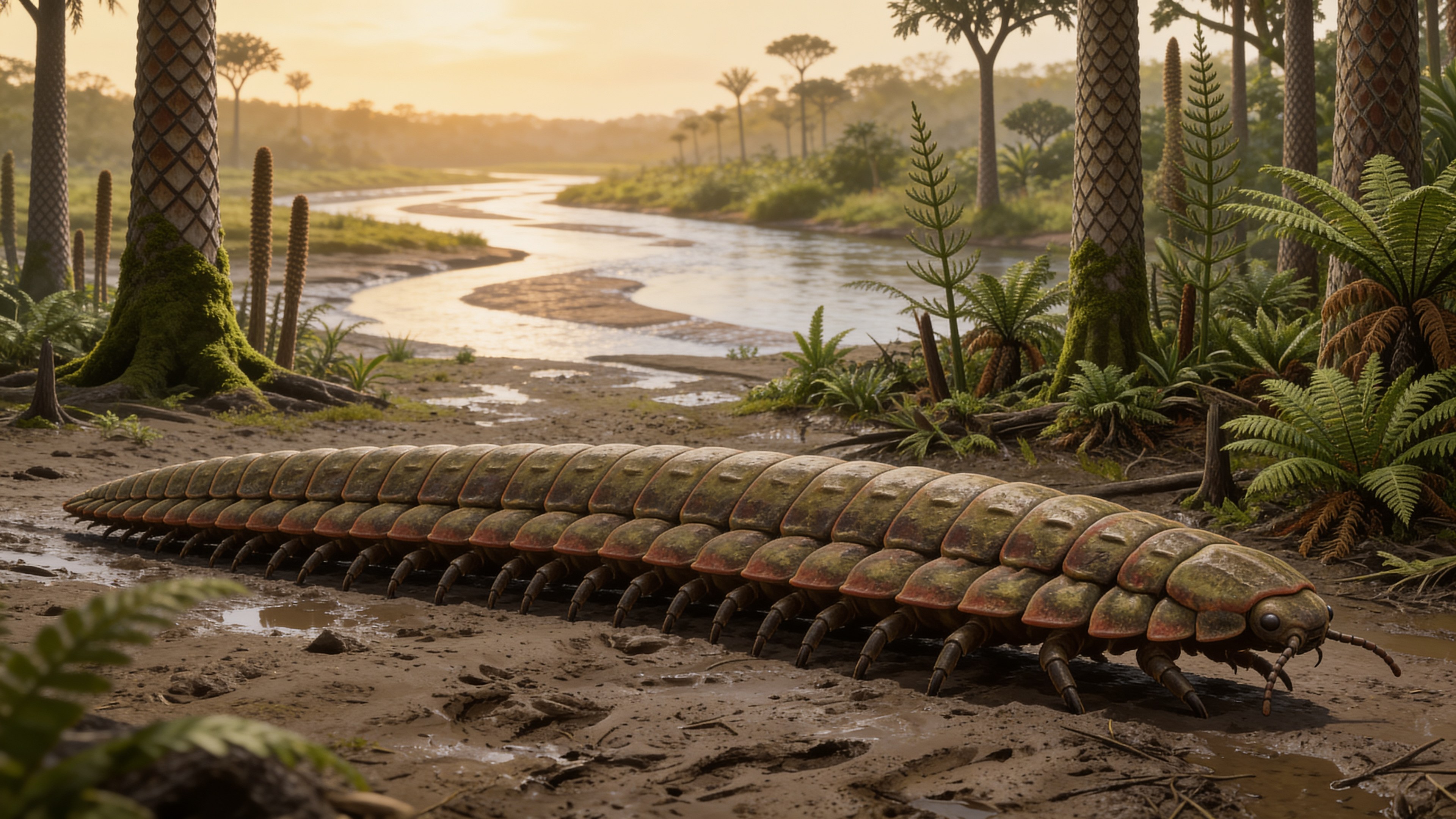
Discovery and name
Arthropleura was named in 1854 by the German naturalist F. W. H. Jordan, from fragments found in the coal-bearing rocks around Saarbrücken, in a paper on the 'crustaceans' of the coal formation; the type species is Arthropleura armata. The name comes from Greek words for 'joint' and 'side' or 'rib'. For about 170 years its fossils stayed frustratingly incomplete: most are loose pieces of armour or shed skins, and a plate long thought to be the head turned out to be the collum, the first segment behind it.
In January 2018 a block of sandstone fell from the cliffs onto the beach at Howick Bay in Northumberland, England, and cracked open to reveal a large piece of Arthropleura, spotted by a former Cambridge PhD student walking past. It was removed in May 2018 and described in 2021 by Neil Davies and colleagues. The fossil, 76 by 36 cm (30 by 14 in), is part of an exuvium, a moulted exoskeleton, covering 12 to 14 body segments, and it is about 326 million years old.
Body and anatomy
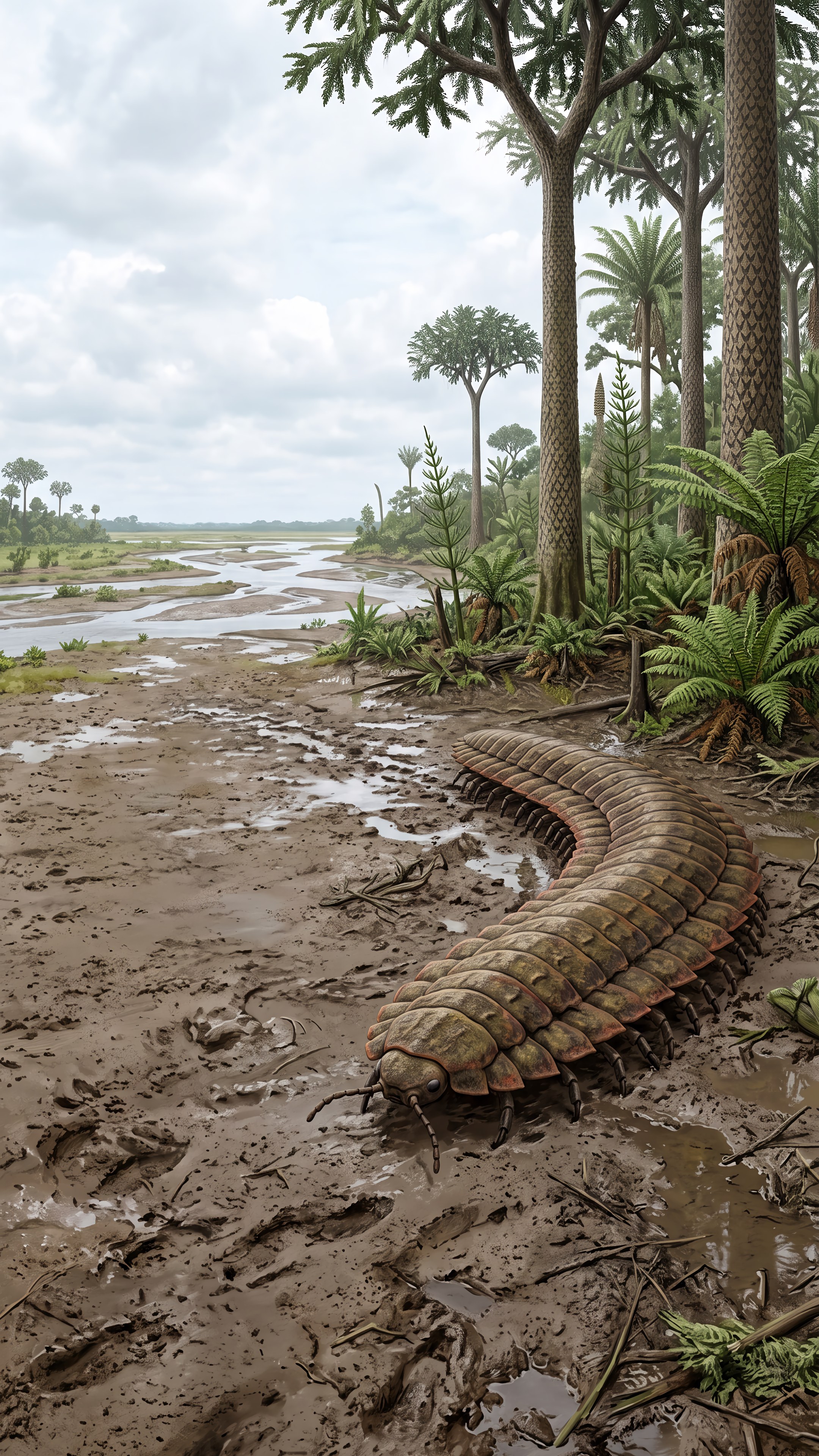
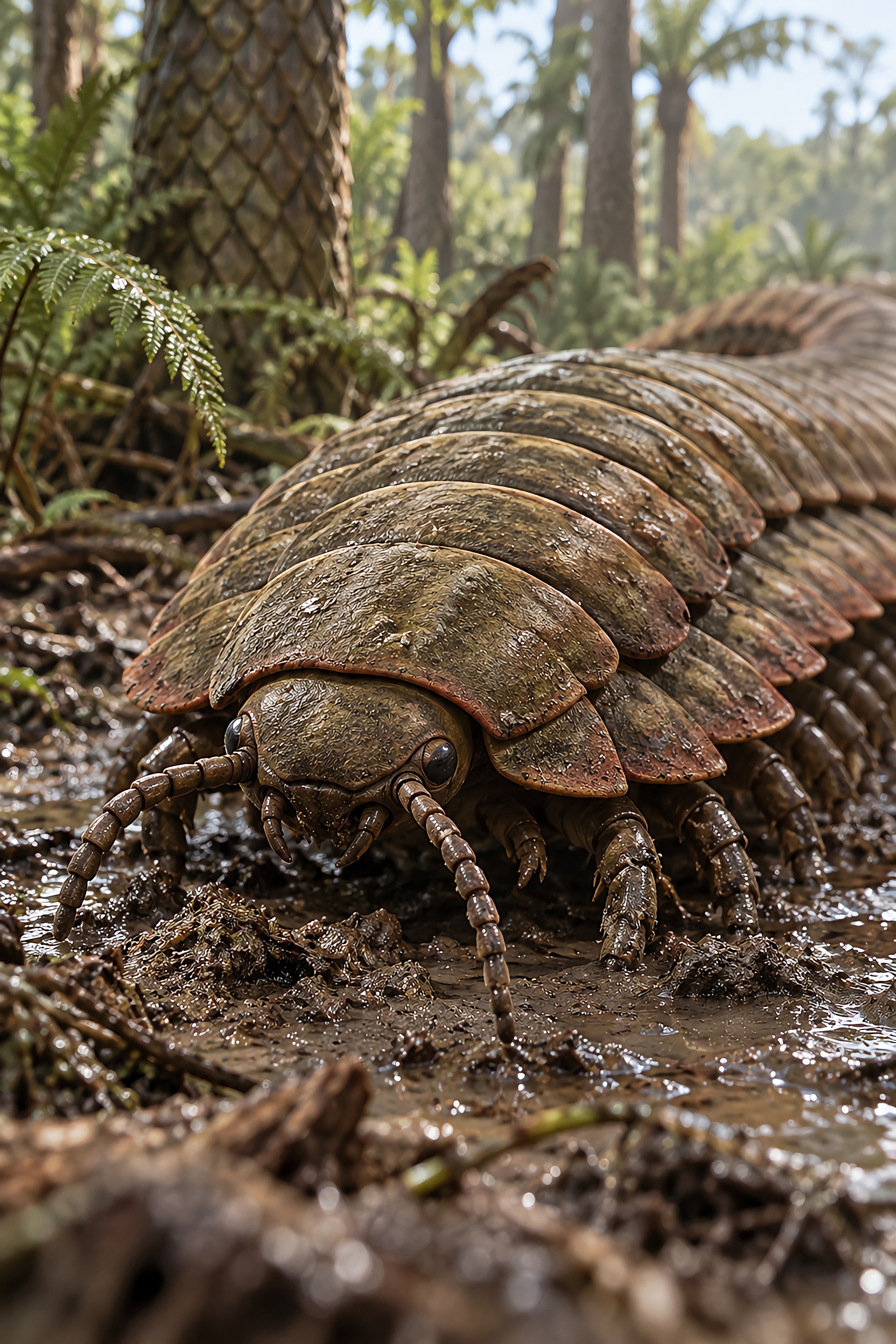
Arthropleura had a long, flattened body covered by a series of dorsal plates, or tergites, usually counted at 28 to 32, each divided into three lobes and studded with bumps. The Northumberland fossil confirms that it had a tough, well-hardened exoskeleton. As in millipedes, most trunk segments were double segments carrying two pairs of legs each, but the collum and the next segment carried only one pair each.
Its head was finally described in 2024 by Lhéritier and colleagues, who used X-ray scanning on two small juveniles still inside rock nodules from Montceau-les-Mines, France. The head had stalked eyes, seven-segmented antennae and enclosed jaws. It lacked the plate-like lower lip of modern millipedes and also lacked the venomous claws of centipedes, while some mouthparts looked more like a centipede's.
No breathing organs have been found, so it is not known whether it breathed through air tubes like living myriapods or had some form of gills.
How it lived
What Arthropleura ate is not known directly. A 1967 study reported plant fragments in the gut of one specimen, but these were later reinterpreted as an artefact of fossilisation, and the Montceau juveniles show no food remains. Most researchers still think it fed on decaying plant matter, like nearly all living millipedes, and the 2024 study concluded it was likely a detritivore, but this is an inference from its anatomy and relationships. Davies has suggested it could also have eaten nuts and seeds from the leaf litter, and has not ruled out that it sometimes preyed on other animals.
Trackways tell us how it moved. A trail from the Isle of Arran, Scotland, named Diplichnites cuithensis in 1979, shows two long rows of footprints left by a giant myriapod crossing sand in a river delta, and suggests it changed its walking style to suit the ground, as modern millipedes do. Trackways and the rocks around fossils suggest it favoured open, wooded ground on delta plains rather than dense swamps.
The juveniles show how it grew: rear segments and legs were smaller than those in front, suggesting that it added segments and pairs of legs each time it moulted. Its stalked eyes might hint at time spent in water, but this remains unproven.
Its world
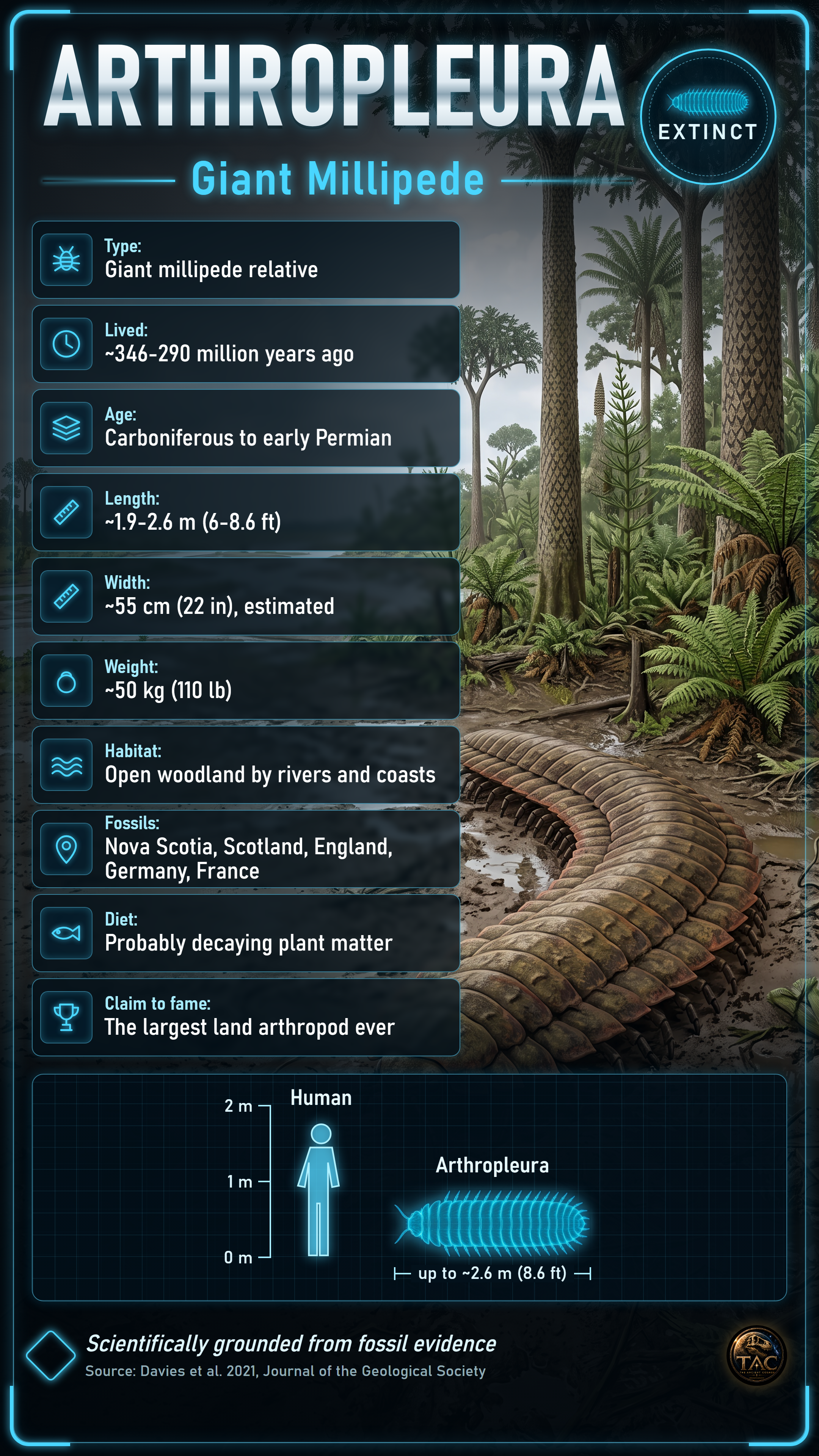
Arthropleura lived from about 346 to 290 million years ago, from the Visean stage of the Carboniferous to the Sakmarian stage of the early Permian. Its fossils are restricted to regions that then lay near the equator, in the tropical forests of Euramerica, including Britain, France and Germany. When the Northumberland animal lived, northern England had a tropical climate.
The late Carboniferous atmosphere was richer in oxygen than today's, and this is often used to explain giant arthropods. Arthropleura complicates that story: the Northumberland fossil shows it was already giant around 326 million years ago, before oxygen reached its late Palaeozoic peak, so oxygen alone cannot explain its size. It also seems to have been little affected by the climate changes that hit the late Carboniferous forests.
It shared its habitats with early four-limbed vertebrates, and at Montceau-les-Mines, about 305 million years ago, with other arthropods including euthycarcinoids, which also had stalked eyes.
Size and records
The Northumberland animal is estimated to have been 55 cm (22 in) wide and between about 1.9 and 2.63 m (6 ft 3 in to 8 ft 7 in) long, weighing about 50 kg (110 lb). That is longer than a tall adult is tall, and roughly the weight of a 14-year-old. These figures are estimates made by scaling up from the width of the preserved plates using the proportions of more complete specimens; press reports rounded the length to about 2.7 m.
It is the largest arthropleurid found so far and one of the largest arthropod fossils of any kind, which is why Arthropleura is described as the largest arthropod in Earth history. Not every individual was huge: the two Montceau juveniles are only about 23 and 40 mm long, and some species were much smaller.
Relatives and legacy
Arthropleura is a myriapod, the group that includes millipedes and centipedes. The 2024 study combined fossil anatomy with genetic data from living species and found Arthropleura to be an early member of the millipede lineage that branched off before modern millipedes. When the older and very incomplete Eoarthropleura was added, the arthropleurids moved deeper, onto the stem of all myriapods.
The study also supported the idea that millipedes and centipedes are each other's closest relatives, a view based mainly on genetic data. The Natural History Museum's Greg Edgecombe, a co-author, said the evidence led him to overturn 20 years of his own work.
Arthropleura died out in the early Permian and left no descendants. Why is unknown; suggestions include a drier climate and competition from the reptiles that were becoming common.
Myths and misconceptions
Myth: Arthropleura was a giant venomous centipede. It had no venom claws, and its closest relatives are millipedes. Myth: it lived in steamy coal swamps. Trackways and the rocks around its fossils suggest it preferred more open, wooded ground. Myth: high oxygen explains its size. It was already giant before the oxygen peak.
Myth: we know it ate rotting plants. That is the most likely diet, but no convincing gut contents have been found. Myth: the Northumberland fossil is a complete animal, or a single segment. It is a partial moulted skin covering 12 to 14 segments, from which the size of the whole animal was estimated.