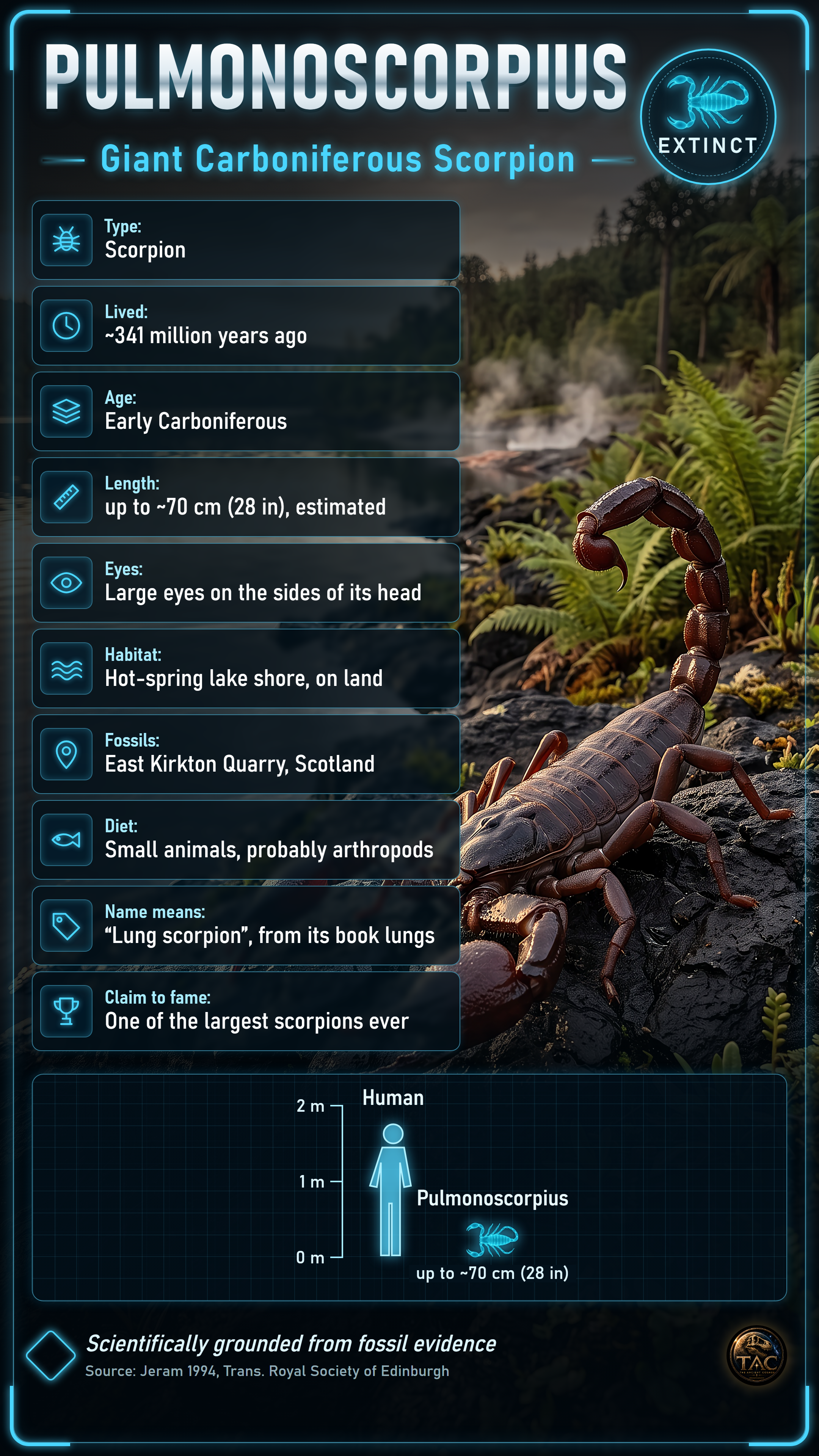
Reconstruction of Pulmonoscorpius kirktonensis, the giant carboniferous scorpion
A reconstruction from the fossil evidence, not a photograph. Click or tap it to see it full screen.
Carboniferous · Early Carboniferous (Visean) · 344–338 million years ago

Pulmonoscorpius kirktonensis

Giant Carboniferous Scorpion

Say it PUL-muh-noh-SKOR-pee-us kirk-tuh-NEN-sis

EXTINCTCarboniferous344–338 MaArthropods0.7 m

Pulmonoscorpius kirktonensis was a giant scorpion that lived on land in what is now Scotland about 341 million years ago, in the Early Carboniferous. Known from hundreds of fossil fragments from East Kirkton Quarry, it breathed air through book lungs like living scorpions, and the largest individual has been estimated at about 70 cm (28 in) long.

At a glance

Pulmonoscorpius kirktonensis key stats
TypeScorpion
Lived~341 million years ago
AgeEarly Carboniferous
Lengthup to ~70 cm (28 in), estimated
EyesLarge eyes on the sides of its head
HabitatHot-spring lake shore, on land
FossilsEast Kirkton Quarry, Scotland
DietSmall animals, probably arthropods
Name means“Lung scorpion”, from its book lungs
Claim to fameOne of the largest scorpions ever
0 m1 m2 mHumanPulmonoscorpius · up to ~70 cm (28 in)
Size against a 1.8 m human

Quick facts

  • The largest specimen is estimated at about 70 centimetres long, around three times the size of the biggest scorpions alive today.
  • Its fossils preserve book lungs, so it breathed air and lived on land, unlike the sea scorpions.
  • Dating published in 2025 puts the East Kirkton rocks at about 341 million years old.
  • It comes from East Kirkton in Scotland, a hot-spring lake deposit that also holds some of the earliest land vertebrates.

Discovery and name

East Kirkton Quarry, near Bathgate in West Lothian, had yielded very few fossils until 1984, when the collector Stan Wood discovered a previously unsuspected community of land animals in its limestone. Careful bed-by-bed excavations followed from 1985 to 1992, and the results were published together in one volume of the Transactions of the Royal Society of Edinburgh: Earth Sciences, dated 1993.

In that volume Andrew Jeram described the East Kirkton scorpions and named most of the material as a new genus and species, Pulmonoscorpius kirktonensis. The name is usually cited as Jeram 1994, although the journal volume is dated 1993. It combines the Latin pulmo, 'lung', with scorpius, 'scorpion', so it means 'lung scorpion'; kirktonensis means 'from Kirkton'.

Body and anatomy

Most of the fossils are fragments of cuticle, the tough outer skeleton, with rarer articulated specimens. When the cuticle is freed from the rock it is exquisitely preserved, so Jeram could describe these scorpions in more detail than any other Carboniferous scorpion fauna. The overall body plan was that of a scorpion: a pair of pincers, four pairs of walking legs, a broad body and a segmented tail ending in a sting.

The name records its most important feature: book lungs, stacks of thin air-breathing plates like those of living scorpions. Early fossil scorpions also had compound lateral eyes made of many small lenses, while living scorpions have only a few simple eyes on each side of the head. Pulmonoscorpius had large lateral eyes of this older kind. A detail used to classify it is the position of its last pair of leg bases, which touch the small breastplate on its underside.

How it lived

Book lungs mean Pulmonoscorpius breathed air and lived on land, not in water. That matters, because the same deposit also contains rare fragments of an aquatic scorpion, a reminder that not all scorpions of this age had moved onto land.

No fossil shows what Pulmonoscorpius ate. Every living scorpion is a predator, so palaeontologists reasonably assume it was too. An animal of its size could have tackled millipedes, harvestmen and other arthropods, and possibly small four-legged vertebrates, but this is inference, not evidence. Jeram found that most specimens are juveniles, so young scorpions were far more common in the deposit than giant adults.

Its world

East Kirkton was a shallow lake set among volcanic cones a few hundred metres high, surrounded by a fire-prone forest of seed plants. The lake water had unusual chemistry, and at times it was heated by local hot springs; both factors kept out most normal aquatic life. The lake existed for only a few tens of thousands of years before it filled with volcanic ash. Uranium-lead dating published in 2025 placed the fossil beds at 341 million years old, give or take 3 million years, in the early to middle Visean Age, older than previously thought.

Its neighbours included some of the earliest land-living tetrapods: Westlothiana, Balanerpeton, Eucritta, Silvanerpeton, the legless Ophiderpeton and Kirktonecta. Large eurypterids such as Hibbertopterus, early harvestmen and millipedes lived there too. High oxygen levels in the Late Palaeozoic air are often linked with giant land arthropods of the Carboniferous, but how high oxygen was at East Kirkton's time, and whether it affected this scorpion's size, has not been measured.

Size and records

Most Pulmonoscorpius fossils come from young animals. The largest individual is known from fragments and has been estimated at about 70 cm (28 in) long, roughly the length of an adult's arm, or about 40 per cent of the height of a 1.8 m (5 ft 11 in) person. That makes it one of the largest scorpions known.

Because the estimate is scaled up from pieces, it should be treated as approximate. The juvenile specimens, which are much smaller and more complete, give a clearer picture of the body shape but not of its maximum size.

Relatives and legacy

Pulmonoscorpius belongs to an extinct group of early scorpions that Jeram placed in the infraorder Mesoscorpionina. Within that group, it belongs to a set of forms with the same leg-base arrangement that ranged from the Late Devonian to the Late Carboniferous. Its closest living relatives are modern scorpions, although exactly how Carboniferous scorpions relate to living families is still studied.

Over time, scorpions lost the many-lensed compound side eyes seen in early forms like Pulmonoscorpius, keeping just a few simple eyes. Its home, East Kirkton, is now one of the most important sites for understanding how animals, including early tetrapods, first built communities on land.

Myths and misconceptions

Pulmonoscorpius is often confused with the sea scorpions (eurypterids). It was a true scorpion that breathed air, while the eurypterids found beside it at East Kirkton, such as Hibbertopterus, belong to a different group. It is also sometimes pictured stalking through a steaming swamp. The East Kirkton lake sat in a forest of seed plants among volcanic hills, and hot springs heated the water only at times.

Many websites state that it preyed on early tetrapods. That is possible, but it is a guess based on its size and on the fact that tetrapods lived nearby; no fossil records such an attack. Its size is also often credited to high oxygen, which is plausible but has not been tested for this animal.

Did you know?

  • The land animals of East Kirkton were unknown until the collector Stan Wood found them in 1984.
  • A 'fish bone' collected at East Kirkton before 1870 was later recognised as a bone from an amphibian.
  • Most Pulmonoscorpius fossils are juveniles, not giant adults.
  • The East Kirkton lake lasted only a few tens of thousands of years before it filled with volcanic ash.
  • Uranium-lead dating in 2025 placed the East Kirkton fossils at about 341 million years old, older than earlier estimates.

Discovery timeline

  1. 1984Stan Wood discovers fossils of land animals in the East Kirkton Limestone.
  2. 1985-1992Bed-by-bed excavations at East Kirkton Quarry, supplemented by boreholes.
  3. 1993The East Kirkton research volume is published, including Andrew Jeram's naming of Pulmonoscorpius kirktonensis (usually cited as 1994).
  4. 1998Jennifer Clack names Eucritta melanolimnetes, one of the East Kirkton tetrapods that lived alongside Pulmonoscorpius.
  5. 2025Uranium-lead dating places the East Kirkton fossil beds at 341 million years old, give or take 3 million years.

Still debated

What the fossils do not settle yet, and where the estimates differ.

  • The 70 cm maximum length is an estimate scaled from a fragmentary specimen; the figure is widely attributed to Jeram's 1993 description, whose full text was not checked for this profile.
  • The often-quoted count of 40-60 lenses in each lateral eye also traces to Jeram's description and was not checked against the original.
  • Its diet, including any taste for small tetrapods, is inferred from its size and from living scorpions; no direct evidence exists.
  • The age of East Kirkton was revised in 2025 from late Visean (Brigantian) to about 341 million years (early to middle Visean).
  • The role of Carboniferous oxygen levels in scorpion gigantism is untested for this species.
Pulmonoscorpius kirktonensis: full-body scene
Full-body scene · 4K
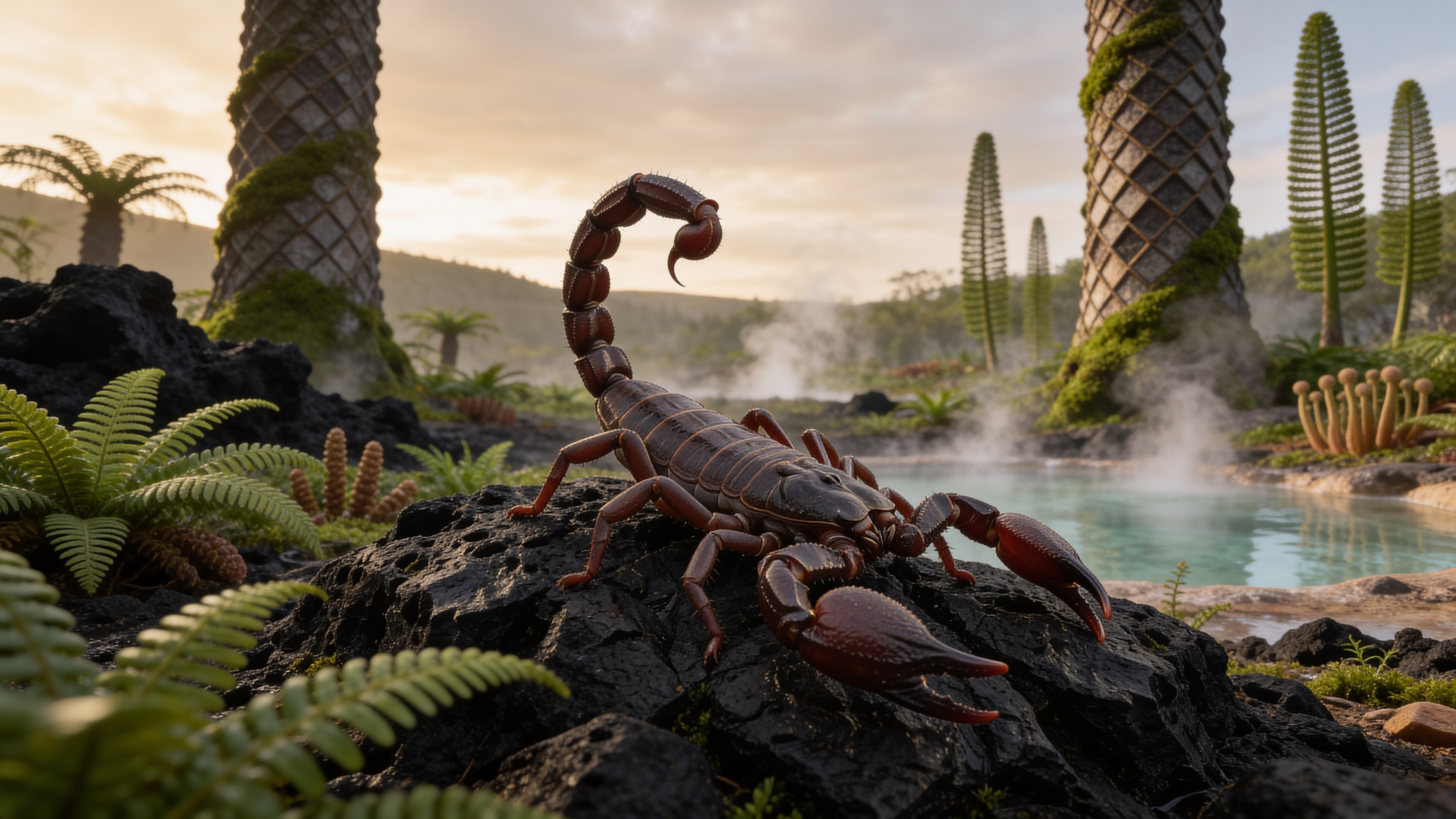
Pulmonoscorpius kirktonensis: in its world
In its world · 4K
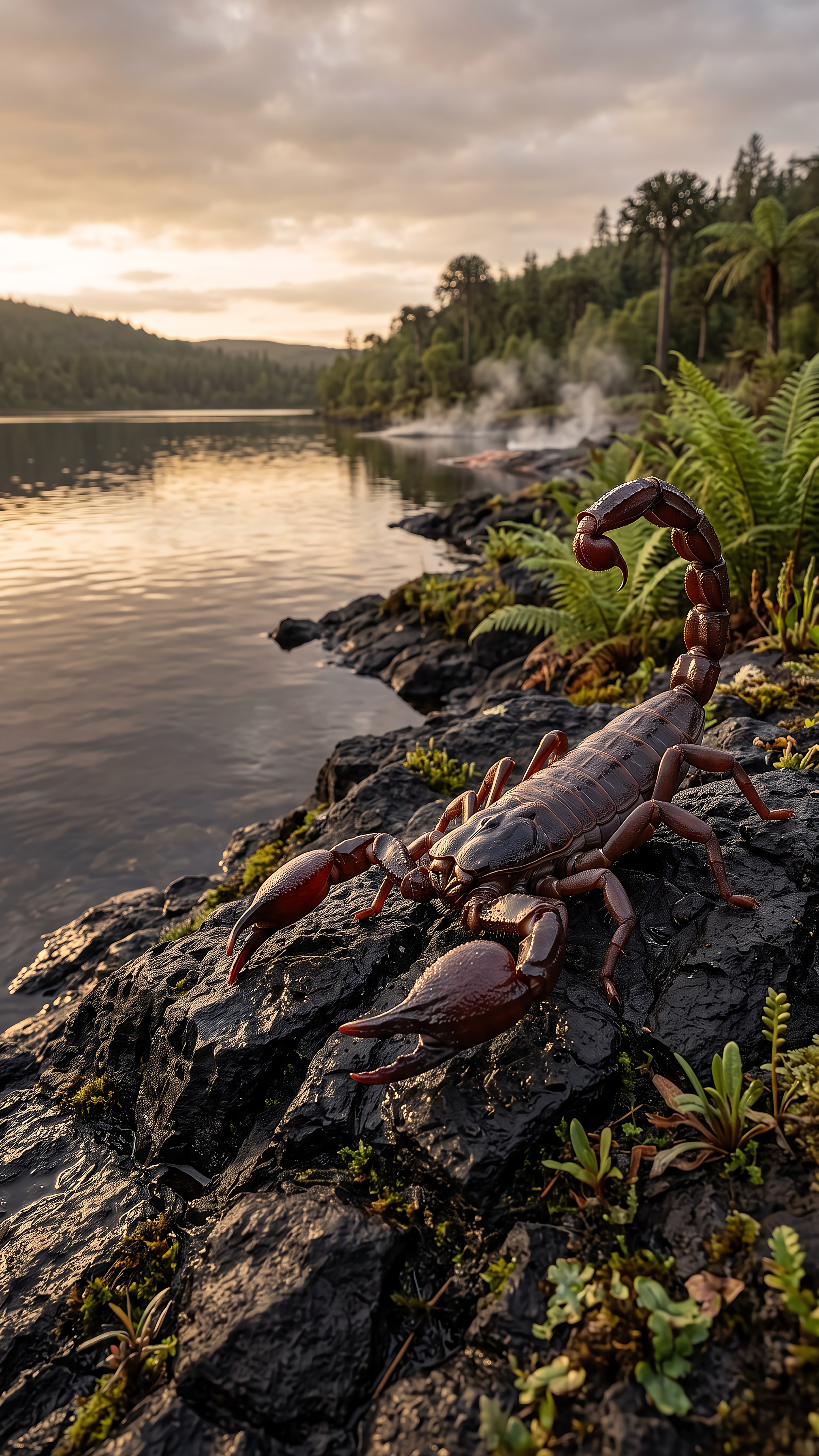
Pulmonoscorpius kirktonensis: close-up
Close-up · 4K

Free downloads

The 4K creature card for Pulmonoscorpius kirktonensis

Creature card

The full stat card as a 2160×3840 PNG. Free for wallpapers, classrooms and your own videos with a credit to The Ancient Cosmos.

Free 4K card · PNG · 6.6 MB

4K wallpaper

The picture without any text, 3840×2160 JPEG for desktops and TVs.

Download · 1.0 MB

Watch

Sources

Stats and facts on this page were checked against these sources (last checked 2026-09-18). Sizes are the best current estimates; where the science has moved, the newer figure is given.

  1. Scorpions from the Viséan of East Kirkton, West Lothian, Scotland, with a revision of the infraorder Mesoscorpionina · Earth and Environmental Science Transactions of the Royal Society of Edinburgh, 1993
  2. The East Kirkton Limestone, Viséan, of West Lothian, Scotland: introduction and stratigraphy · Earth and Environmental Science Transactions of the Royal Society of Edinburgh, 1993
  3. Palaeoecology of the Viséan of East Kirkton, West Lothian, Scotland · Earth and Environmental Science Transactions of the Royal Society of Edinburgh, 1993
  4. Eurypterids from the Viséan of East Kirkton, West Lothian, Scotland · Earth and Environmental Science Transactions of the Royal Society of Edinburgh, 1993
  5. A new Early Carboniferous tetrapod with a mélange of crown-group characters · Nature, 1998
  6. Homology of the lateral eyes of Scorpiones: a six-ocellus model · PLOS ONE, 2014
  7. New U-Pb constraints and geochemistry of the East Kirkton Quarry, Scotland: implications for early tetrapod evolution in the Carboniferous · PLOS ONE, 2025
  8. Giant claw reveals the largest ever arthropod (discussion of oxygen and arthropod gigantism) · Biology Letters, 2008
  9. Jeram, A. J. (1994). Scorpions from the Visean of East Kirkton, West Lothian, Scotland, with a revision of the infraorder Mesoscorpionina. Transactions of the Royal Society of Edinburgh: Earth Sciences 84.

← All creatures

Download