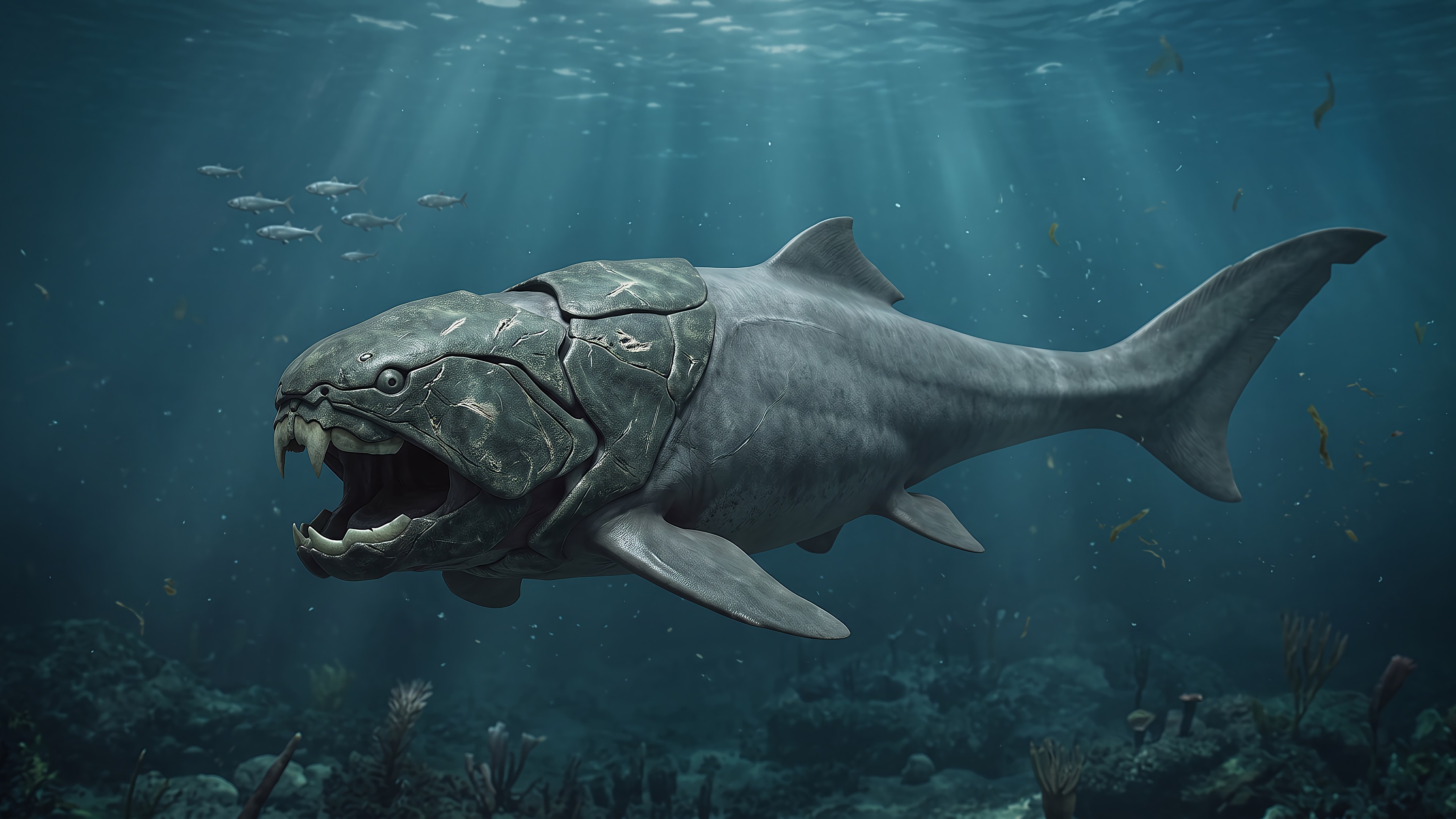
Discovery and name
The first fossils were found in 1867 by Jay Terrell, an amateur collector, in the shale cliffs along Lake Erie in Ohio. The geologist John Strong Newberry described the material in the 1870s and named this species Dinichthys terrelli in 1873, after its finder. In 1956 the French palaeontologist Jean-Pierre Lehman moved it into a new genus, Dunkleosteus, honouring David Dunkle of the Cleveland Museum of Natural History; the ending -osteus comes from the Greek word for bone.
Almost everything we know comes from the Cleveland Shale, a black rock exposed around Cleveland. Many specimens were dug up in the 1960s when Interstate 71 was built, and the Cleveland Museum of Natural History now holds the world's largest and best-preserved collection of Dunkleosteus fossils. In 2020 the Ohio General Assembly made Dunkleosteus terrelli the state's official fossil fish.
Body and anatomy
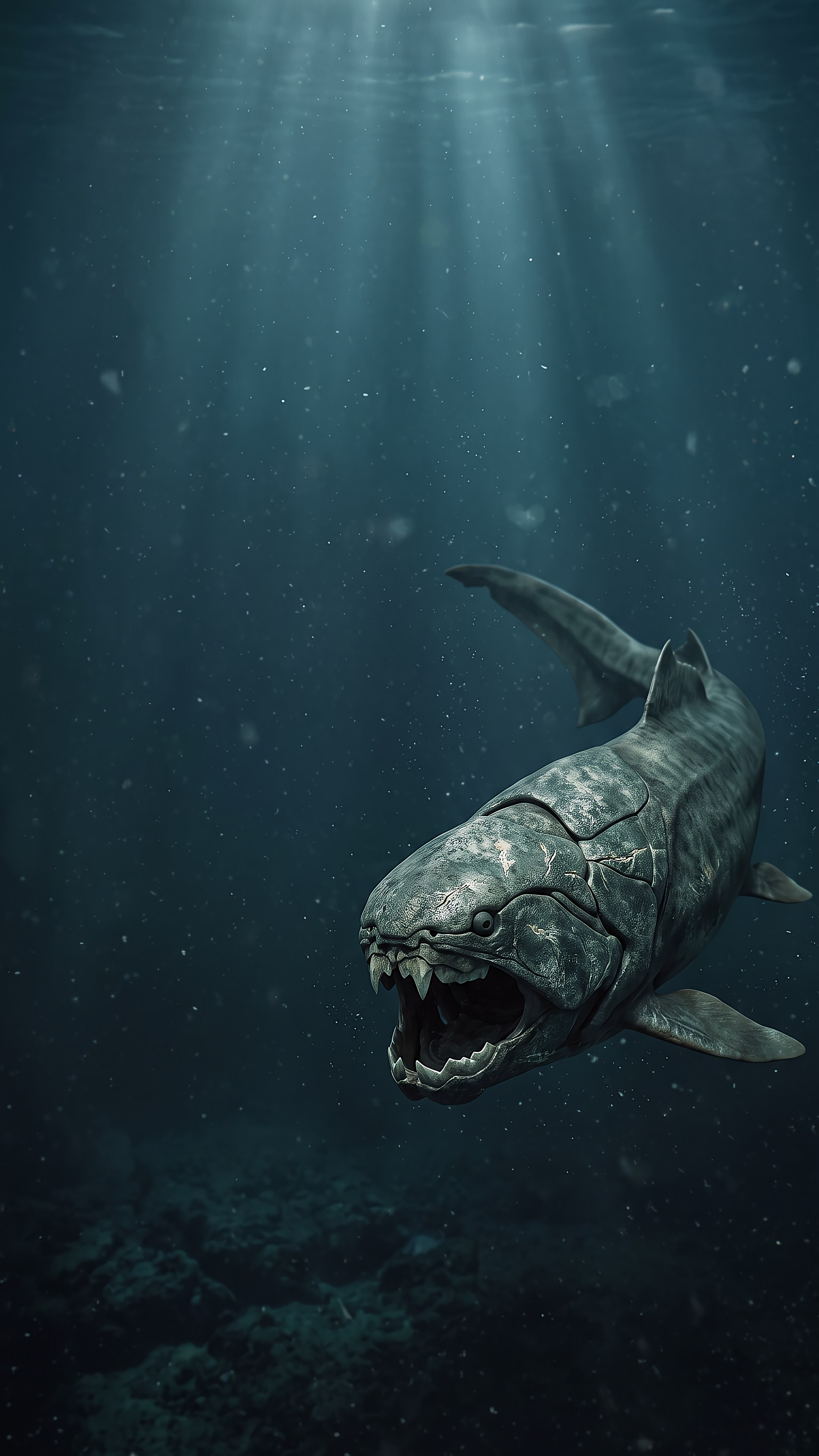
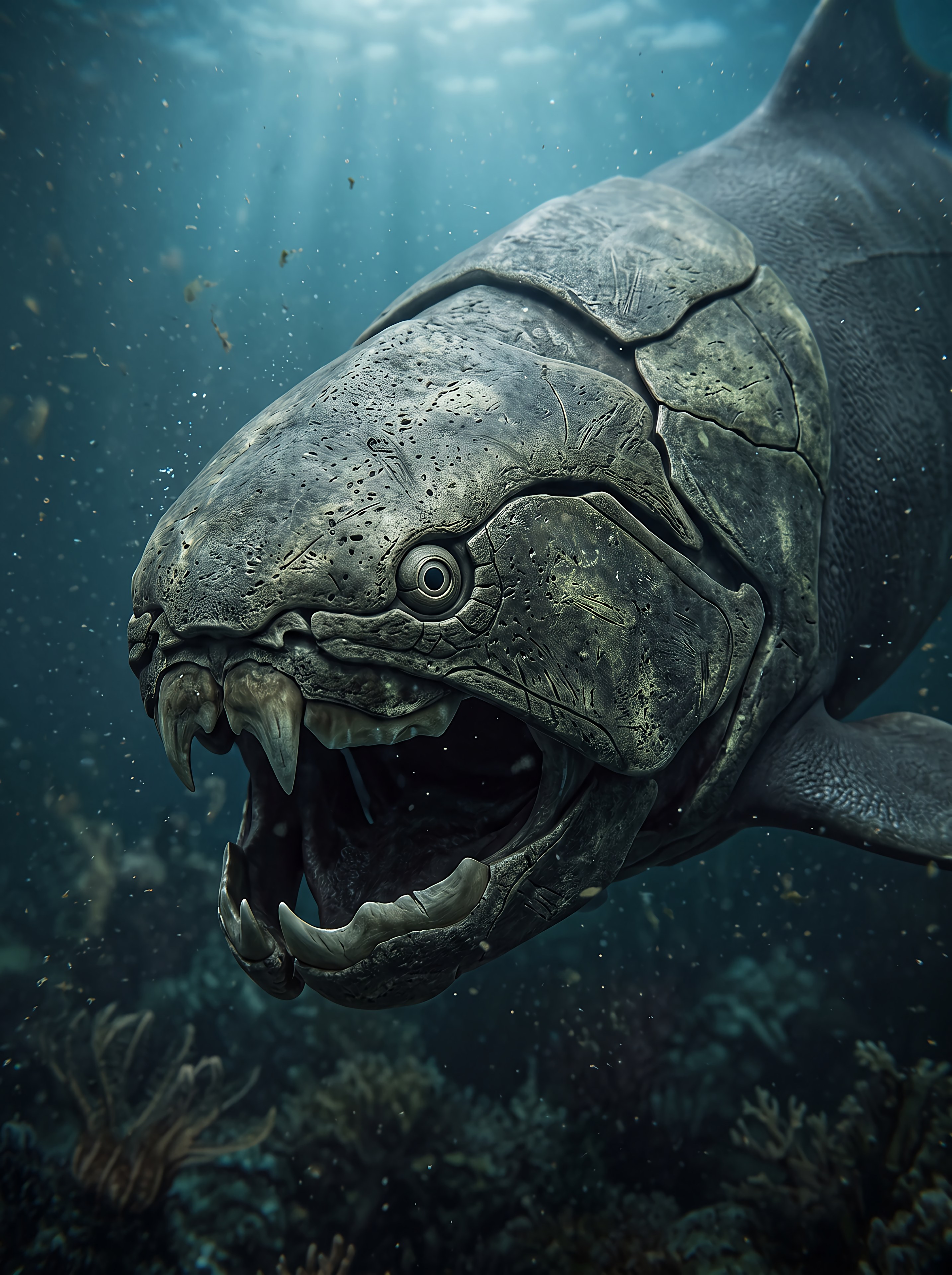
Dunkleosteus was an arthrodire, a placoderm whose head and shoulders were covered in thick bony plates. Behind this armour nearly the whole skeleton was cartilage, which rarely fossilises, so the fins, tail and body outline have to be reconstructed rather than seen directly. Its skull worked as a system of linked moving parts that let the head shield lift as the lower jaw dropped.
It had no true teeth. The upper jaw carried bony plates and the lower jaw a pair of long bony blades, with pointed fangs at the front and sharp shearing edges behind; as the plates slid past each other they wore to a keen edge, which is why they are often called self-sharpening. A 2025 study found that nearly half of the skull was cartilage, and that major jaw muscles attached to cartilage rather than to the skull roof as once thought.
A 2024 reconstruction by Russell Engelman gives it a short, deep, rounded trunk, closer in shape to a tuna or mako shark than to the long, slender body of older pictures. The pectoral fins sat very far forward and the pelvic fins were unusually small.
How it lived
Dunkleosteus is interpreted as a specialised predator of large animals that probably cut prey into pieces. In 2007 Philip Anderson and Mark Westneat modelled its jaws and calculated that it could go from closed jaws to full gape in about 20 milliseconds, with a whole bite cycle of 50-60 milliseconds. They suggested such fast opening might have drawn prey in by suction.
That picture is now being questioned. A 2025 study of the jaw anatomy argued that suction feeding is unlikely on both anatomical and ecological grounds, and that its blade-like jaws are more like those of fish that chase down prey and slice it. The same study concluded that earlier bite-force estimates need to be redone using the revised jaw muscles.
The fossils also show how it grew. Younger individuals had shallower bodies, about 20% as deep as they were long, while adults were roughly 28%, so the body became chunkier with age. Its stiff front half and large trunk muscles suggest it swam mainly by beating its tail, like a tuna, though this is inferred rather than observed.
Its world
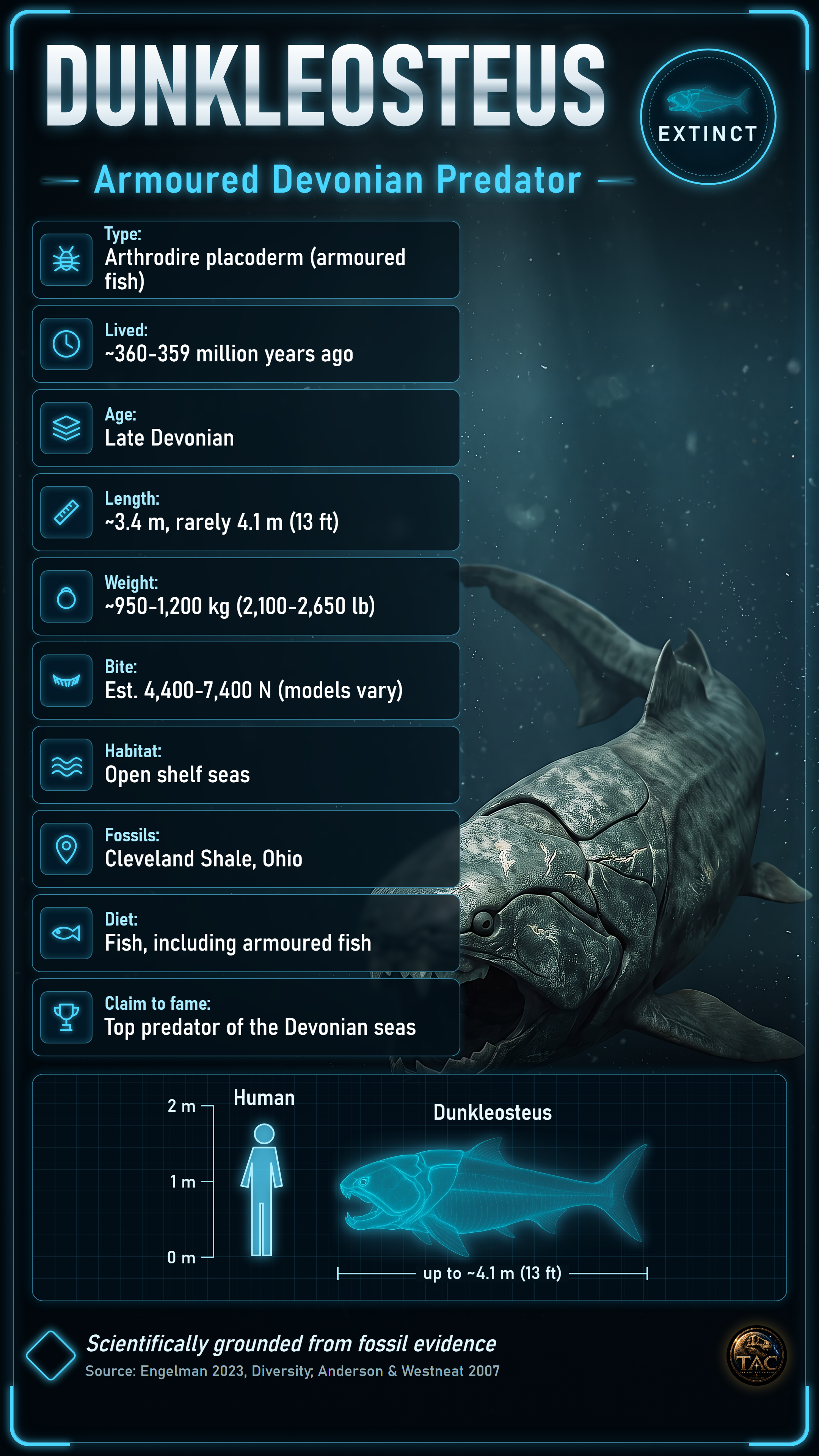
Dunkleosteus terrelli is best known from the Cleveland Shale, laid down in the late Famennian, the last stage of the Devonian, about 360 to 359 million years ago. Northern Ohio then lay in the tropics, roughly 23 degrees south of the equator, at the edge of the Appalachian Basin, an arm of a vast inland sea. The dark seafloor muds were rich in organic matter and low in oxygen, which helped preserve carcasses.
It shared these waters with other large armoured fishes such as Titanichthys, Bungartius and Heintzichthys, with the shark-like Cladoselache, and with a still-undescribed ctenacanth shark whose lower jaw cartilage is 68 cm long. That shark may have rivalled Dunkleosteus in size.
Soon after, the Hangenberg Event at the end of the Devonian brought major extinctions in the oceans. Placoderms, including Dunkleosteus, did not survive into the Carboniferous.
Size and records
Because usually only the head and shoulder armour is preserved, books gave lengths of 5-10 m that were not based on rigorous measurements. In 2023 Engelman used orbit-opercular length, the distance from the eye socket to the back of the gill cover, tested on 972 species of living and fossil fishes.
The result was much smaller than before: about 3.4 m (11 ft) for a typical adult, the specimen CMNH 5768, and about 4.1 m (13.5 ft) for the largest known individual, CMNH 5936. A typical adult was therefore roughly as long as two adults lying head to toe. Because its body was so deep, it was still heavy: an estimated 950-1,200 kg (2,100-2,650 lb) for a typical adult and 1,494-1,764 kg (3,300-3,900 lb) for the largest.
Its bite is often called the strongest of any fish. The 2007 model gave over 4,400 newtons at the jaw tip and over 5,300 newtons at the rear blades for a fish assumed to be 6 m long, and a 2009 follow-up gave over 6,000 and 7,400 newtons for a 10 m fish. Both lengths are now thought far too large, so these numbers are outdated.
Relatives and legacy
Placoderms were a diverse group of armoured jawed fishes that lived through much of the Silurian and Devonian, and arthrodires were the most varied of them. They sit near the base of the family tree of jawed vertebrates, the group that includes sharks, bony fishes and ourselves, but they left no living descendants.
Many other Dunkleosteus species have been named from North America, Europe and North Africa, but most are based on single plates or fragments. A 2023 review found that only D. terrelli and D. raveri of Ohio are taxonomically stable, while naming a new species, D. tuderensis, from Russia. The Moroccan D. marsaisi may even be a North African population of D. terrelli, the Belgian D. belgicus may not be a valid name, and material from Poland has only been identified as Dunkleosteus sp.
Myths and misconceptions
Myth: Dunkleosteus was 6-10 m long, bigger than any shark. The evidence points to about 3.4 m for adults and about 4.1 m for the largest known fish, and even the biggest Dunkleosteus was smaller than the largest great white sharks in both length and mass. Even Newberry, who named it, suggested only 4.5-5.5 m.
Myth: it looked like a shark with an armoured head. Its body was probably much shorter and deeper than a shark's. Myth: its record-breaking bite and suction feeding are settled facts. Both come from computer models of a fish assumed to be far larger than it was, and a 2025 study argues that suction feeding is unlikely and that the bite needs to be recalculated.