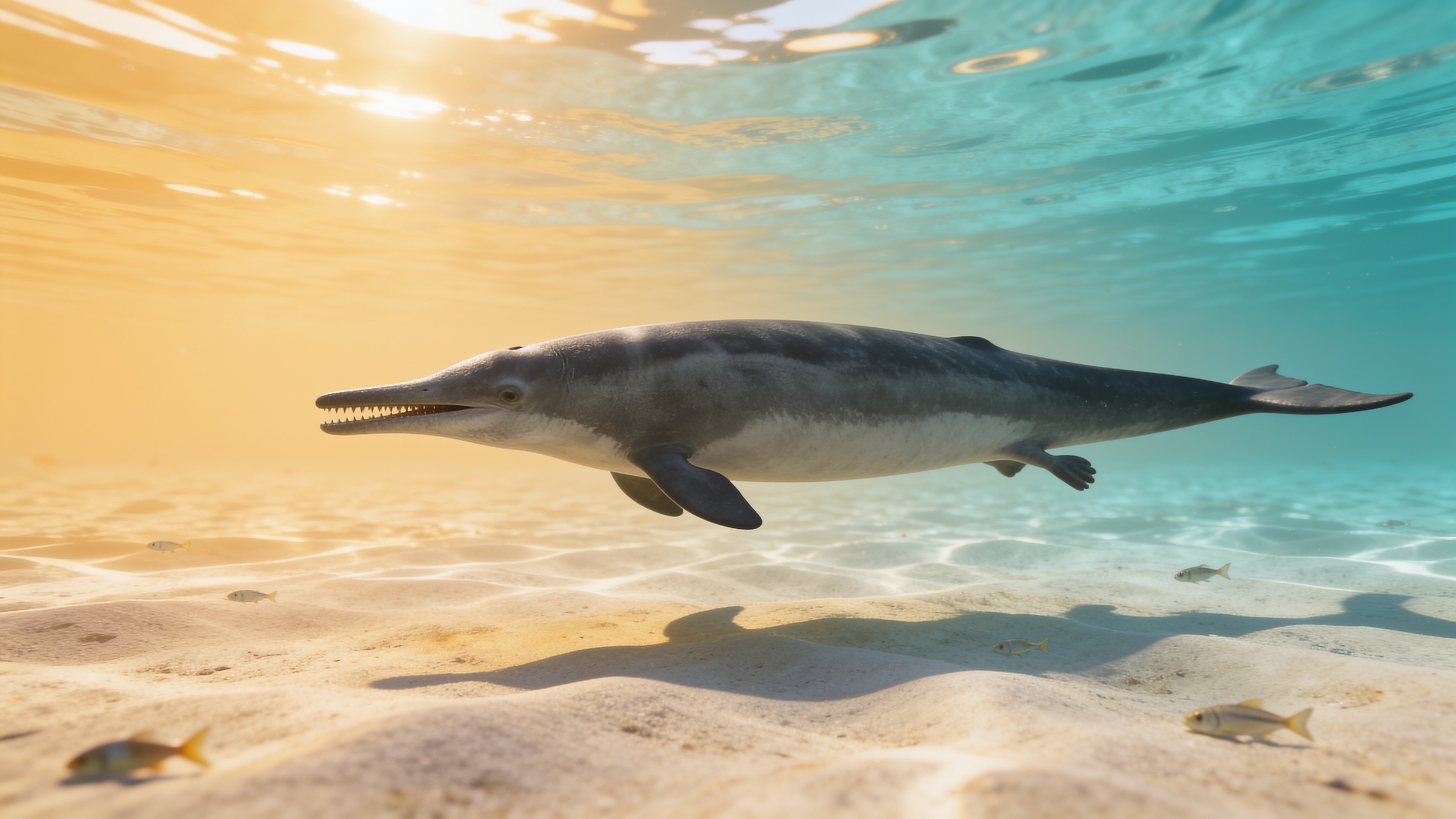
Discovery and name
The genus name Dorudon, from Greek words usually translated as 'spear tooth', was coined in 1845 by Robert Gibbes for a different species, Dorudon serratus, known from a fragment of upper jaw and a few teeth found in South Carolina. Dorudon atrox itself comes from Egypt: it was first described in 1906 by Charles Andrews as Prozeuglodon atrox, from skull material in the Geological Museum in Cairo. 'Atrox' is Latin for fierce. The species was later moved into Dorudon, the older name, which has priority.
For decades some researchers thought these Egyptian fossils were simply young Basilosaurus. That changed in the 1980s, when University of Michigan and Cairo Geological Museum expeditions led by Philip Gingerich began collecting in Wadi Al-Hitan and found Dorudon in abundance, including the first complete skeletons known for any archaeocete whale. Mark Uhen described the species in detail in a 222-page monograph in 2004.
Body and anatomy
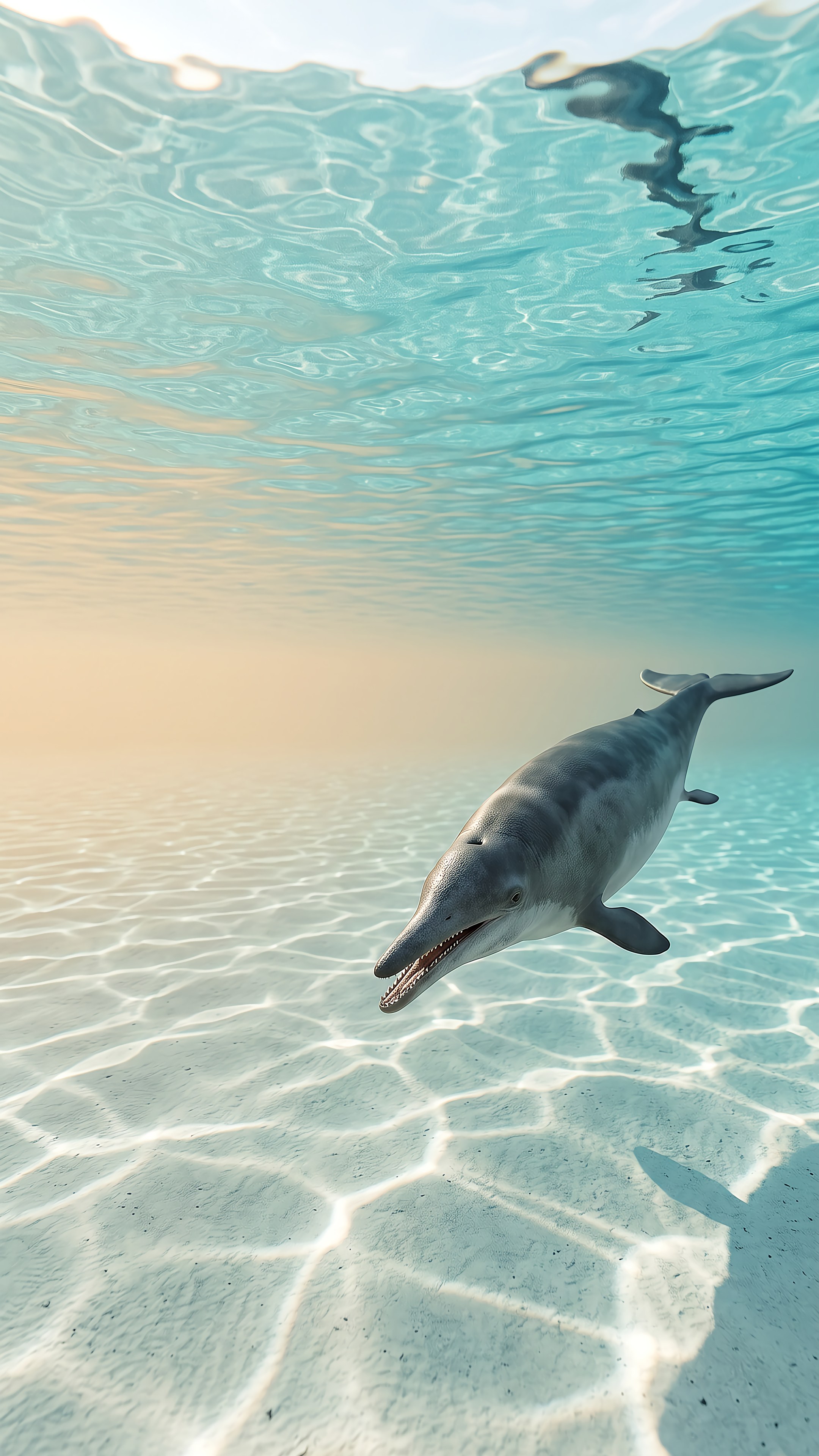
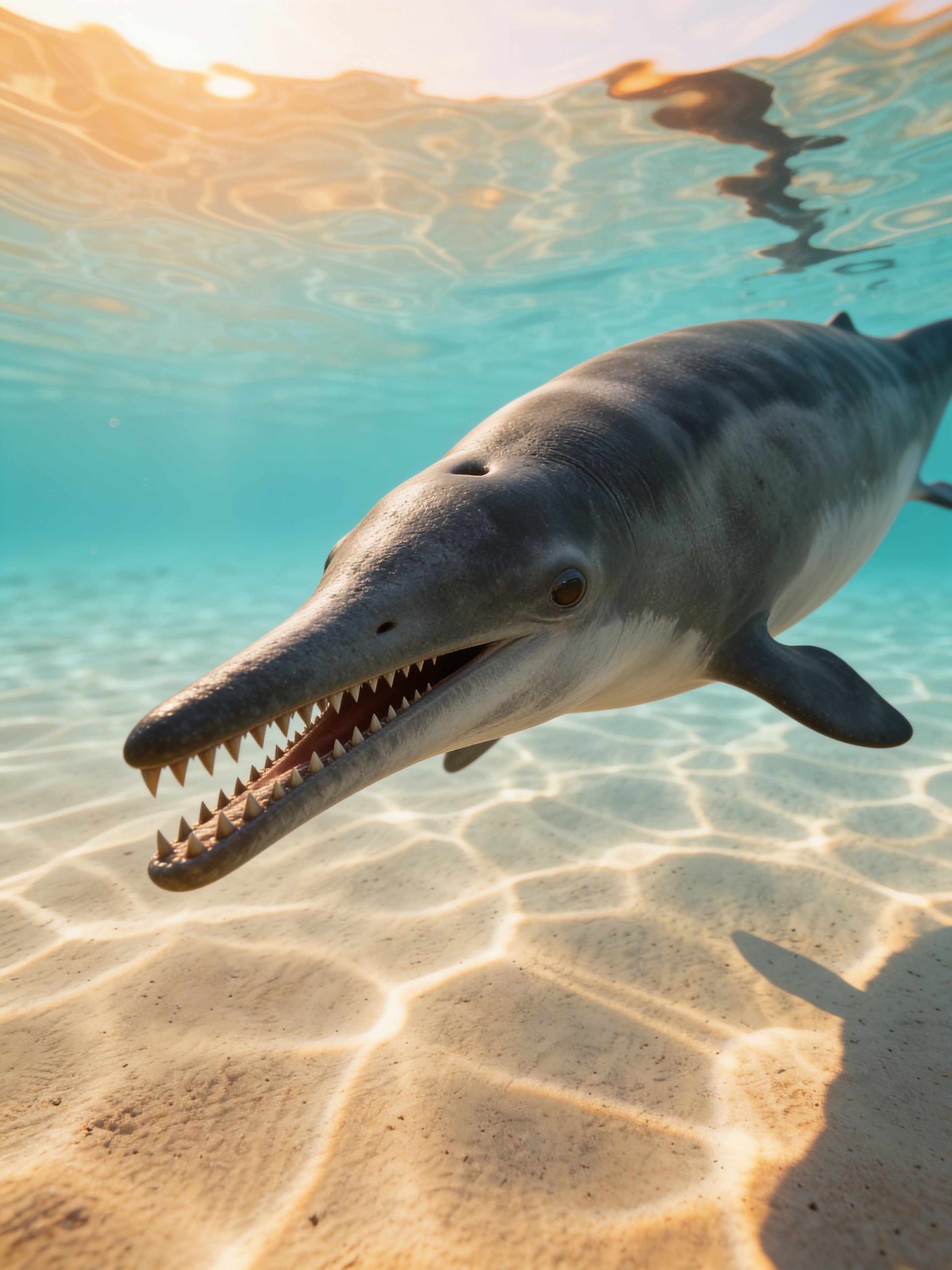
Dorudon had a long, low skull with a long snout. Its front teeth were simple cones that interlocked when the jaws closed, good for seizing slippery prey, while its cheek teeth had several cusps and more than one root, unlike the uniform peg teeth of modern dolphins. The nostrils had moved back to a point above the first premolars, part-way towards a blowhole, and the modest braincase carried a crest for strong jaw muscles.
The skeleton has seven neck vertebrae, 17 in the chest, a long run of 20 in the lower back and 21 in the tail. The forelimbs were flattened flippers, and the hip bones were no longer attached to the spine. Tiny, movable hind legs still stuck out from the body wall, but they could not have supported the animal on land. The shapes of the tail vertebrae suggest a fluke, although the fluke itself, like the blubber and skin, was soft tissue and is reconstructed rather than preserved.
How it lived
Dorudon swam by beating its tail up and down, as modern whales do, rather than by the eel-like bending inferred for Basilosaurus. Its teeth and jaws suit a hunter of fish, and the bones of two fish found inside the ribcage of one Dorudon skeleton confirm that it ate them. Its ears and lower jaw were built for hearing well under water: dense ear bones isolated from the skull, a lopsided snout and thin lower jaws that probably held fat pads to carry sound. These show good directional hearing, but there is no evidence that Dorudon echolocated as modern toothed whales do.
Because its hips were free of the spine, a mother could have a wide birth canal, and palaeontologists infer that newborns were large and able to swim straight away. Wadi Al-Hitan holds both adult and young Dorudon but only adult Basilosaurus isis, which led to the idea that the area was a calving ground where Basilosaurus came to hunt. Bite marks on the skulls of very young Dorudon match the teeth of B. isis, and the stomach region of a 15 m (49 ft) B. isis skeleton held the remains of young Dorudon, so at least some calves were killed or scavenged by their giant relative.
Its world
Today Wadi Al-Hitan is part of the Sahara, but in the late Eocene it lay under a warm, shallow sea at the edge of the Tethys, with lagoons and open coastal water. Dorudon fossils come from the Gehannam, Birket Qarun and Qasr el-Sagha formations, made of mudstones, clays and sands laid down in that sea. Recent studies date the main whale-bearing beds to about 38-36.5 million years ago.
Dorudon shared these waters with the much larger Basilosaurus isis, sea cows, reptiles, sharks and bony fish; the stomach of one B. isis also contained a large crushing-toothed fish and a tooth from a shark about 5 m (16 ft) long. The site's hundreds of fossil whales earned it a place on the UNESCO World Heritage List in 2005.
Size and records
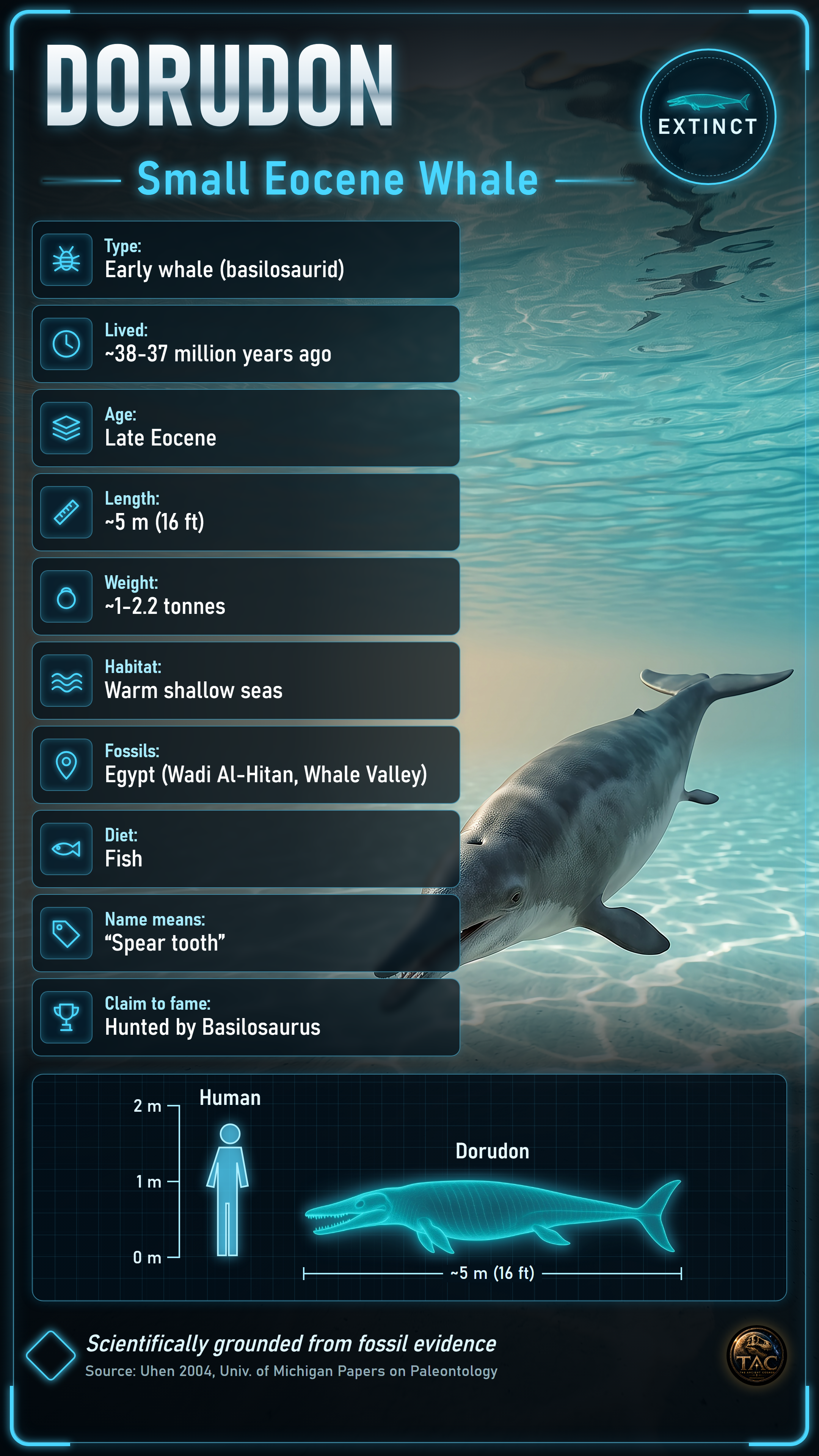
An adult Dorudon atrox was about 5 m (16 ft) long, nearly three adult humans lying head to toe and about the size of a modern beluga. Its skull alone was roughly 85 cm (2.8 ft) long. The calves found with bite marks were much smaller, about 1.5-2 m (5-6.5 ft).
Weight estimates depend on the method. Uhen scaled up from body length using modern whales and got about 2,240 kg (2.5 US tons); Gingerich, working from the size of the vertebrae, favoured about 1,130 kg (1.2 US tons). That is why Dorudon is often listed at 1-2.2 tonnes. Its brain weighed an estimated 944 g (2 lb), small for its body size compared with living mammals.
Relatives and legacy
Dorudon belongs to the Basilosauridae, the first fully aquatic whales, alongside Basilosaurus and smaller American relatives such as Zygorhiza. Its compact skeleton, fluke-driven swimming and fully marine life are much closer to living whales than Basilosaurus, and it may be close to the ancestry of today's baleen whales and toothed whales, the two groups alive today.
Because so many skeletons exist, including young animals, Dorudon is one of the best-studied early whales, a key example of how early whales were built, how they heard and how they grew. It shows the stage when whales had left land completely but still carried the last traces of their hind legs.
Myths and misconceptions
Dorudon is not a young Basilosaurus, an idea some earlier researchers held; it is a separate, smaller species with its own adults and young. It also did not come ashore: its hind legs were far too small to walk on and it almost certainly never left the water.
It is often said that Dorudon had no melon and so hunted only by sight. Modern whales use the fatty melon in the forehead to focus sound for echolocation, and there is no evidence Dorudon could echolocate, but its ears were well adapted to underwater hearing, so sound mattered as well as sight. Finally, the 1845 South Carolina jaw that gave Dorudon its name belongs to Dorudon serratus, not to the Egyptian Dorudon atrox.