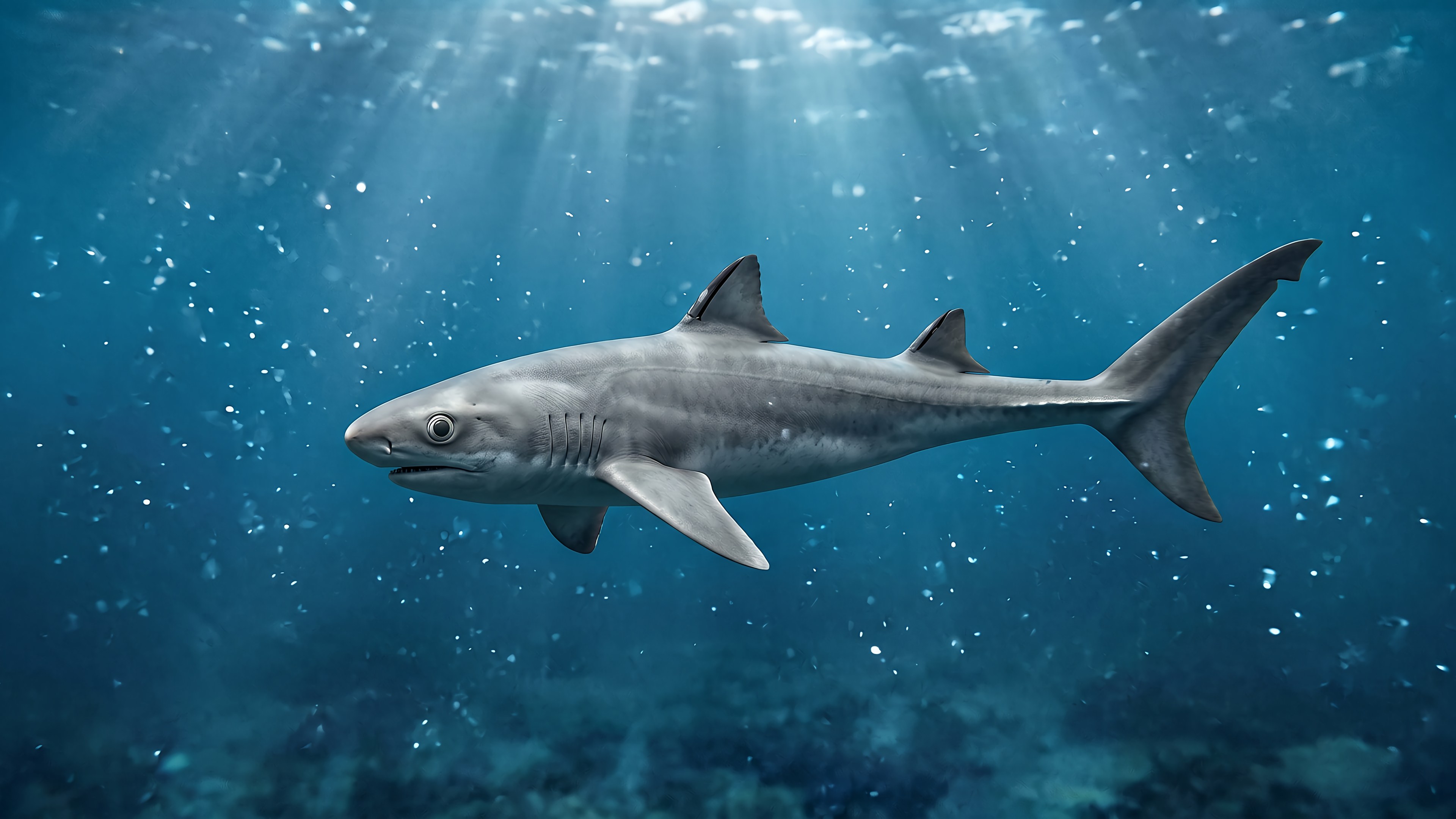
Discovery and name
Cladoselache fossils come from the Cleveland Shale around Cleveland, Ohio, and are almost always found inside elongated, rounded nodules of iron carbonate, called concretions, within the black shale. Collectors were gathering them in the 19th century; one specimen, collected by William Kepler between 1880 and 1886, was recently rediscovered in the old geological collection of Ohio Wesleyan University.
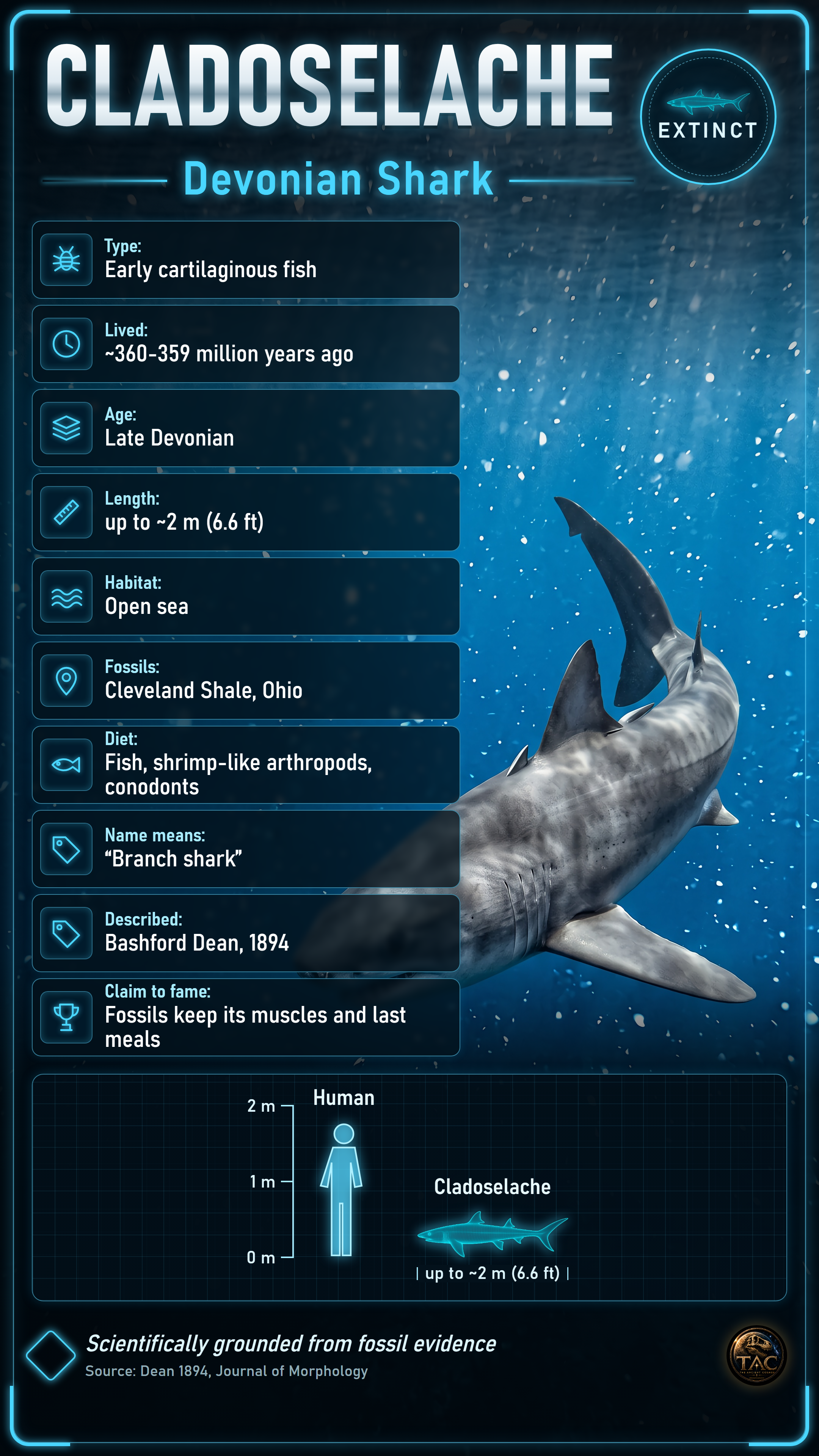
The American fish specialist Bashford Dean named the genus in 1894 in the Journal of Morphology. The name combines the Greek klados, 'branch', with selache, a word for sharks and their relatives, and is usually translated 'branch shark'. Dean's paper title linked it to Cladodus, a name already given to similar many-pointed teeth found on their own. Dean described it again in more detail in 1909, and many shorter studies followed, but the flattened Ohio specimens have never been given one complete modern description, and several of the species named over the years are doubtful.
Body and anatomy
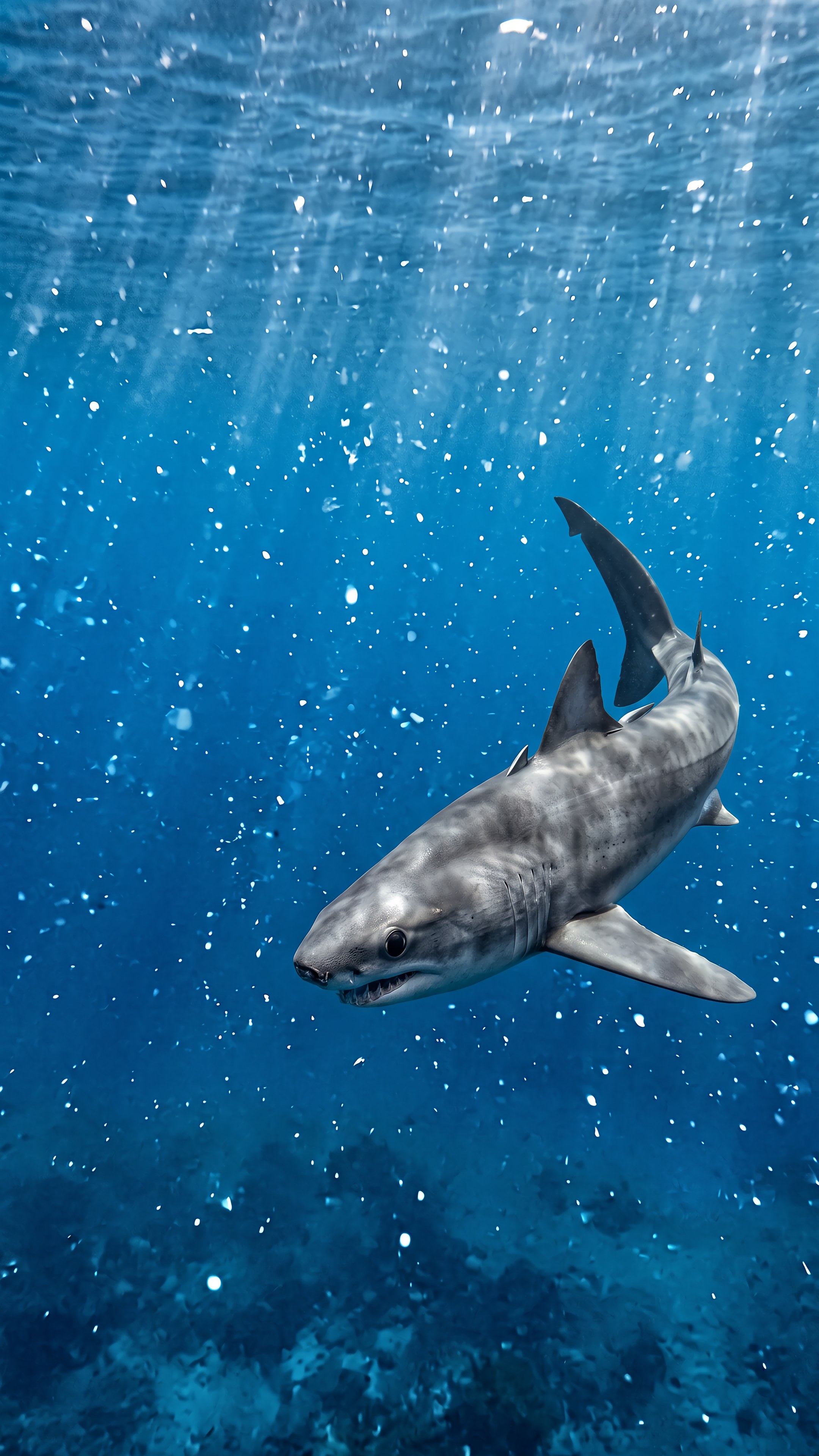
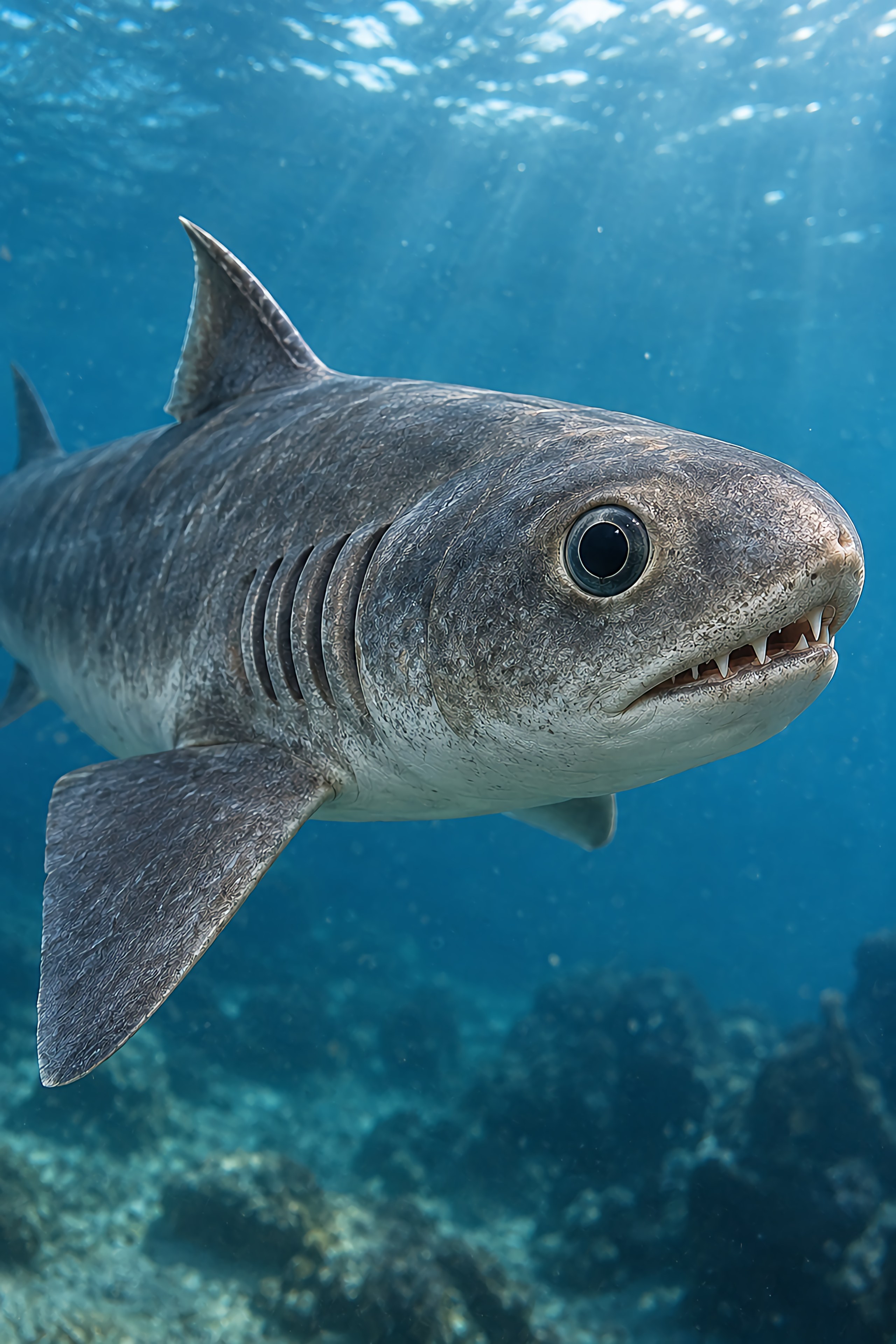
Cladoselache had a streamlined body resembling a mackerel shark, large, well-developed pectoral fins and a short spine in front of the dorsal fin. Its skeleton was cartilage, like a modern shark's, and it had supports for gill slits and dermal denticles in the skin. Older descriptions report that these denticles were sparse, concentrated on the fin edges and around the eyes and mouth rather than covering the whole body.
In other ways it was unlike a modern shark. Its mouth opened at the front of the head instead of underneath, its jaws were not loosely slung below the skull, and its teeth lacked the hard enameloid coating of true sharks. Each tooth had a tall central point flanked by smaller side points, a 'cladodont' pattern, and teeth were replaced during life, but slowly.
Because the concretions formed so quickly, some fossils preserve cartilage and even muscle. One puzzle stands out: claspers, the organs that male sharks and chimaeras use to mate, have never been found in any Cladoselache.
How it lived
Its streamlined shape suggests an active swimmer in open water, and its gut contents support that. In a 1990 study of feeding in Cleveland Shale fishes, palaeontologist Mike Williams reported last meals in dozens of Cladoselache specimens, mostly small ray-finned fishes, along with shrimp-like arthropods and conodonts, small eel-like animals with comb-like teeth. Conodont elements were found inside about 9% of the specimens.
Williams also reported that some of the small fishes lie with their heads pointing forward in the gut, meaning they were swallowed tail-first. This is usually read as evidence that Cladoselache chased prey from behind and swallowed it whole, which fits its grasping, many-pointed teeth. A close relative from Morocco, Maghriboselache, has also been found with a small ray-finned fish, about 40 mm long, in its stomach.
How it reproduced is unknown. Since no claspers have been found, one idea is that most complete fossils are females, perhaps because females gathered in shallow, sheltered waters to give birth and were caught by storms there. This is a hypothesis, not something the fossils show directly.
Its world
The Cleveland Shale dates to the late Famennian, the last stage of the Devonian, about 360 to 359 million years ago. Northern Ohio then lay in the tropics, about 23 degrees south of the equator, near the edge of the Appalachian Basin, part of a vast inland sea. The seafloor mud was dark, rich in organic matter and low in oxygen. When a fish died, microbes quickly formed a film around it and began depositing minerals, so concretions started to grow within days and locked in soft parts before they could rot.
Cladoselache shared this sea with large armoured placoderms such as Dunkleosteus terrelli and Titanichthys, with other cartilaginous fishes, and with small ray-finned fishes and arthropods that it ate. Its fossils are concentrated in a small area, Cuyahoga County, even though similar concretions without them are found over a much wider region. Shortly afterwards the end-Devonian Hangenberg Event struck the oceans, and many early cartilaginous fish lineages, Cladoselache among them, are not found in the Carboniferous.
Size and records
Complete fossils vary a lot in size. The rediscovered Ohio Wesleyan specimen is 50 cm (20 in) long, many others are around a metre, and the largest reported individuals are usually put at about 1.8-2 m (6-6.5 ft), a little longer than a tall adult is tall. Because the concretions preserve whole bodies, these lengths are measured from real skeletons rather than scaled up from teeth.
Cladoselache is one of the most completely known Palaeozoic cartilaginous fishes. Few fossils from this time preserve an outline of the whole body, fins, muscles and stomach contents, which is why it has appeared in textbooks for more than a century.
Relatives and legacy
Living cartilaginous fishes form two branches: elasmobranchs (sharks and rays) and holocephalans (chimaeras, or ratfishes). For more than a century Cladoselache was treated as an early shark. Today it is most often grouped with the symmoriiforms, an extinct group of Palaeozoic shark-like fishes, many with strange fin spines.
In 2017 Michael Coates and colleagues described a symmoriiform braincase from South Africa and found that symmoriiforms belong on the chimaera branch, not the shark branch. In 2023 Christian Klug and colleagues described Maghriboselache from Morocco, a close relative of Cladoselache; their analysis placed the family Cladoselachidae next to the symmoriiforms, with both groups as early relatives of chimaeras. Other analyses, however, place symmoriiforms at the base of all cartilaginous fishes or on the shark branch, so the question is not fully settled.
If the current majority view is right, Cladoselache is not an ancestor of modern sharks but an early cousin of chimaeras that happened to look like a shark. Rather than showing what the first jawed fishes looked like, as older books suggested, it probably shows conditions near the base of the chimaera lineage.
Myths and misconceptions
Myth: Cladoselache was the ancestor of modern sharks. Most recent studies place it closer to chimaeras than to true sharks, and even researchers who disagree do not treat it as a direct ancestor of living sharks. Its shark-like shape was probably an adaptation to fast swimming that evolved more than once.
Myth: fossils like these take millions of years to form. The concretions around Cladoselache began forming within days of death, which is why cartilage and muscle survived. Myth: it looked just like a modern shark. Its mouth was at the front of its head, its jaws were fixed differently and its teeth lacked enameloid.