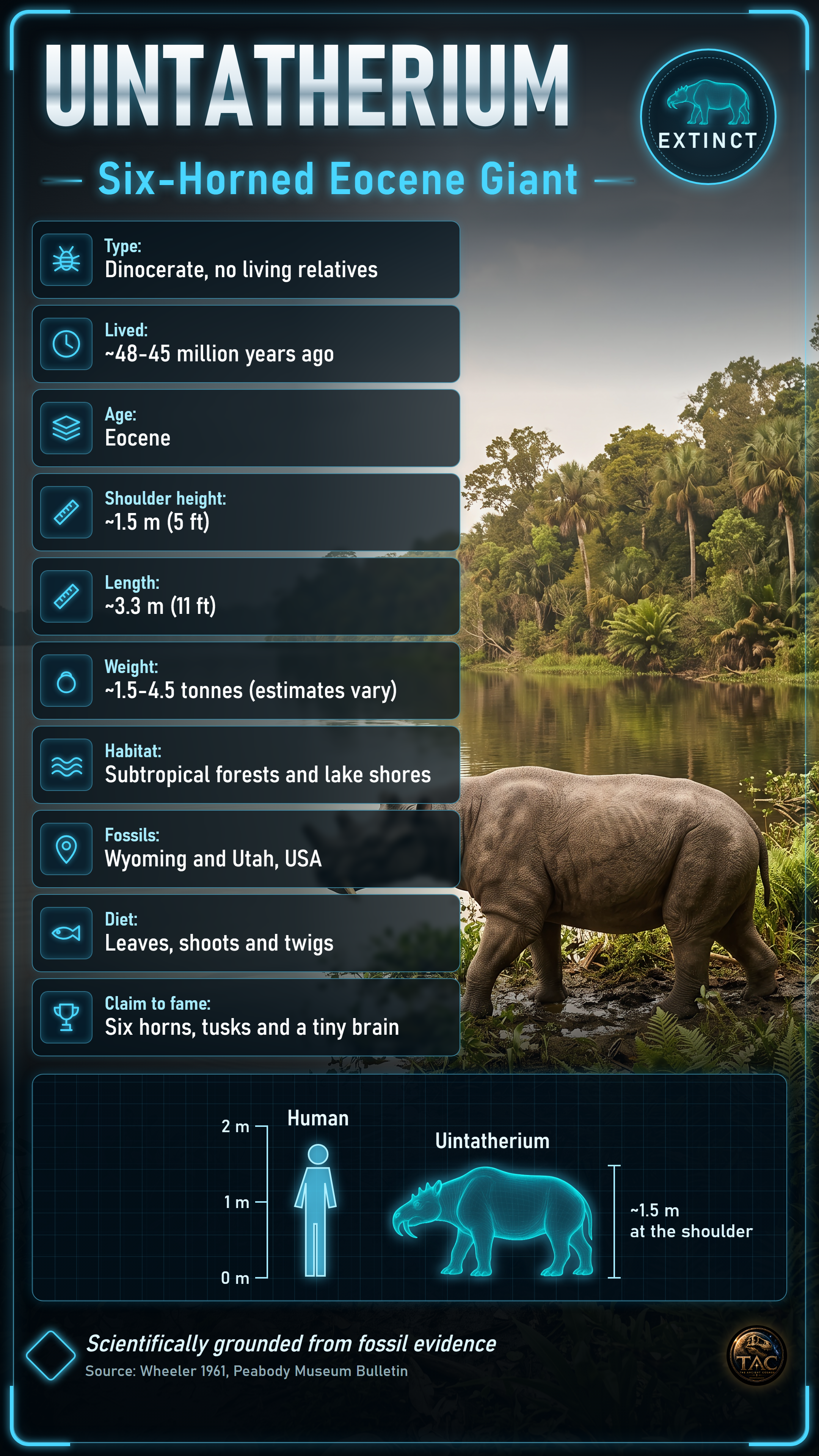
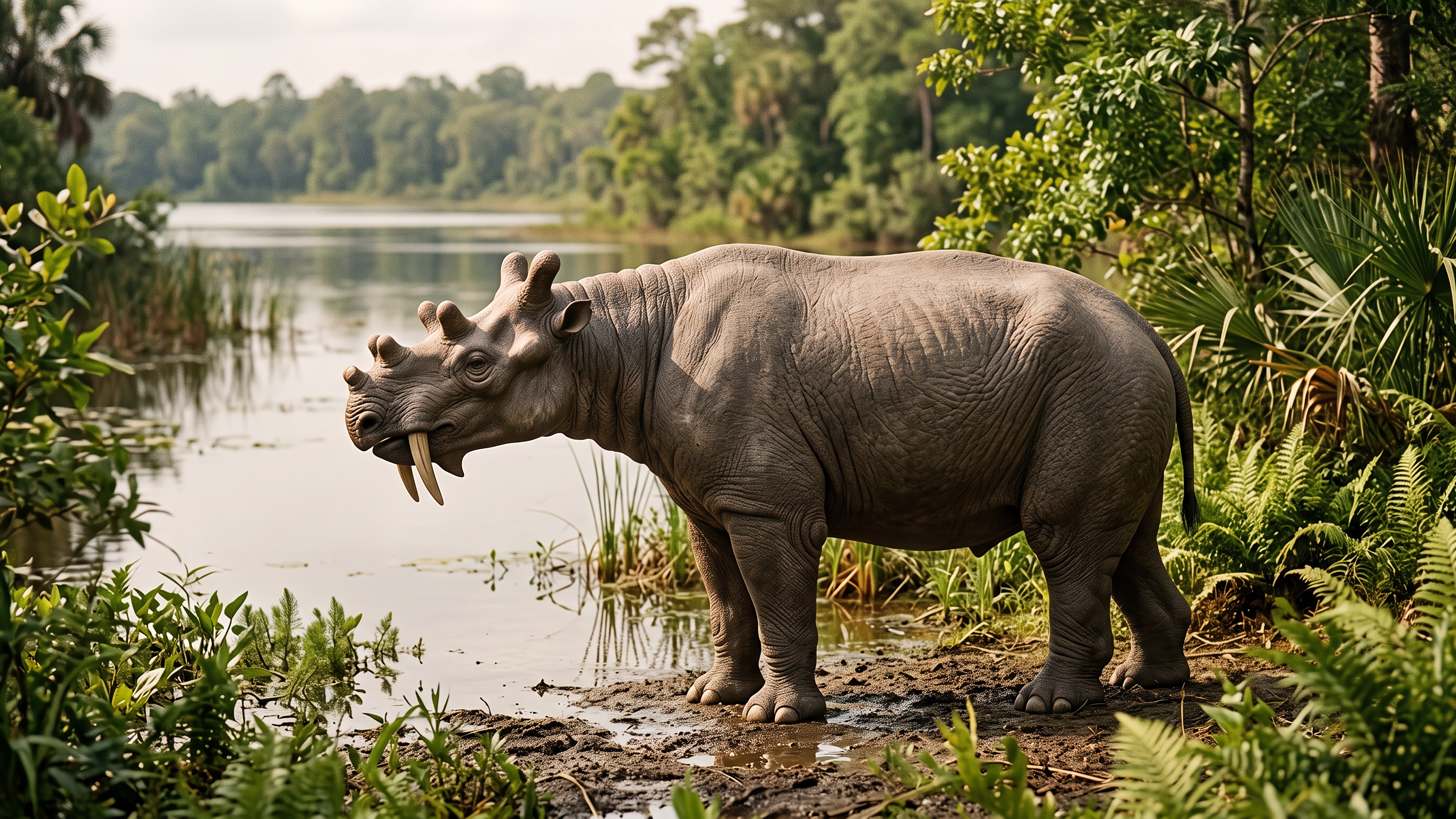
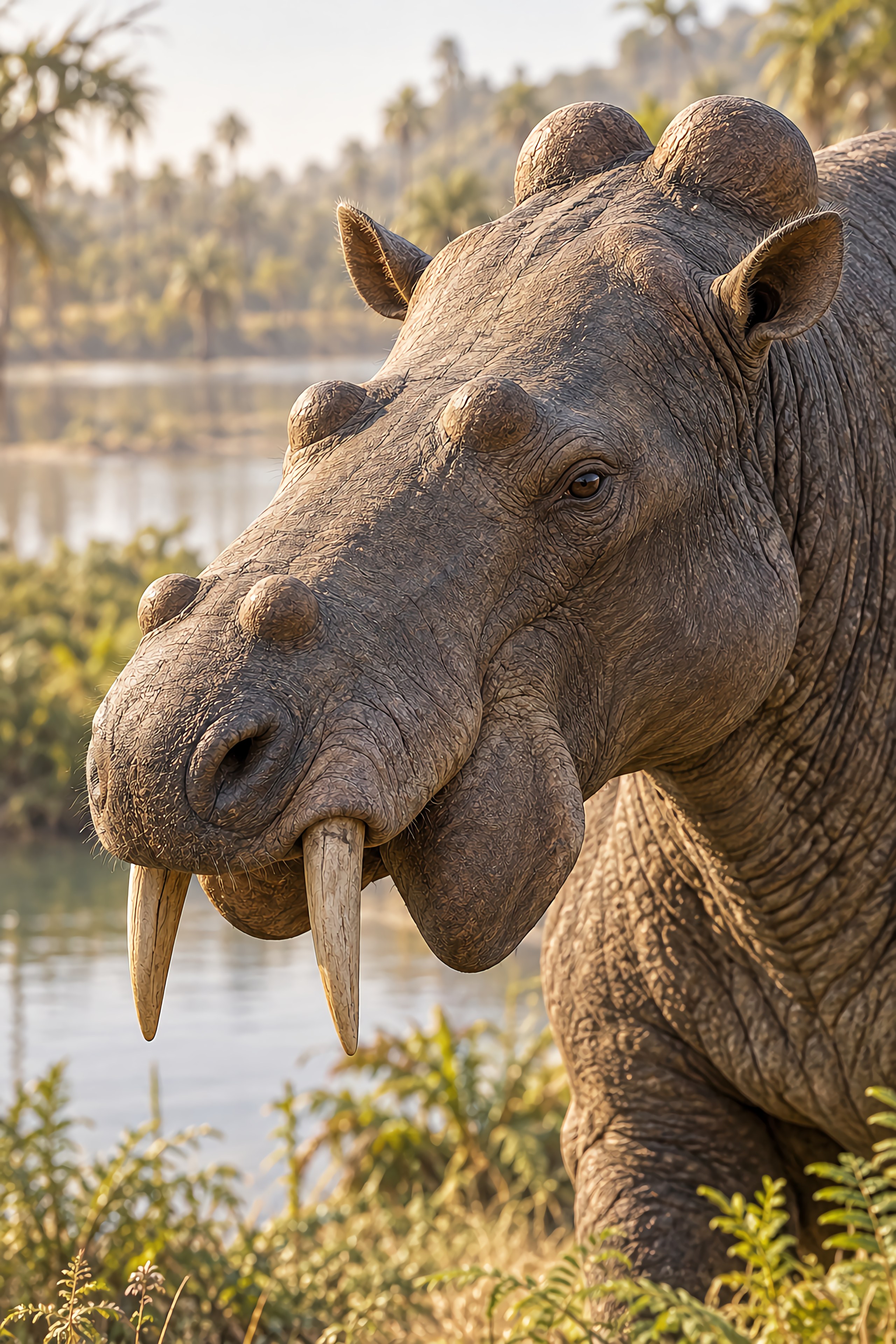
Reconstruction of Uintatherium anceps, the six-horned eocene giant
A reconstruction from the fossil evidence, not a photograph. Click or tap it to see it full screen.
Paleogene · Middle Eocene · 48–45 million years ago

Uintatherium anceps

Six-Horned Eocene Giant

Say it yoo-IN-tuh-THEER-ee-um AN-seps

EXTINCTPaleogene48–45 MaMammals1.5 m tall

Uintatherium anceps was a rhinoceros-sized plant-eating mammal that lived in what is now Wyoming and Utah during the middle Eocene, roughly 48 to 45 million years ago. It carried three pairs of bony knobs on its skull and, in males, long blade-like upper tusks. It is the best-known member of the Dinocerata, an extinct group of large mammals whose place in the mammal family tree is still debated, and its fossils were a prize in the 19th-century 'Bone Wars'.

At a glance

Uintatherium anceps key stats
TypeDinocerate, no living relatives
Lived~48-45 million years ago
AgeEocene
Shoulder height~1.5 m (5 ft)
Length~3.3 m (11 ft)
Weight~1.5-4.5 tonnes (estimates vary)
HabitatSubtropical forests and lake shores
FossilsWyoming and Utah, USA
DietLeaves, shoots and twigs
Claim to fameSix horns, tusks and a tiny brain
0 m1 m2 mHumanUintatherium · 1.5 m tall
Size against a 1.8 m human (shoulder height)

Quick facts

  • Its skull carried three pairs of bony knobs and, in males, huge upper canine tusks braced by flanges on the lower jaw.
  • Its brain is reported at about 290 grams, tiny for an animal the size of a rhinoceros.
  • Othniel Marsh named the species in 1871 and Joseph Leidy named the genus in 1872. It became a prize of the Bone Wars, with Cope adding names of his own.
  • It belongs to the Dinocerata, an order with no living relatives at all.

Discovery and name

The first fossils came from the Bridger Basin near Fort Bridger in south-west Wyoming. In 1871 Othniel Charles Marsh of Yale described the species from fragmentary remains, tentatively placing it in the genus Titanotherium as 'Titanotherium? anceps'. On 1 August 1872 Joseph Leidy of Philadelphia named the new genus Uintatherium, 'beast of the Uinta', after the Uinta Mountains, with the species U. robustum.

Within months Edward Drinker Cope and Marsh were naming more genera for similar animals: Cope's Loxolophodon and Eobasileus, and Marsh's Dinoceras and Tinoceras. Cope even sent some names by telegraph, and they arrived garbled. Several of these names later proved to be duplicates, although a few, such as Eobasileus, are still used for separate animals.

Walter Wheeler's 1961 revision of the uintatheres sorted out the valid genera and species. Today the animal is written Uintatherium anceps (Marsh, 1871): Leidy's genus name combined with Marsh's older species name, with U. robustum treated as a later synonym.

Body and anatomy

The skull is its most striking feature. Marsh described three separate pairs of bony knobs: the smallest on the nasal bones near the tip of the snout, a larger pair on the upper jaw bones above the tusks, and the largest at the back of the skull. What covered these knobs in life is not preserved.

Males had long, curved, blade-like upper canine tusks, and each side of the lower jaw carried a downward flange of bone that Marsh thought protected them. In females both the tusks and the flanges were much smaller. The skull walls were thick, leaving a small space for the brain; Marsh noted that the brain was small for the animal's size.

Behind the head was a heavy body on stout, pillar-like limbs. For such a large animal its cheek teeth were small and fairly simple, which has made its exact diet and digestion hard to interpret.

How it lived

Uintatherium was a plant-eater. Its low, ridged cheek teeth suggest it ate relatively soft vegetation such as leaves, shoots and water plants rather than tough grasses, which were not yet widespread. The traditional picture is of a forest browser, filling the role of a rhinoceros. William Turnbull, who studied uintathere fossils from the Washakie Basin, argued instead that their broad hips and large gut suggest a partly amphibious, hippo-like life. The fossils do not yet settle which view is right.

The large difference in tusk size between males and females suggests the tusks were used mainly by males, probably for display or contests over mates, much as in some living deer and pigs. This is an inference from the anatomy; no fossil records such behaviour directly.

Its world

Uintatherium anceps is known from the late Bridgerian through the early Uintan North American land-mammal ages. Volcanic ash layers in the Bridger Formation dated to about 47.3 and 46.9 million years ago fall inside this interval, so the species lived roughly 48 to 45 million years ago, in the middle Eocene. Its fossils come from the Bridger and Washakie Basins of Wyoming and the Uinta Basin of Utah.

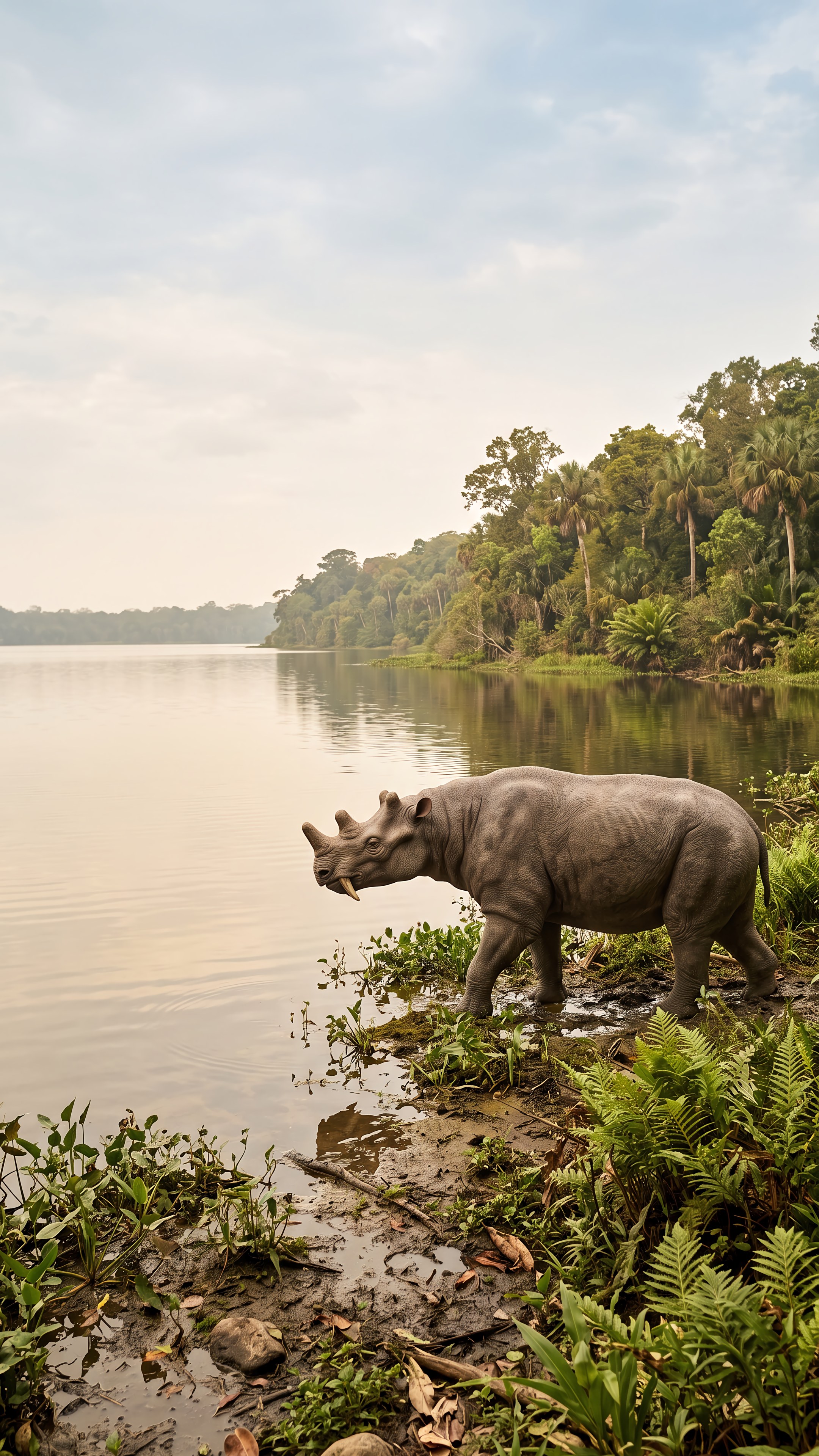
The middle Eocene was warmer than today, and the basins of Wyoming and Utah held rivers, lakes and forests. Uintatherium shared them with the small hoofed mammal Hyopsodus, early horses such as Epihippus, brontotheres, small rhino relatives such as Triplopus, early even-toed hoofed mammals and small carnivorous mammals.

A second species, Uintatherium insperatus, was named in 1981 from a skull found in the Lushi Formation of Henan Province, China. Chinese fossils belong to that species, not to U. anceps.

Size and records

Turnbull described uintatheres as about the size of the largest living rhinoceroses. Uintatherium anceps is usually given as about 1.5 m (5 ft) tall at the shoulder and about 3.3 m (11 ft) long, so its back would have been roughly level with the shoulders of an adult human, and it was longer than a small car.

Its weight is much less certain. Published estimates run from under 2 tonnes to about 4.5 tonnes, depending on whether they are based on bone measurements or on comparisons with living animals. Either way it was one of the largest land animals of its time, one of the first mammals to reach the size of a modern rhinoceros after the dinosaurs died out.

Relatives and legacy

Uintatherium belongs to the Dinocerata ('terrible horns'), a group that lived in North America and Asia during the Paleocene and Eocene and has no living descendants. Its close relatives include Eobasileus, a slightly later North American uintathere that also carried paired skull knobs.

Where the Dinocerata fit among other mammals is unresolved. In 1985 Schoch and Lucas grouped them with the South American xenungulates in a larger group called Uintatheriamorpha, based on similar teeth. Most later researchers treat that resemblance as convergence, and a 2024 study found xenungulates closer to other South American groups. Other ideas have linked dinoceratans to the ancestry of rodents and rabbits. For now they are best described as placental mammals with no close living relatives.

Myths and misconceptions

Myth: Uintatherium was an early rhinoceros or elephant. Its size and head knobs invite the comparison, and early naturalists sometimes linked uintatheres to elephants, but dinoceratans are a separate, extinct branch of mammals. The knobs were bony outgrowths of the skull, not rhinoceros horns made of keratin.

Myth: Joseph Leidy named it, and Marsh and Cope named it again. Leidy did name the genus in 1872, but Marsh had already named the species anceps in 1871, which is why his species name is the one used today.

Myth: its small brain proves it was unintelligent. The brain was small relative to body size, but brain size alone cannot tell us how it behaved.
Did you know?

  • Marsh first described the species in 1871 as a possible Titanotherium, before the genus Uintatherium existed.
  • During the 1872 naming race, Edward Drinker Cope sent new animal names by telegraph, and they arrived garbled.
  • Female Uintatherium had much smaller tusks and jaw flanges than males.
  • Marsh's 1886 monograph on the Dinocerata filled 243 pages of text with 56 pages of plates.
  • In 2017 three teeth from the earliest Uintan Turtle Bluff Member of Wyoming were identified as Uintatherium anceps, helping to show it outlasted the Bridgerian.

Discovery timeline

  1. 1871Othniel Charles Marsh names the species anceps, provisionally in Titanotherium.
  2. 1872Joseph Leidy names the genus Uintatherium (U. robustum); Cope and Marsh add rival names such as Loxolophodon, Eobasileus, Dinoceras and Tinoceras.
  3. 1886Marsh publishes his US Geological Survey monograph on the Dinocerata.
  4. 1961Walter Wheeler's revision sorts out the valid uintathere genera and species.
  5. 1981Tong and Wang name Uintatherium insperatus from Henan, China.
  6. 2002William Turnbull's monograph on Washakie Basin uintatheres proposes a partly amphibious lifestyle.
  7. 2017Murphey and Kelly record U. anceps from the late Bridgerian to the early Uintan.

Still debated

What the fossils do not settle yet, and where the estimates differ.

  • Size: the 1.5 m shoulder height and 3.3 m length are widely quoted (reportedly from mounted skeletons measured by Turnbull 2002) but were not checked in the original.
  • Weight: estimates range from under 2 tonnes to about 4.5 tonnes; the 3-4.5 tonne figures are attributed to Lucas and Schoch (1998) and could not be checked.
  • Brain: a figure of about 290 g is often quoted (attributed to Jerison 1973) but could not be verified; Marsh and later workers agree only that the brain was small.
  • Age: the numerical range (about 48-45 million years ago) is derived from its land-mammal-age range and radiometric dates in the Bridger Formation and is approximate.
  • Lifestyle: forest browser versus partly amphibious grazer of water plants is unresolved.
  • Relationships: the position of Dinocerata among placental mammals, including any link to South American xenungulates, is unresolved.
Uintatherium anceps: full-body scene
Full-body scene · 4K
Uintatherium anceps: in its world
In its world · 4K
Uintatherium anceps: close-up
Close-up · 4K

Free downloads

The 4K creature card for Uintatherium anceps

Creature card

The full stat card as a 2160×3840 PNG. Free for wallpapers, classrooms and your own videos with a credit to The Ancient Cosmos.

Free 4K card · PNG · 6.7 MB

4K wallpaper

The picture without any text, 3840×2160 JPEG for desktops and TVs.

Download · 1.8 MB

Watch

Sources

Stats and facts on this page were checked against these sources (last checked 2026-09-18). Sizes are the best current estimates; where the science has moved, the newer figure is given.

  1. Dinocerata: a monograph of an extinct order of gigantic mammals (Marsh) · U.S. Geological Survey Monograph 10, 1886
  2. Revision of the uintatheres (Wheeler) · Bulletin of the Peabody Museum of Natural History 14, 1961
  3. The mammalian faunas of the Washakie Formation, Eocene age, of southern Wyoming. Part IV. The uintatheres (Turnbull) · Fieldiana Geology, 2002
  4. The battle for the Bone Wars beasts (Riley Black) · Scientific American (Laelaps blog), 2016
  5. Mammals from the earliest Uintan (middle Eocene) Turtle Bluff Member, Bridger Formation, southwestern Wyoming, USA, Part 2 (Murphey & Kelly) · Palaeontologia Electronica, 2017
  6. Mammals from the earliest Uintan Turtle Bluff Member, Part 3: Marsupialia and a reevaluation of the Bridgerian-Uintan transition (Murphey et al.) · Palaeontologia Electronica, 2018
  7. New insights on the anatomy, paleobiology, and biostratigraphy of Xenungulata (Mammalia) from the Paleogene of South America (Gelfo, Lopez & Bond) · Palaeontologia Electronica, 2024
  8. What did a dinoceratan do? (Darren Naish) · Tetrapod Zoology, ScienceBlogs, 2009
  9. Uintatherium insperatus Tong and Wang 1981 (taxon record) · Fossilworks, 1981
  10. Wheeler, W. H. (1961). Revision of the uintatheres. Peabody Museum of Natural History Bulletin 14.

← All creatures

Download