Discovery and name
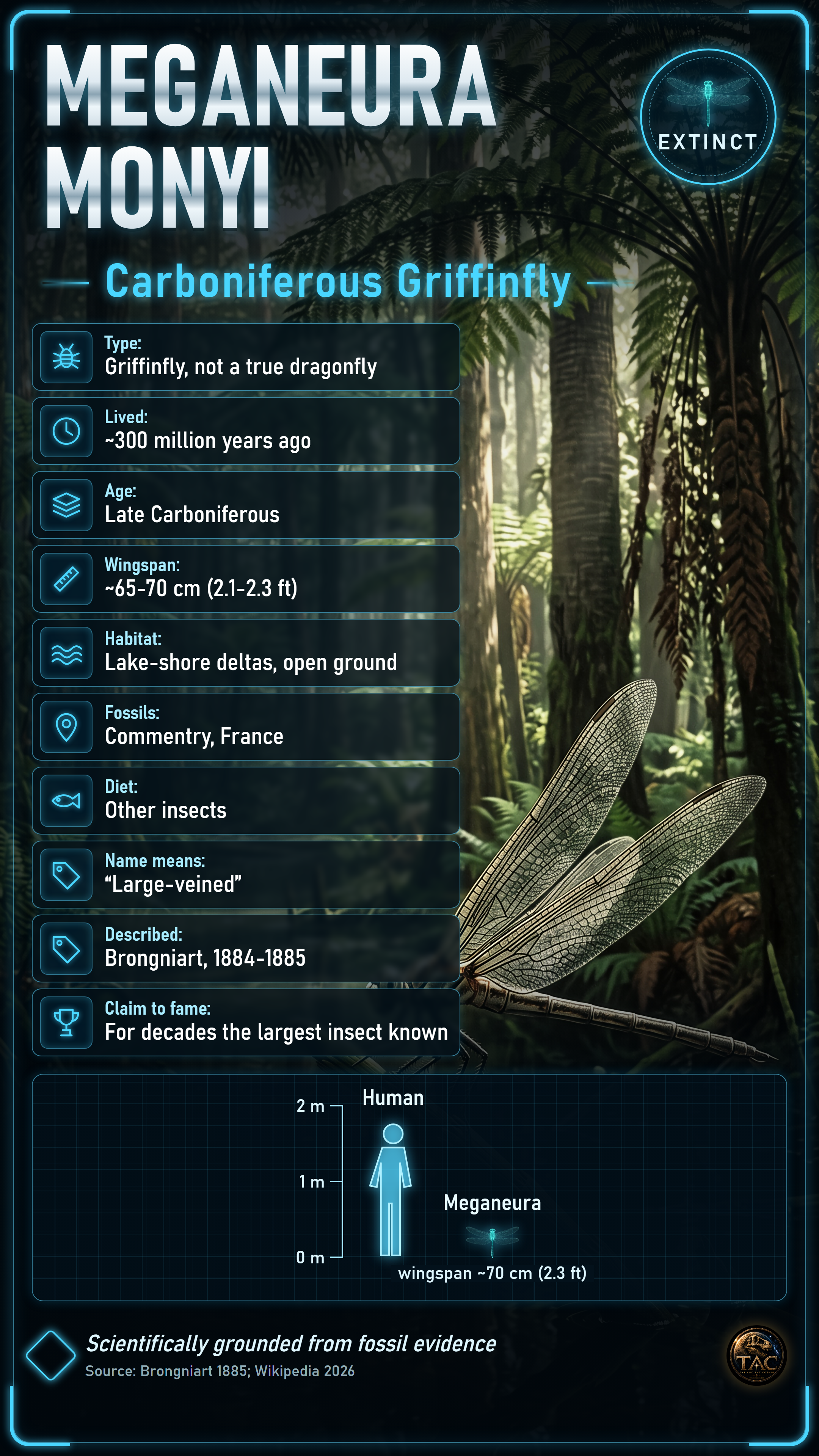
Meganeura was found in the coal mines of Commentry, in the Allier region of central France, where mining in the late nineteenth century turned up thousands of fossil insects in the shales between the coal seams. In 1884 the Paris palaeontologist and entomologist Charles Brongniart described one enormous specimen in a short note to the French Academy of Sciences, naming it Dictyoneura monyi. The species name honours Stéphane Mony of the Commentry mines. A year later, in 1885, Brongniart moved it into a new genus of its own, Meganeura.
The name comes from the Greek mega, 'large', and neuron, 'nerve', the word entomologists use for the veins of an insect wing, so it is usually translated as 'large-veined'. The holotype, the specimen the name is anchored to, is an impression of wing fragments kept at the Muséum national d'Histoire naturelle in Paris. Because the species was first published in a different genus, its formal citation is Meganeura monyi (Brongniart, 1884); the brackets show that it has since been moved. Several later names given to Commentry griffenflies in the early twentieth century are now treated as the same species.
Body and anatomy
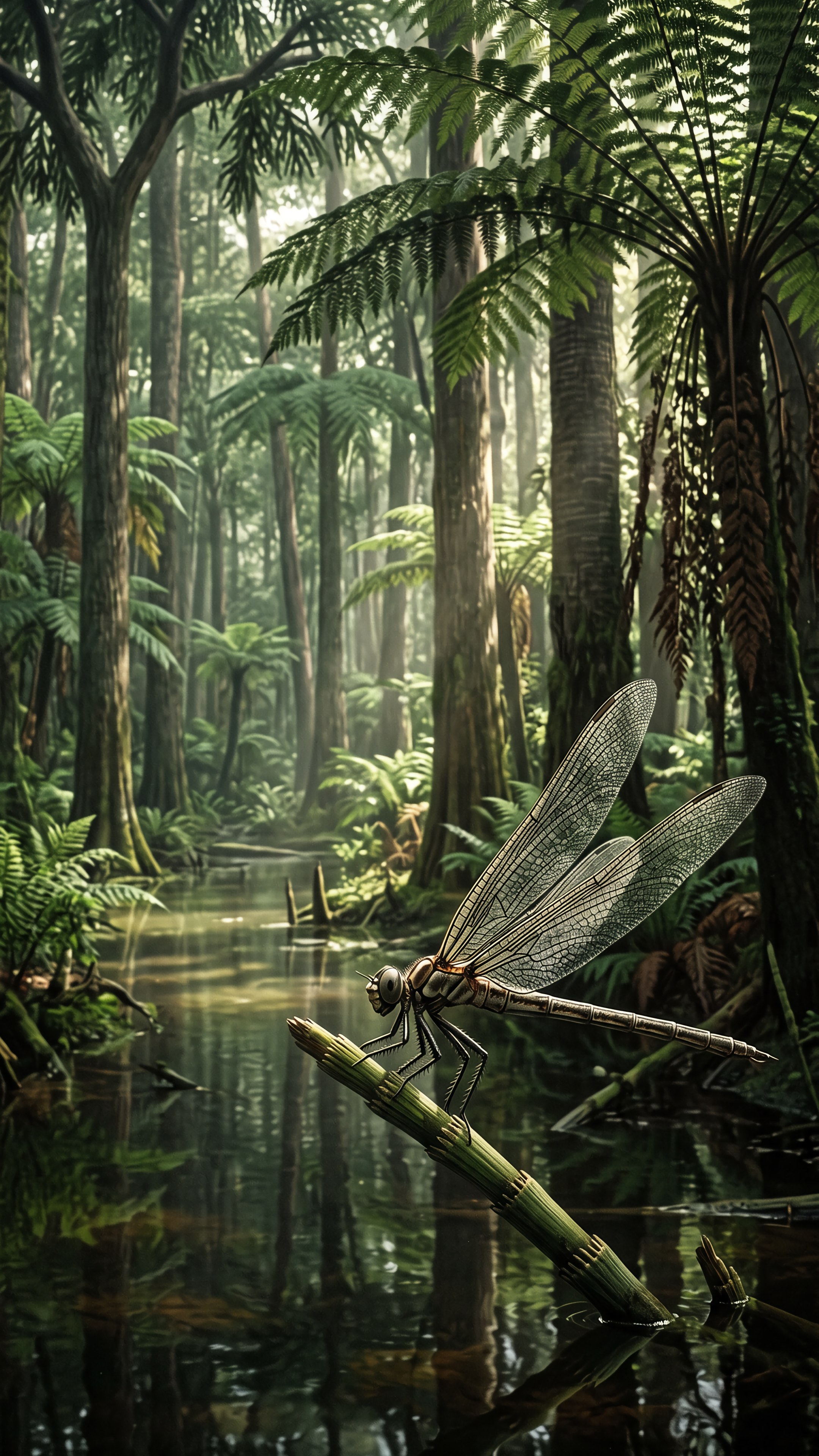
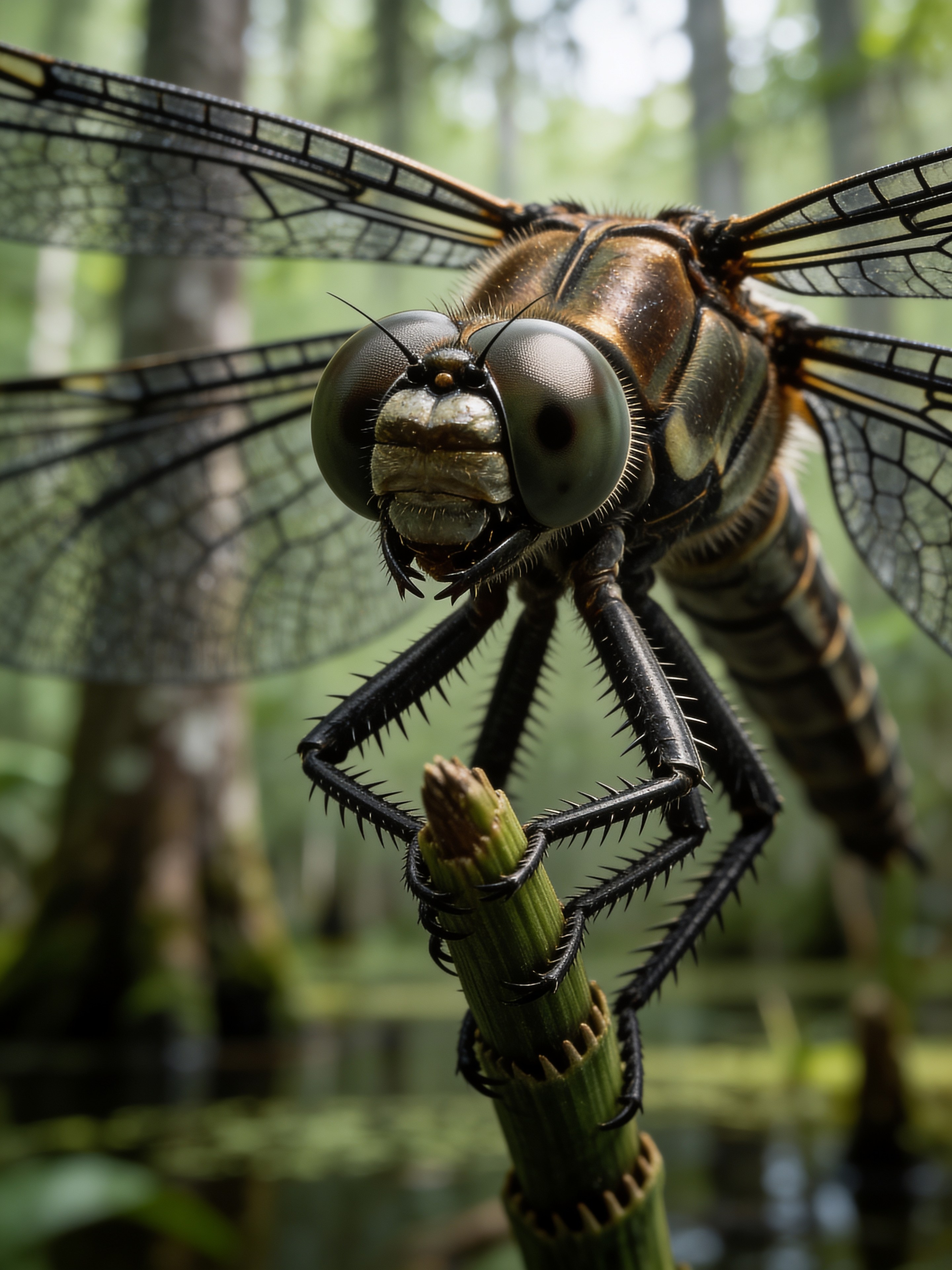
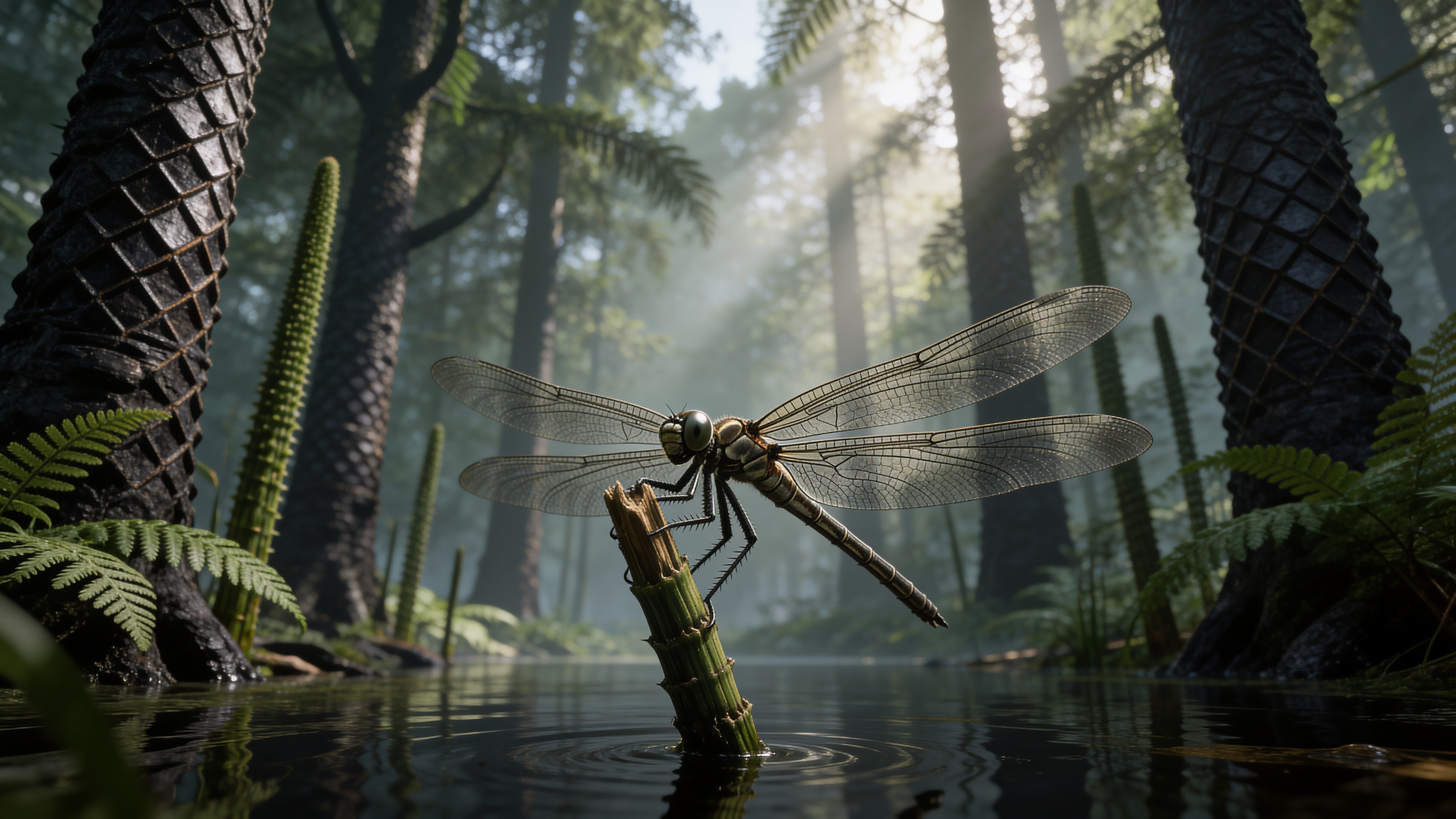
Meganeura had four long, narrow wings stiffened by a dense network of veins, a large thorax and a long, slender abdomen, a body plan broadly like a modern dragonfly's. Most of what is known comes from wings and scattered body parts: a 2018 study described Meganeura monyi itself as poorly preserved. Strong spines on the lower leg segments (the tibiae and tarsi) have been reported in Meganeura, matching the prey-catching legs of living dragonflies.
The head is the least known part. Much of the modern picture comes from a close relative from the same Commentry beds, Meganeurites gracilipes, whose head is unusually well preserved. It had very large compound eyes that met along the top of the head and were enlarged upwards, and sturdy mandibles armed with sharp teeth. Reconstructions of Meganeura borrow these features, so the head seen in museum models and films is an informed reconstruction rather than something shown directly by its own fossils.
How it lived
Griffenflies were almost certainly predators. The evidence is anatomical: toothed mandibles, spiny legs placed well forward under the head, and a thorax tilted in the same way as in dragonflies, which use their legs as a 'flying trap' to snatch prey in mid-air. The 2018 study of Meganeurites concluded that these giants hunted like modern 'hawker' dragonflies, patrolling in flight and spotting prey from a distance with their upward-facing eyes. It suggested that the prey probably included other large insects such as palaeodictyopterans, which also lived at Commentry.
The same study argued that such long wings would be easily damaged among dense vegetation, so the giants probably hunted in more open spaces, such as over water, clearings or above the trees, rather than weaving between trunks. Nothing is known directly about Meganeura's young. Living dragonflies spend their early life as aquatic nymphs, and many researchers assume griffenflies did the same, but this is an inference from their relatives.
Its world
Meganeura lived in the Gzhelian stage at the very end of the Carboniferous Period, roughly 304 to 299 million years ago. The Commentry fossils formed in a basin among mountains: streams washed sediment into delta-like deposits along the shore of a lake, carrying the remains of insects and plants from the surrounding land into the mud. That is why the site preserves such a rich mix of land insects.
Atmospheric oxygen was probably well above today's 21 per cent in the Late Carboniferous; a widely cited 1995 analysis of geochemical models put the peak at around 35 per cent. The skies held no flying vertebrates at all. Birds, bats and pterosaurs did not yet exist, and the first gliding and flying vertebrates appeared roughly 30 million years after Meganeura, so the largest flying animals of its world were insects.
Size and records
Meganeura's wingspan is usually given as about 65-70 cm (26-28 in), and the 2018 study uses a round figure of about 700 mm. That is roughly the length of an adult's arm from shoulder to fingertip, and more than three times the wingspan of the largest living dragonflies, which stay under about 20 cm (8 in). The figure is an estimate rebuilt from incomplete wings.
For more than half a century Meganeura was the largest insect known. In 1939 the American palaeoentomologist Frank Carpenter still described its fore wing, at about 300 mm (12 in), as belonging to the largest insect so far discovered. In the same paper he named Meganeuropsis permiana from Kansas, whose estimated wingspan is slightly larger, so Meganeura now ranks as one of the two largest insects known, and both are known mainly from incomplete wings.
Relatives and legacy
Meganeura belongs to the Meganisoptera, the griffenflies (also spelled griffinflies), an extinct order within the Odonatoptera, the wider group that includes today's dragonflies and damselflies (Odonata). Griffenflies are ancient stem relatives of dragonflies rather than their direct ancestors: they share the basic body plan and hunting equipment but differ in details of the wing veins. Their closest living relatives are the dragonflies and damselflies.
Because it lived at a time of high oxygen, Meganeura became the textbook example of the idea that oxygen limits insect size. Griffenflies persisted into the Permian, including the slightly larger Meganeuropsis in North America, and disappeared around the end of the Permian.
Myths and misconceptions
Meganeura is often called a giant dragonfly, but it was not a true dragonfly. It belonged to a separate, older branch, the griffenflies, which shared a common ancestor with dragonflies. Nor was it the largest insect ever found: its Permian relative Meganeuropsis permiana has a slightly larger estimated wingspan. Documentary scenes of giant griffenflies weaving through dense coal-swamp forest are also largely imagined; the anatomy suggests they hunted in open spaces.
The popular idea that 'oxygen made insects giant' is too simple. Higher oxygen may well have helped, and a 2012 study of more than 10,500 fossil insect wings found that maximum insect size tracked oxygen levels for the first 150 million years of insect history. But from the Early Cretaceous, insect size fell even as oxygen rose, around the time birds became agile fliers. In 2026 a study of flight muscles found that the tiny air tubes (tracheoles) delivering oxygen take up about 1 per cent of muscle volume or less, even when scaled up to a giant griffenfly, suggesting that oxygen supply to the muscles did not cap their size. Many researchers now think several factors worked together, including oxygen, the lack of flying vertebrate predators and perhaps the oxygen needs of water-dwelling young.