Discovery and name
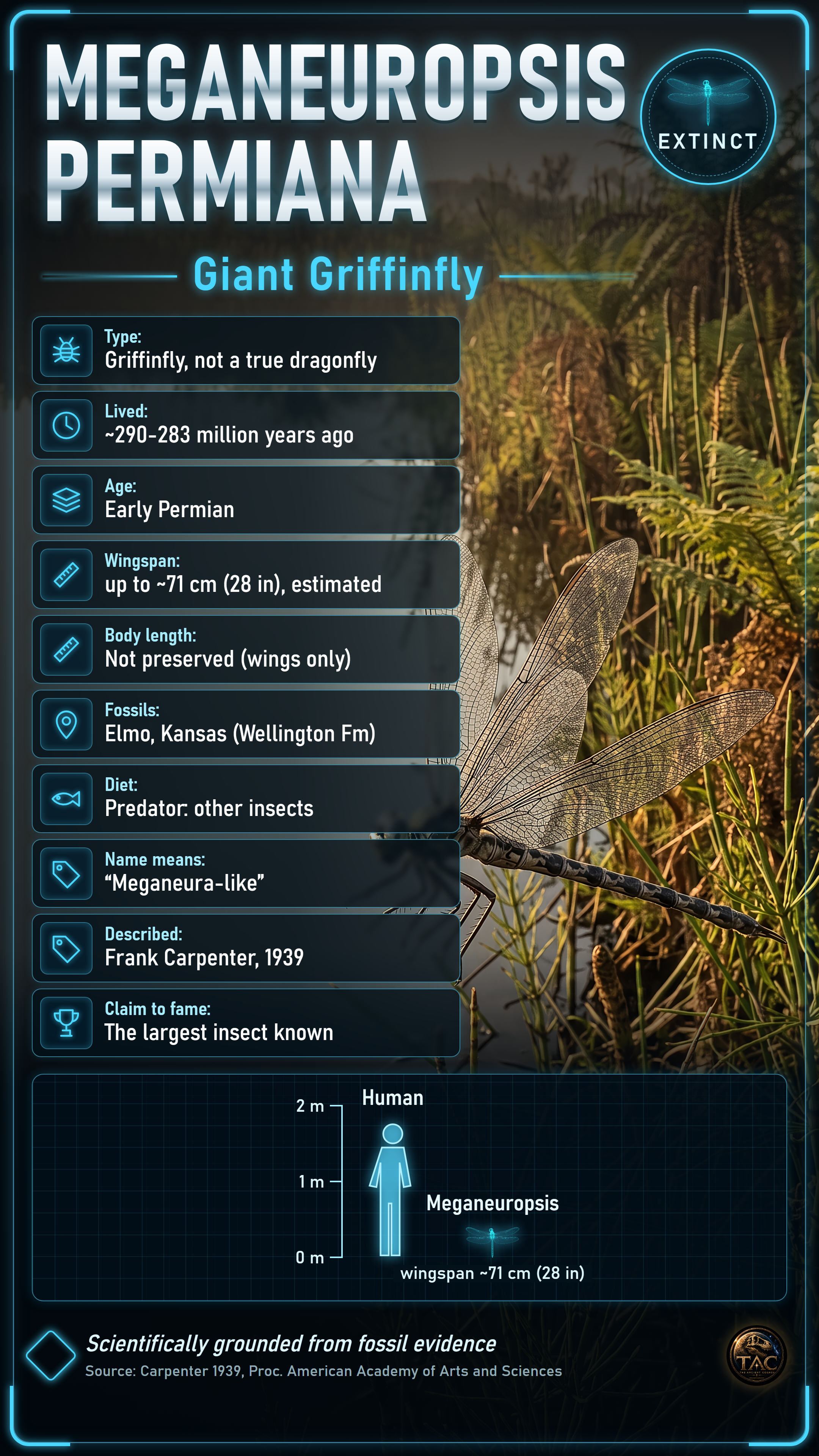
Meganeuropsis was described in 1939 by Frank M. Carpenter, curator of fossil insects at Harvard's Museum of Comparative Zoology, from the famous insect beds in the Elmo limestone near Elmo, Kansas. Carpenter collected the fossils himself: two wing fragments found at the same level in the limestone, less than 60 cm (2 ft) apart. When he drew them to the same scale, the pieces overlapped slightly, so he concluded that they came from one insect but from two different wings, probably a fore wing and a hind wing.
The name joins Meganeura, the giant Carboniferous griffenfly, with the Greek ending -opsis, 'appearance', so it means roughly 'looking like Meganeura'. That suits it: Carpenter admitted it was hard to tell the two apart from such fragments, but preferred a new genus to stretching Meganeura into the Permian and into North America. The species name permiana refers to the Permian Period. The holotype, the larger fragment, is kept at the Museum of Comparative Zoology.
In 1940 Carpenter collected another giant griffenfly wing in Noble County, Oklahoma, which he named Meganeuropsis americana in 1947. It is sometimes suggested that this is the same species as M. permiana, but the two are still listed separately in the Paleobiology Database.
Body and anatomy
Only wings are known. The holotype is the base of a wing, 140 mm (5.5 in) long, with the main veins visible although the surface is partly obscured by calcite; the second piece is a perfectly preserved section from the middle of a wing. The vein pattern matches Meganeura closely. Carpenter separated the two genera on small details: in Meganeuropsis the base of the leading edge of the wing (the costa) is curved, and the bases of two of the rear veins are almost straight.
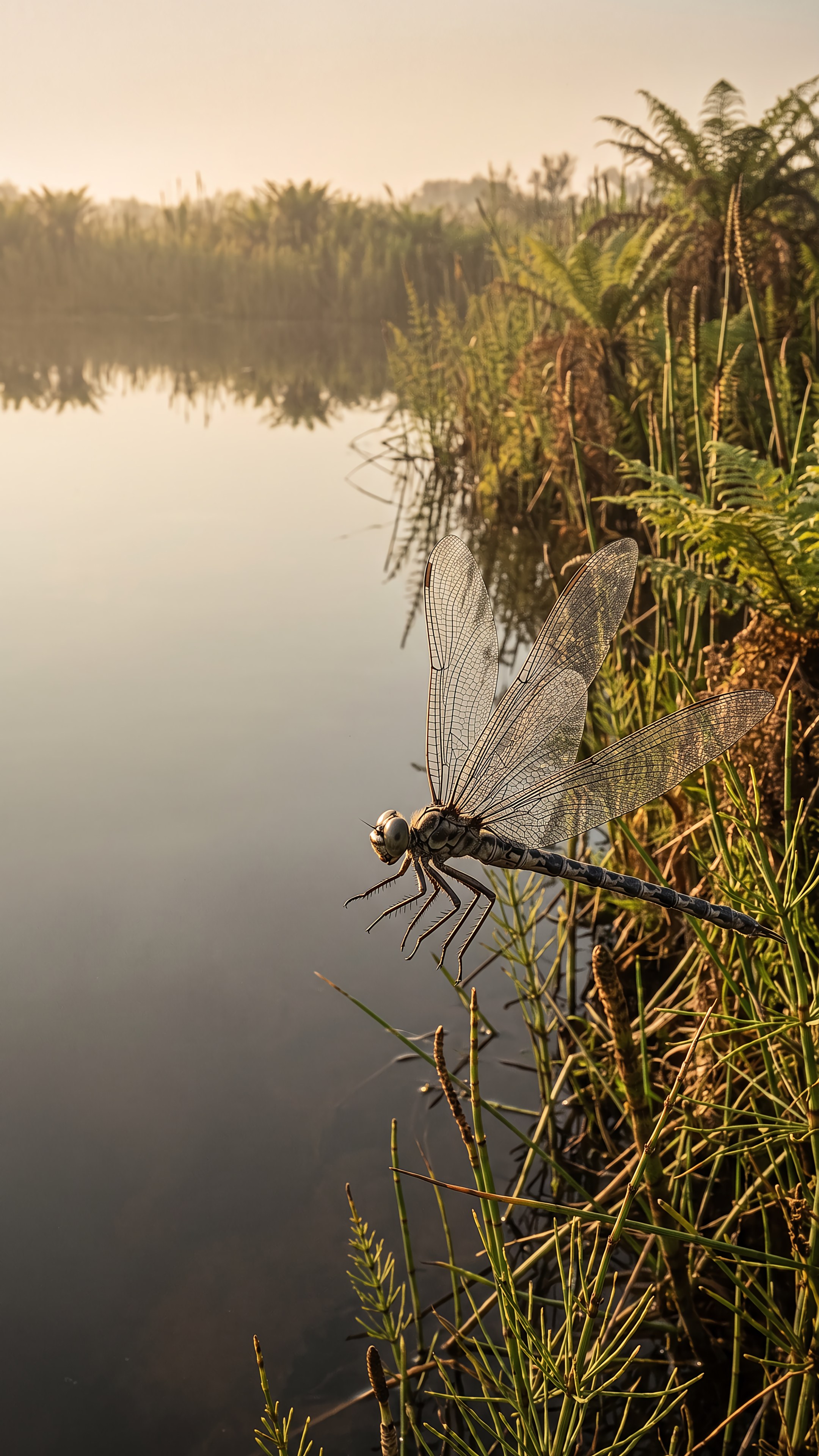
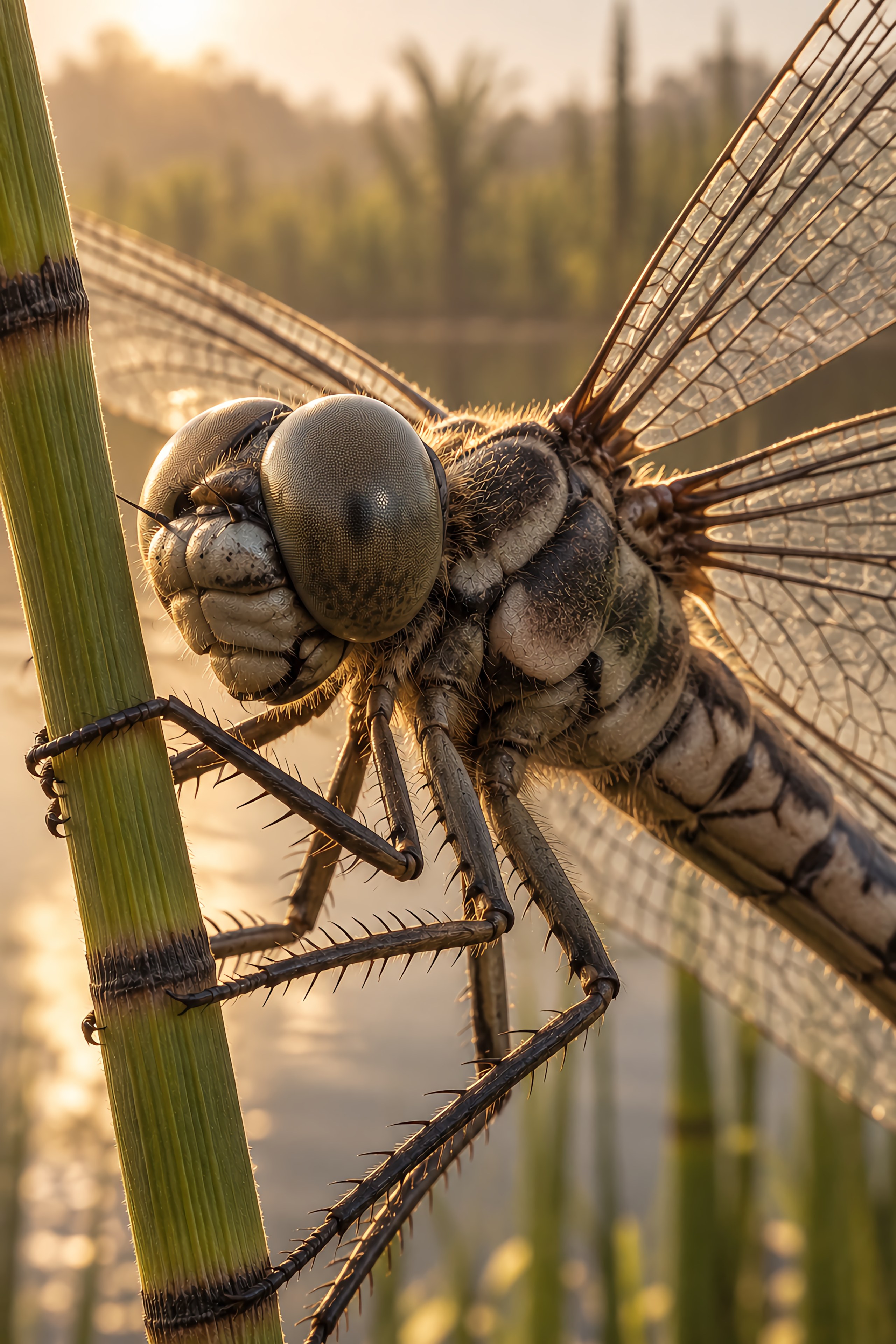
Everything else, including the head, legs and abdomen, is reconstructed from better-known relatives. By comparison with Meganeura and with Meganeurites, a griffenfly with a well-preserved head, Meganeuropsis probably had large compound eyes, toothed mandibles and spiny legs used to seize prey. Body lengths of around 43 cm (17 in) quoted in popular books are estimates, not measurements, because no body fossil has been found.
How it lived
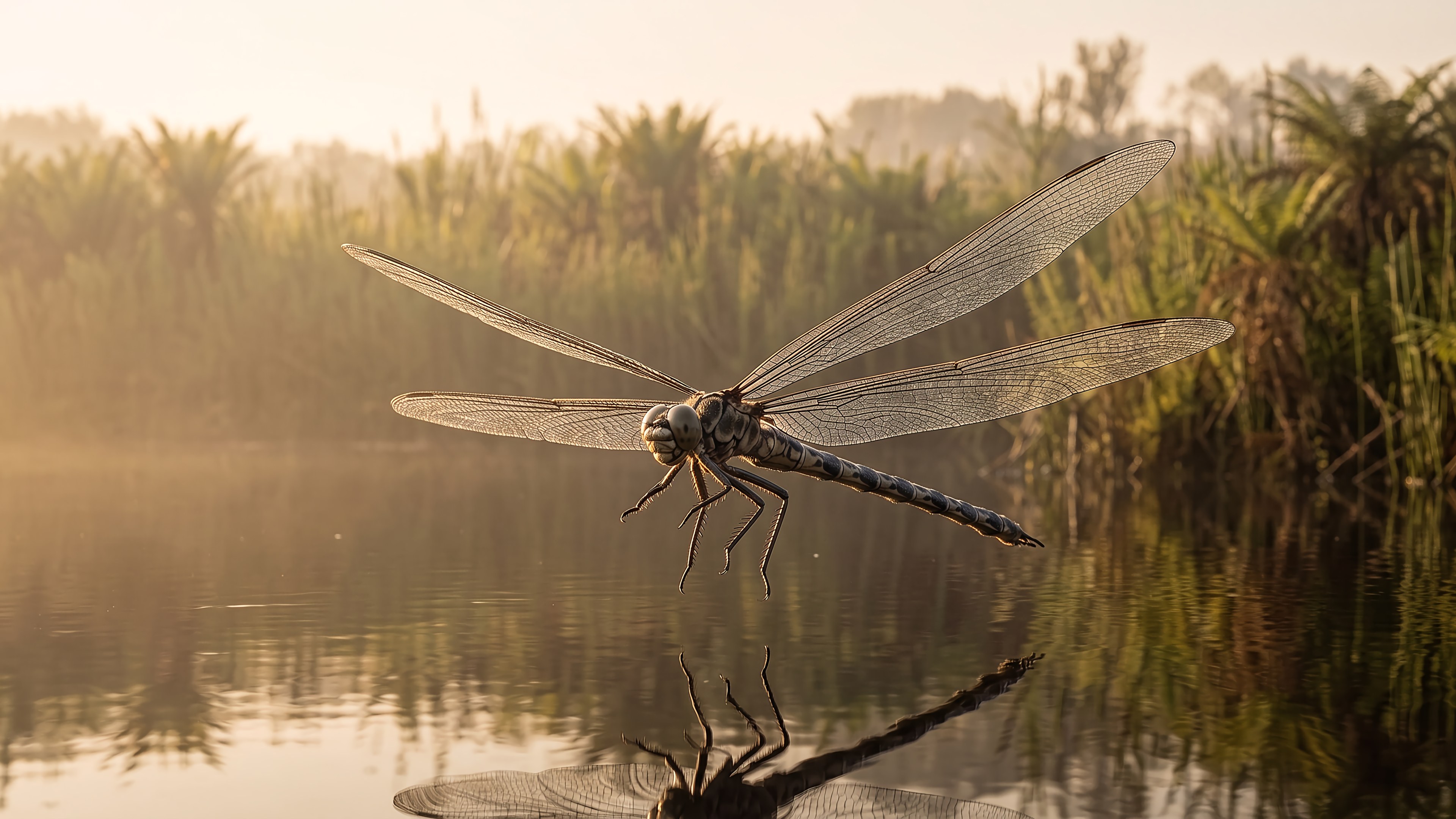
Like other griffenflies, Meganeuropsis was very probably an aerial predator. That conclusion comes from its relatives: griffenflies with preserved heads and legs show sturdy toothed mandibles, strong spines on the legs and a forward-tilted thorax, the same equipment living dragonflies use to grab prey in mid-air. A 2018 study of the relative Meganeurites argued that giant griffenflies hunted like modern 'hawker' dragonflies, patrolling in flight over open ground rather than among dense trees, where long wings would be damaged.
Its prey was probably other flying insects, which were abundant and varied in the Kansas fauna. Its young are unknown. If griffenflies developed like dragonflies, with water-dwelling nymphs, Meganeuropsis would have needed ponds or slow water to breed, but this is inference rather than fossil evidence.
Its world
The Elmo insect beds belong to the Wellington Formation of the North American midcontinent and are usually dated to the Artinskian stage of the Early Permian, about 290-283 million years ago. Elmo has produced tens of thousands of fossil insects and more than 150 described species, and the Midco beds in Oklahoma, some 270 km (170 miles) to the south, are just as productive. Together they form one of the most important windows on insect life early in the Permian.
Carpenter was struck by the range of sizes in this one fauna: the same limestone holds a tiny barklouse (a psocopteran) with a wingspan under 4 mm, less than a hundredth of the griffenfly's. Atmospheric oxygen was probably still higher than today, and there were still no flying vertebrates; the first gliding and flying vertebrates appeared later in the Permian and beyond, so large insects had the air to themselves.
Size and records
Carpenter estimated the size of Meganeuropsis by tracing the holotype at natural size and laying the drawing over Brongniart's life-size figure of a Meganeura wing. The Kansas wing turned out slightly larger. Assuming the same wing shape, he calculated a wing length of about 330 mm (13 in) and a wingspan of about 710 mm (28 in), roughly the width of a doorway. These numbers are extrapolated from a 14 cm (5.5 in) fragment, so the real insect could have been somewhat smaller or larger.
By wingspan it is the largest insect known, though only by a few centimetres over Meganeura. It was not heavy: a 2026 study of insect flight muscles estimated M. permiana at about 100 g (3.5 oz), about the weight of a small apple. A large wing of M. americana from Oklahoma is on permanent display at the Harvard Museum of Natural History beside modern darner dragonflies, which have wingspans of only 10-15 cm (4-6 in).
Relatives and legacy
Meganeuropsis belongs to the family Meganeuridae within the Meganisoptera, the griffenflies (also spelled griffinflies). Carpenter placed it in the subfamily Meganeurinae beside Meganeura, which it closely resembles. Griffenflies are stem relatives of the dragonflies and damselflies (Odonata): they share much of the dragonfly body plan but lack some features of true dragonfly wings, such as the nodus, a strengthening notch on the leading edge. They are cousins of dragonflies, not their direct ancestors.
After the Palaeozoic, no insect is known to have approached this size again. A 2012 analysis of more than 10,500 fossil insect wings found that maximum insect size followed oxygen levels until the end of the Jurassic, then fell as birds evolved agile flight, suggesting that predators and competition later set the limit. Meganeuropsis itself has become a test case: the 2026 flight-muscle study used it as its example of a giant extinct insect.
Myths and misconceptions
Meganeuropsis is often called a giant dragonfly, but like Meganeura it was a griffenfly, from an extinct branch beside the true dragonflies. Statements such as 'a single wing from Kansas is 33 cm long' blur fossil and estimate: the longest real fragment of M. permiana is 14 cm, and the 33 cm wing and 71 cm wingspan are reconstructions. Claims that it 'snatched small amphibians' are speculation, since no stomach contents or mouthparts are known.
It is also often said that only oxygen-rich air made it possible. Higher oxygen may have helped, but the 2026 study found that the tiny air tubes supplying the flight muscles take up about 1 per cent of muscle space or less, and that this would still hold for an insect the size of M. permiana. That suggests oxygen delivery inside the muscles did not set its size, although oxygen may still have mattered in other ways, for example for water-dwelling young.