Discovery and name
In 1902 Barnum Brown, collecting for the American Museum of Natural History, found a partial skeleton of a huge meat-eater near Hell Creek, Montana; digging it out took about three years. In 1905 Henry Fairfield Osborn named it Tyrannosaurus rex, from Greek words meaning 'tyrant lizard' and the Latin rex, 'king'. This first specimen, the holotype, was sold to the Carnegie Museum of Natural History in Pittsburgh in 1941, during the Second World War, and is now catalogued as CM 9380.
The most famous skeleton, 'Sue' (FMNH PR 2081), was found by Sue Hendrickson in 1990 near Faith, South Dakota. About 90 per cent of it by bulk was recovered, including around 250 of the roughly 380 bones in a T. rex skeleton, and the Field Museum in Chicago bought it at auction in 1997 for 8.4 million US dollars. In 2019 a University of Alberta team showed that 'Scotty', a skeleton found in Saskatchewan in 1991, was larger still.
Body and anatomy
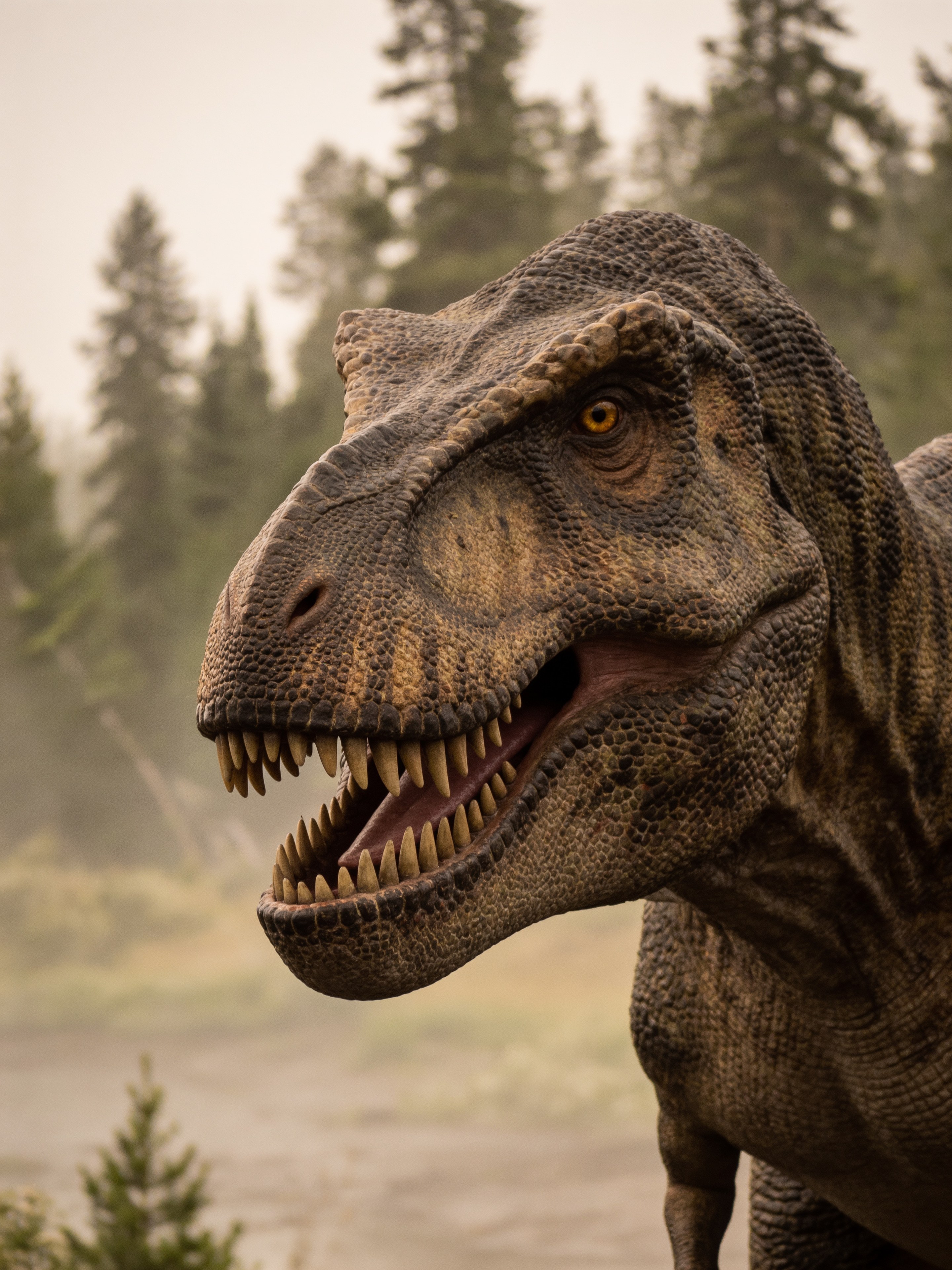
Tyrannosaurus was built around its head. Sue's skull is roughly 1.5 m (5 ft) long, and the real fossil skull alone weighs about 270 kg (600 lb); its largest teeth, root included, approach 30 cm (1 ft). The teeth were thick and rounded in cross-section rather than thin blades, the arms were short with two working fingers, and the long, heavily muscled legs were balanced by a long tail.
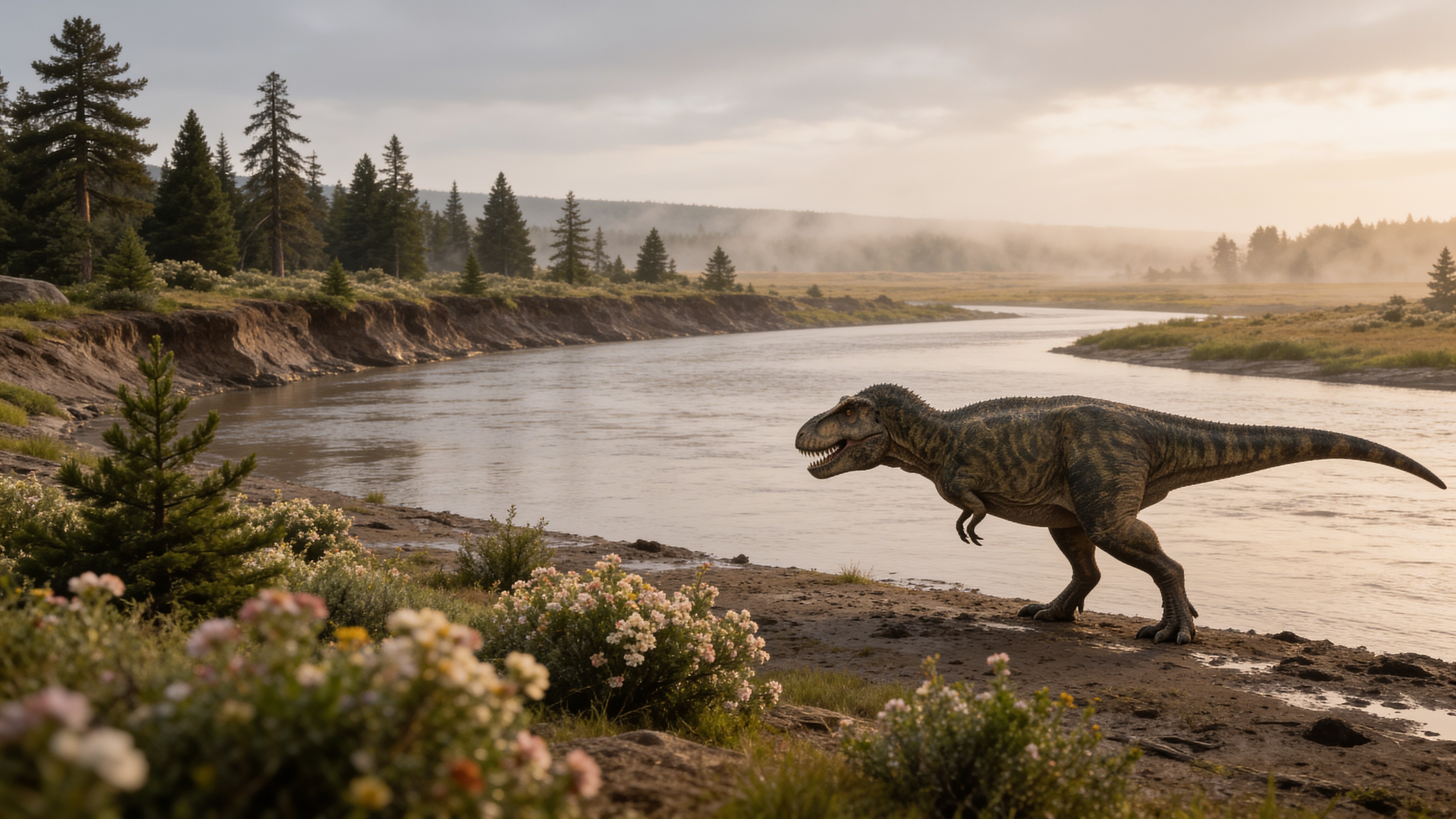
Small patches of fossil skin from the neck, hip and tail of Tyrannosaurus and its close relatives show pebble-like scales. Some earlier tyrannosauroids had extensive feather coverings, so Bell and colleagues concluded in 2017 that large tyrannosaurids had lost most of them. Because skin is known from only a few small areas, a little feathering on the back cannot be completely ruled out.
In 2023 Cullen and colleagues compared tooth wear and jaw bones in theropods with living lizards and crocodiles. They concluded that T. rex probably had lips that covered its teeth when the mouth was closed, as in a Komodo dragon; this is an inference, as no lips are preserved. Its forward-facing eyes gave it a binocular field of view of about 55 degrees, wider than a modern hawk's (Stevens 2006).
How it lived
Direct fossil evidence shows that T. rex attacked live animals. A hadrosaur tail described in 2013 has a T. rex tooth crown embedded in two fused vertebrae, surrounded by healed bone, so the victim escaped and lived on. Computer models of its skull estimate bite forces from about 8,500 to 34,500 newtons, depending on the individual and the tooth, with the highest at Sue's rearmost teeth. Combined with very high pressures at the tooth tips, this let it crush and swallow bone, a habit otherwise typical of hyenas and wolves.
Growth rings in its bones record a fast teenage growth spurt. Erickson and colleagues estimated in 2004 that growth peaked at about 2.1 kg (4.6 lb) a day, roughly 770 kg a year, between about 14 and 18 years old, and that Sue was about 28 when it died. Later studies disagree on the numbers: a 2011 study using digital body models suggested peak growth near 1,790 kg a year, while a 2026 study of 17 individuals found slower growth that continued until about 35 to 40 years of age. Scotty was probably in its early thirties.
A major revision came in 2025. Small Hell Creek tyrannosaurs had long been treated as young T. rex and used in growth studies. Zanno and Napoli showed that the tyrannosaur in the 'Dueling Dinosaurs' fossil was about 20 years old and fully grown, confirming Nanotyrannus lancensis as a separate species; weeks later Griffin and colleagues found adult bone tissue in the throat bone of the Nanotyrannus type skull. Ideas about how young T. rex grew and hunted now need re-checking.
Its world
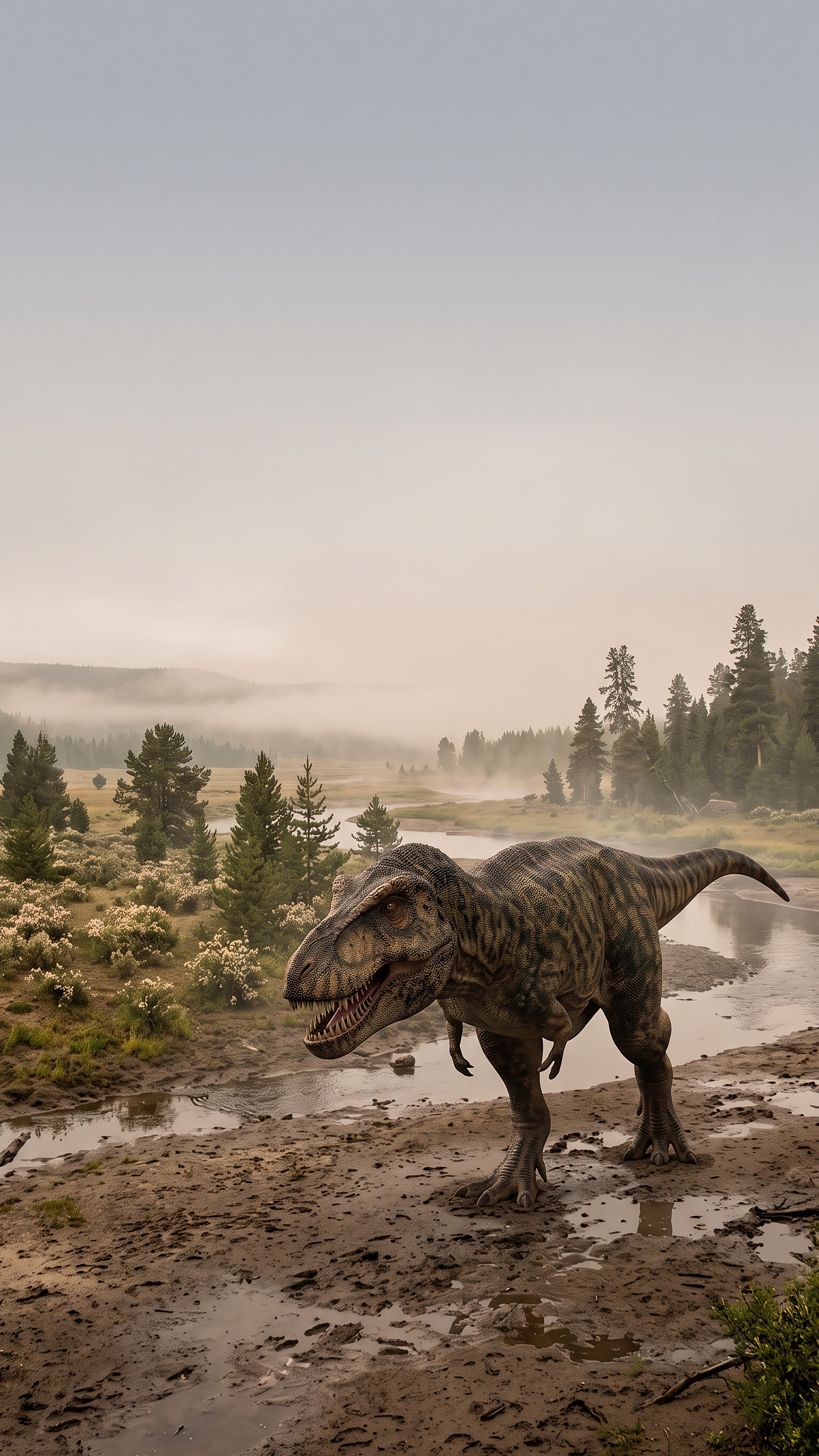
T. rex lived at the very end of the Cretaceous, in the Maastrichtian age, on the plains of western North America. Its fossils come from rock units such as the Hell Creek Formation of Montana and the Dakotas, the Lance Formation of Wyoming and the Frenchman Formation of Saskatchewan, laid down by rivers flowing across a warm coastal lowland.
It shared this landscape with plant-eaters such as the horned Triceratops and the duck-billed Edmontosaurus. It now appears it also lived alongside at least one smaller tyrannosaur, Nanotyrannus, so predator diversity in the last million years of the Cretaceous was higher than once thought. The whole ecosystem ended with the asteroid impact 66 million years ago.
Size and records
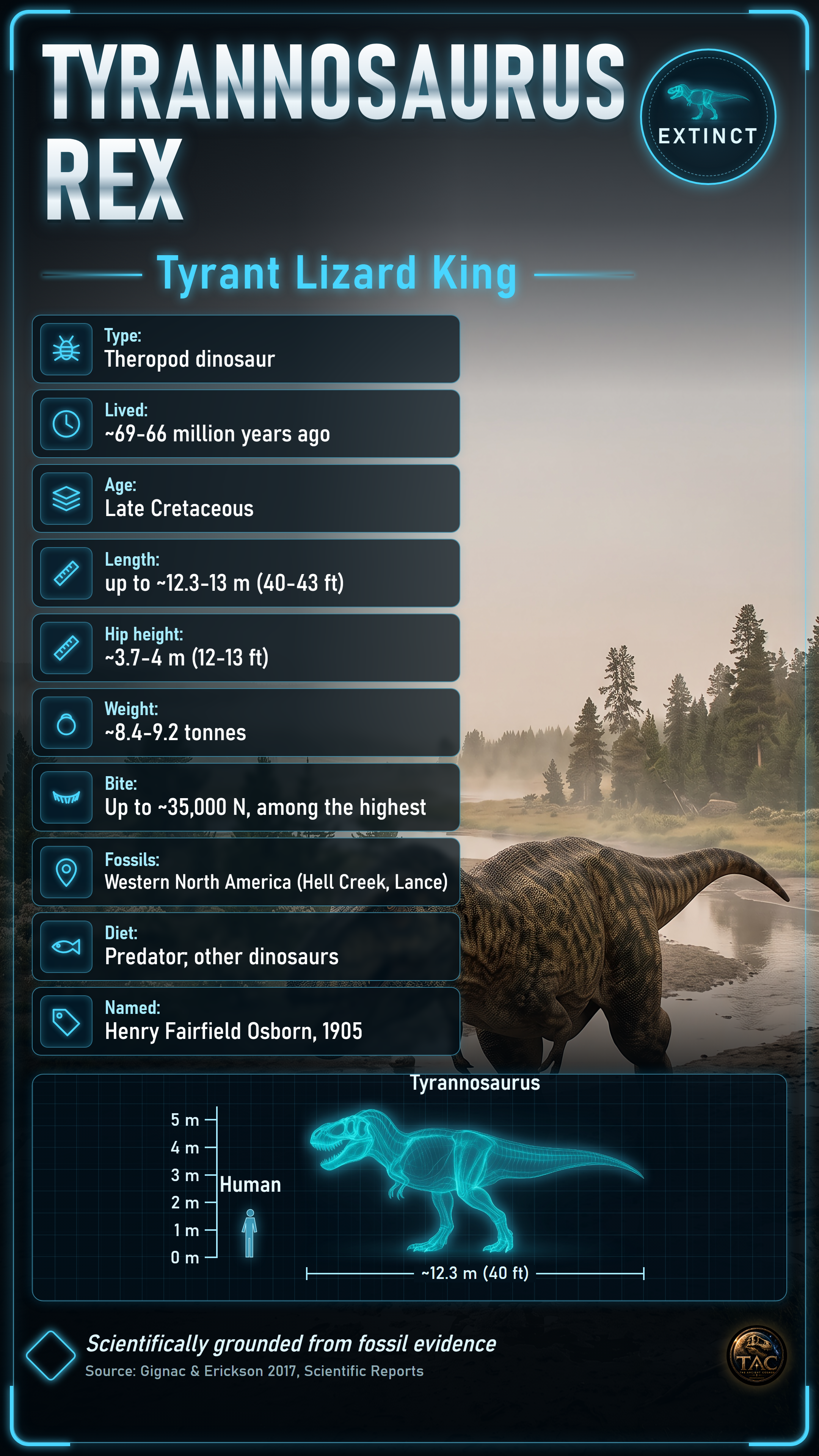
Sue is more than 12 m (40 ft) long and about 4 m (13 ft) tall at the hip, so a 1.8 m (6 ft) adult human would not reach halfway up its leg to the hip. Scotty is slightly longer, about 13 m (43 ft), and Persons and colleagues estimated in 2019 from the thickness of its thigh bone that it weighed about 8,870 kg (19,555 lb).
Weight estimates depend on method. Building digital bodies around mounted skeletons, Hutchinson and colleagues found that typical adults probably weighed about 6 to 8 tonnes, with Sue possibly up to about 9.5 tonnes. These are best treated as ranges, not exact weights. Its bite estimate of about 34,500 newtons is among the highest calculated for any animal, living or extinct.
Relatives and legacy
Tyrannosaurus belongs to the Tyrannosauridae, alongside Tarbosaurus of Asia and Albertosaurus, Gorgosaurus and Daspletosaurus of North America. Tyrannosaurs are coelurosaurs, the branch of theropod dinosaurs that also includes birds, so its closest living relatives are birds, with crocodilians as more distant cousins.
In 2022 Gregory Paul and colleagues proposed splitting Tyrannosaurus into three species, T. rex, T. imperator and T. regina, based on differences in bone robustness and front teeth. Carr and colleagues replied that the sample was too small, the measurements were not comparable and the statistics were unsuitable, and the three-species idea has not been widely accepted.
Myths and misconceptions
Myth: T. rex was only a scavenger. The healed tooth wound in a hadrosaur tail shows it attacked live prey, although, like most large carnivores today, it probably also ate carcasses when it found them.
Myth: T. rex could outrun a car. In 2002 Hutchinson and Garcia showed that a fast-running adult would have needed an impossibly large mass of leg muscle. A 2017 computer study by Sellers and colleagues found that running gaits would overload its skeleton, and suggested a top walking speed of about 20 km/h (12 mph).
Myth: it had a lipless, crocodile-like grin, or was feathered all over. Current evidence points to scaly skin on at least the neck, hips and tail, and probably to lips covering the teeth.