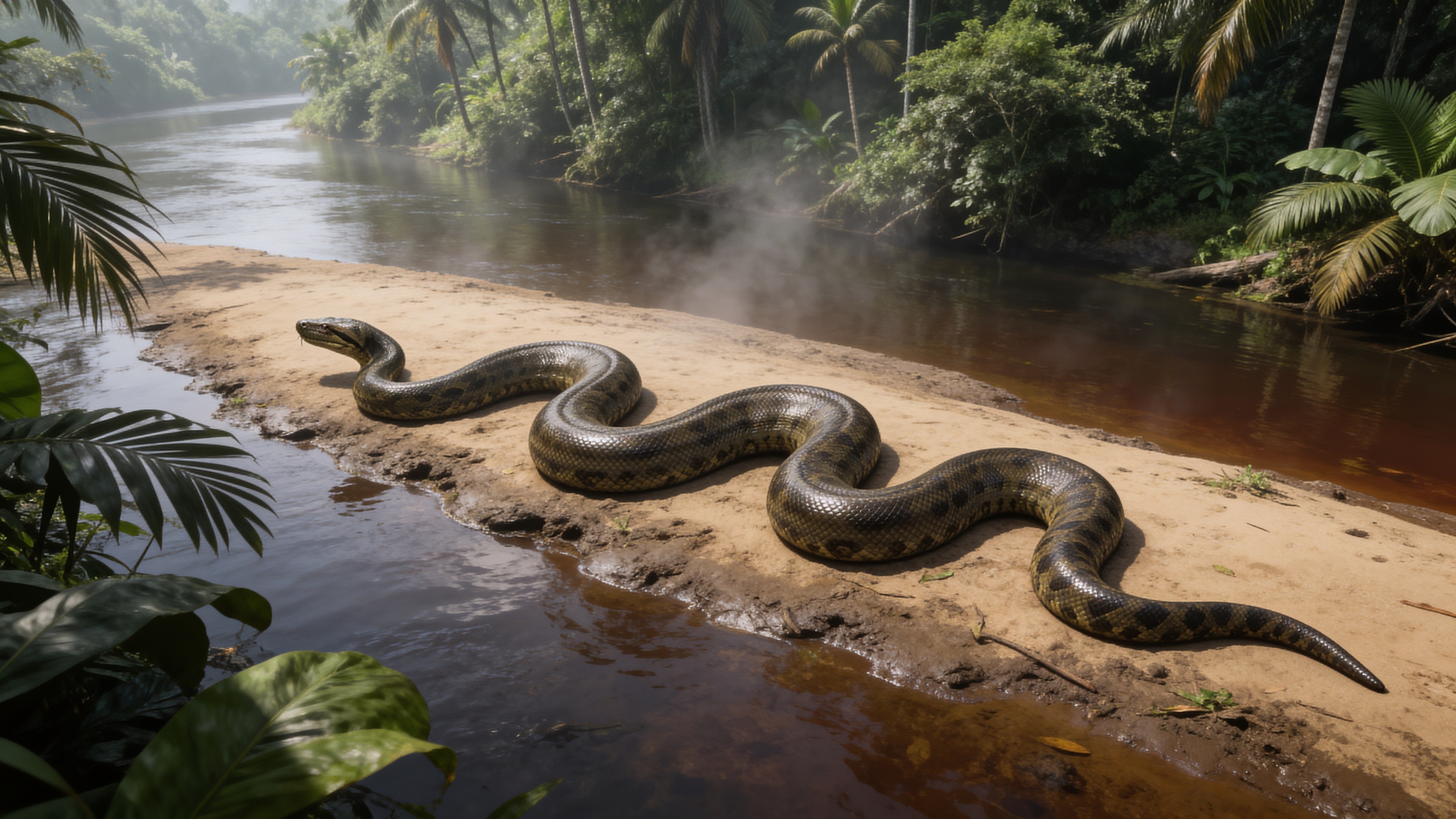
Discovery and name
Titanoboa comes from the Cerrejón coal mine in La Guajira, north-eastern Colombia, one of the largest open-pit mines in the world. In the early 2000s scientists from the Smithsonian Tropical Research Institute and the University of Florida realised that the rocks between the coal seams held fossil plants and vertebrate bones. On a 2004 expedition the team collected ribs, vertebrae, parts of pelvises and turtle shells, and much of the material was shipped to the Florida Museum of Natural History labelled as crocodile relatives.
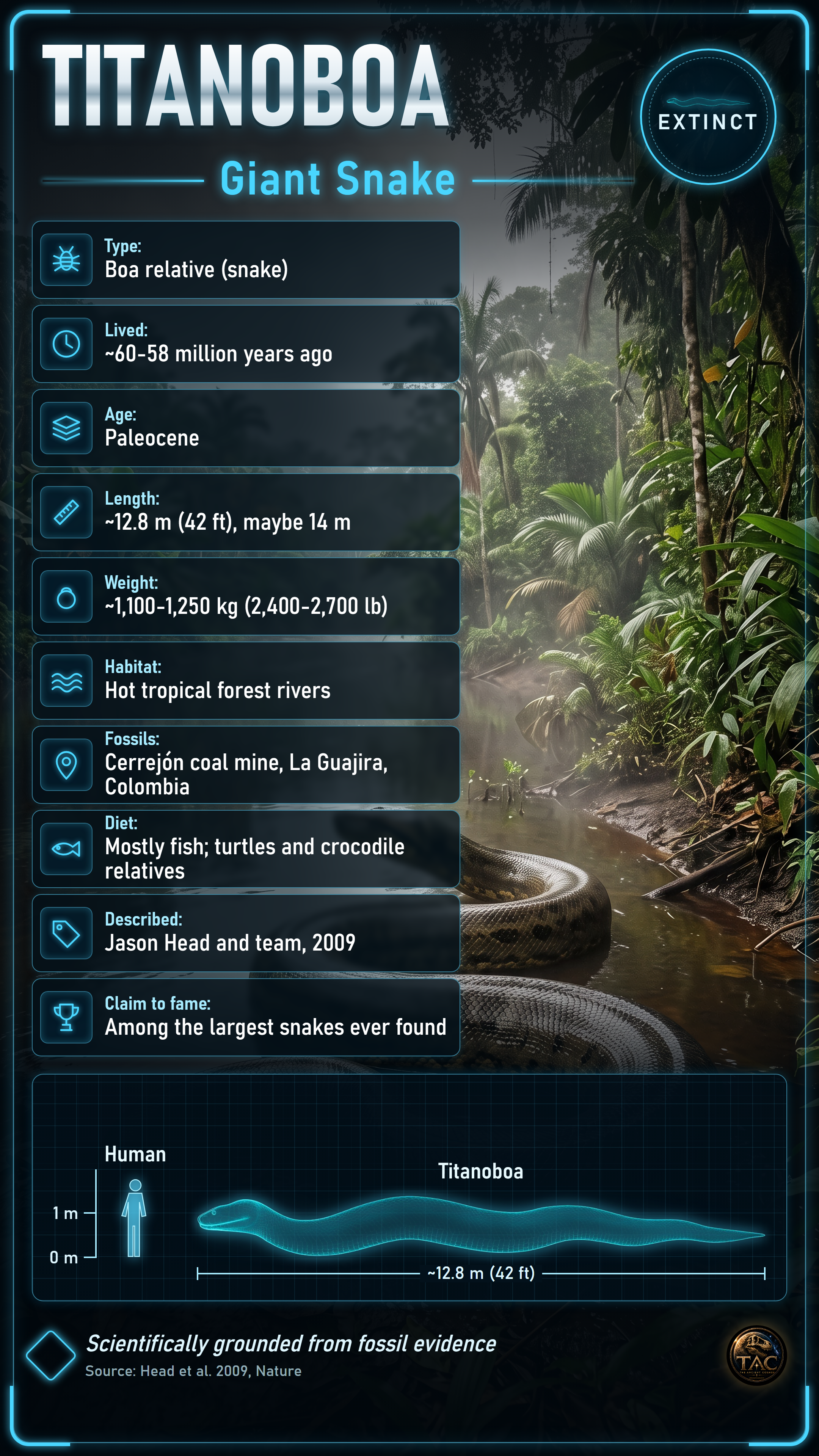
In 2007 University of Florida graduate student Alex Hastings noticed a strange, very large vertebra in a shipment marked 'crocodile', and fellow student Jason Bourque identified it as a snake. The team then searched the Cerrejón collections for more, and in February 2009 a group led by Jason Head described the new species in the journal Nature. The name means 'titanic boa', and cerrejonensis means 'from Cerrejón'.
Body and anatomy
Most Titanoboa fossils are vertebrae and ribs from the trunk. The vertebrae are broad and robust and share features with those of living boas, which is why the snake is placed in the boa family, Boidae, and probably in its subfamily Boinae. Vertebrae from several different individuals are all of similar size, which suggests that giants were normal for the species rather than one unusual animal.
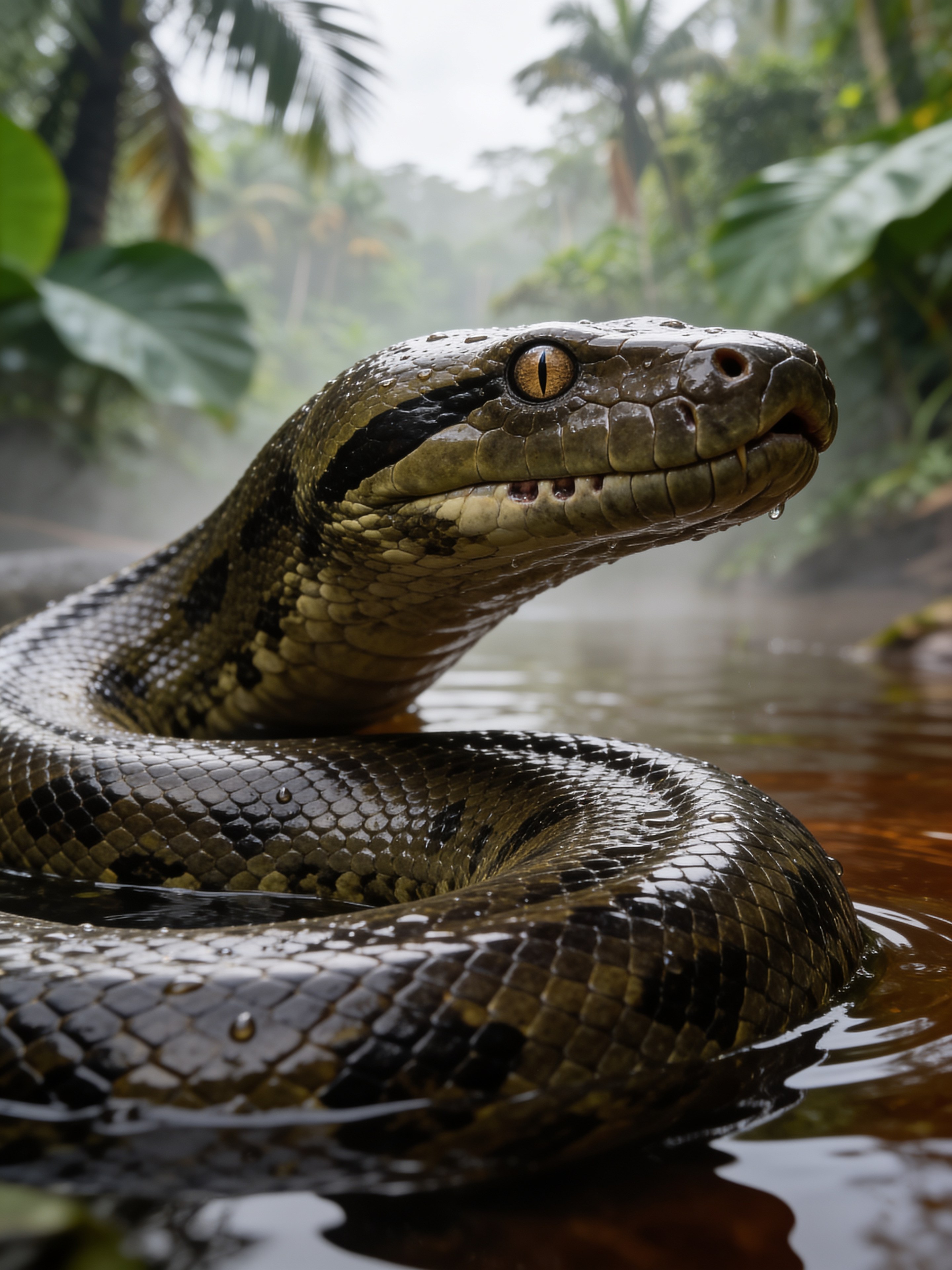
Snake skulls are made of many loosely joined bones and rarely survive as fossils, but in 2011 a Smithsonian intern, Jorge Moreno-Bernal, found skull bones near a Titanoboa skeleton, and further jaw and palate bones followed. So far these have been reported only in a short 2013 conference abstract, not a full scientific paper, so details may change. They show more closely packed teeth than in living boas and a jaw joint that let the mouth open very wide. Everything about its skin, colour and pattern is reconstructed from living anacondas and boas.
How it lived
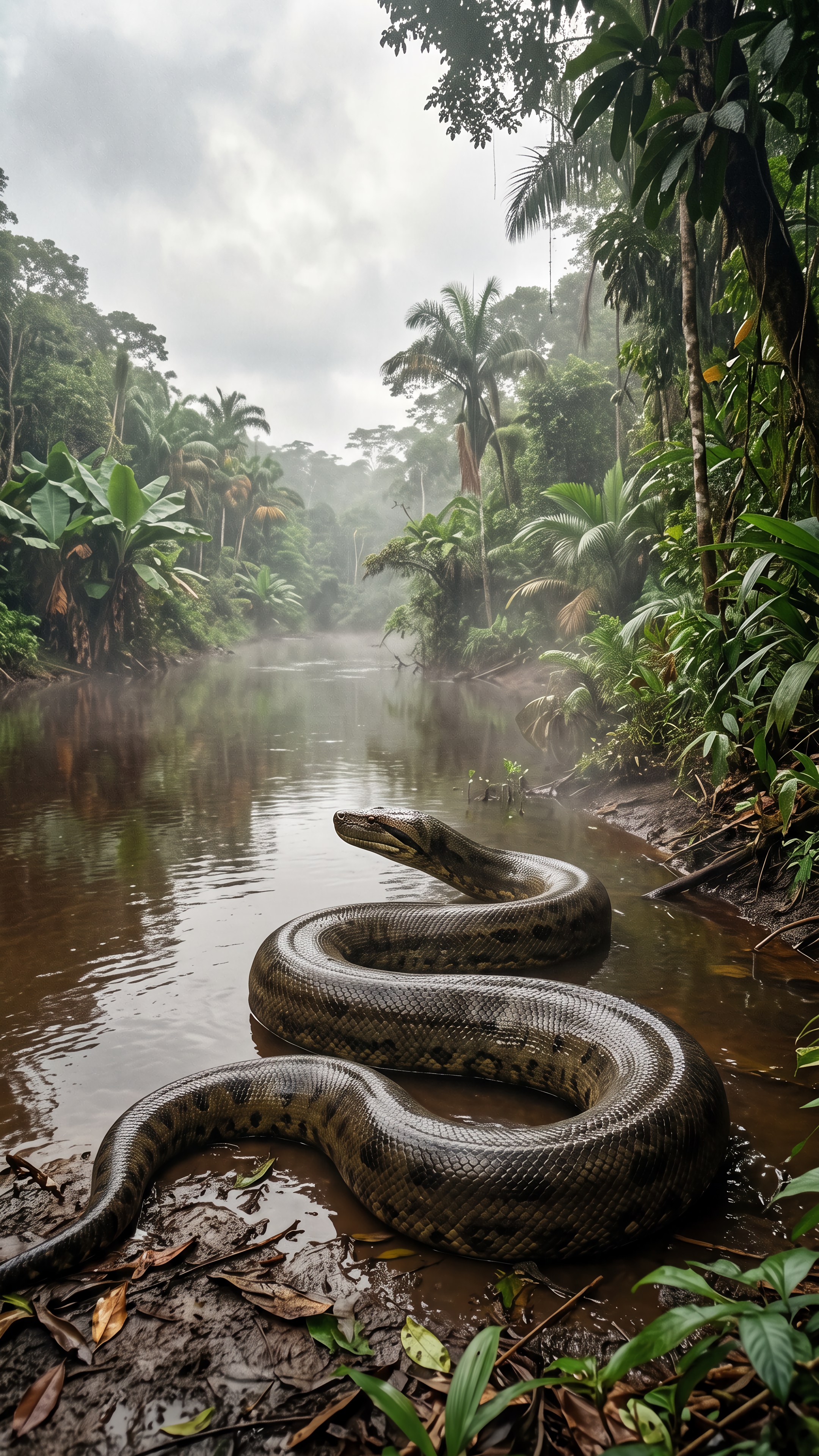
The 2009 description compared Titanoboa's ecology with that of the green anaconda, a heavy snake that spends much of its life in water. The rocks it comes from were laid down by large rivers on a coastal plain, and its fossils are found with abundant fish, turtles and crocodile relatives, which fits a mainly aquatic lifestyle.
The skull points to a diet rich in fish. Head and colleagues reported a high number of tooth positions on the palate and jaws and a jaw structure unlike other boas but typical of fish-eating snakes, and fossils of large lungfish and bony-tongued fishes (osteoglossomorphs) occur in the same rocks. Titanoboa may also have taken turtles and crocodile relatives, as anacondas sometimes eat caimans, and the small dyrosaur Cerrejonisuchus is often suggested as prey. No stomach contents or bite marks confirm this, so it remains an inference.
Its world
Titanoboa lived in the middle to late Paleocene, about 60-58 million years ago, roughly 6-8 million years after the asteroid impact that ended the age of the dinosaurs. The Cerrejón Formation preserves the oldest known rainforest in the Americas, and the fossil plants and animals show that a recognisably tropical South American ecosystem was already in place.
Its neighbours included turtles with shells more than 1.5 m (5 ft) across, at least three kinds of dyrosaurs, which were extinct crocodile relatives, among them Cerrejonisuchus improcerus at about 2 m (6-7 ft) long, and lungfish around 2 m (7 ft) long, two to three times the size of their living Amazon relatives. Titanoboa was the largest non-marine vertebrate known from the time immediately after the dinosaurs.
From Titanoboa's size, Head's team estimated that the region's mean annual temperature was about 30-34 °C (86-93 °F), hotter than any rainforest today and consistent with climate models of a greenhouse world with high carbon dioxide. This estimate has been strongly debated, as explained below.
Size and records
Titanoboa's length was worked out from its vertebrae. In big living boas and pythons, the number of vertebrae stops increasing beyond a certain size and each vertebra simply gets bigger, so Head and David Polly used the size and position of the fossil vertebrae along the spine to scale up to a whole snake. The result was about 12.8 m (42 ft), with a wide margin of error, and a mass of about 1,135 kg (2,500 lb), calculated from anaconda body proportions.
That is about as long as a school bus, with the thickest part of the body reaching nearly to an adult's waist. For comparison, the longest snake reliably measured today, a reticulated python, was about 10 m (33 ft), and the heaviest recorded snake weighed about 183 kg (403 lb).
Partial skull material suggested an even larger individual of about 14.3 m (47 ft), using anaconda head-to-body proportions, but that figure comes from the 2013 abstract. Mass estimates depend on the method: a 2023 comparison with hundreds of wild anacondas suggested about 1,230 kg (2,700 lb) for a non-breeding female of Titanoboa's estimated length.
Relatives and legacy
Titanoboa is a boid, a member of the family that includes boa constrictors and anacondas. The 2013 skull study linked it with boas from Madagascar, which would connect Old World and New World boa lineages, but its exact place in the family is still uncertain. Its closest living counterparts in lifestyle are the green anaconda and other large boas, none of which comes close to its bulk.
When it was named, Titanoboa became the largest snake ever known. In 2024 a different kind of giant snake from India, the madtsoiid Vasuki indicus from about 47 million years ago, was estimated at about 11-15 m long, so it may have rivalled Titanoboa in length. Both estimates rest on vertebrae, so neither record is certain.
Myths and misconceptions
Titanoboa did not hunt dinosaurs or people. It lived millions of years after the non-bird dinosaurs had vanished and tens of millions of years before the first humans. It is often shown as a crocodile-crushing super-predator; crocodile relatives and turtles may have been eaten at times, but its skull suggests fish made up much of its diet.
Titanoboa is also sometimes said to prove that Paleocene rainforests reached 30-34 °C. Other scientists argued that the method is unreliable. Kale Sniderman pointed out that the extinct Australian monitor lizard Varanus priscus grew far larger than the method predicts for its climate, suggesting that competition with mammals, not temperature, may limit reptile size. Mark Denny and colleagues argued that a snake this big would struggle to lose heat at such temperatures, and that posture, behaviour and time in water complicate any link between size and air temperature. Head's team replied to these criticisms, and the temperature estimate remains debated.